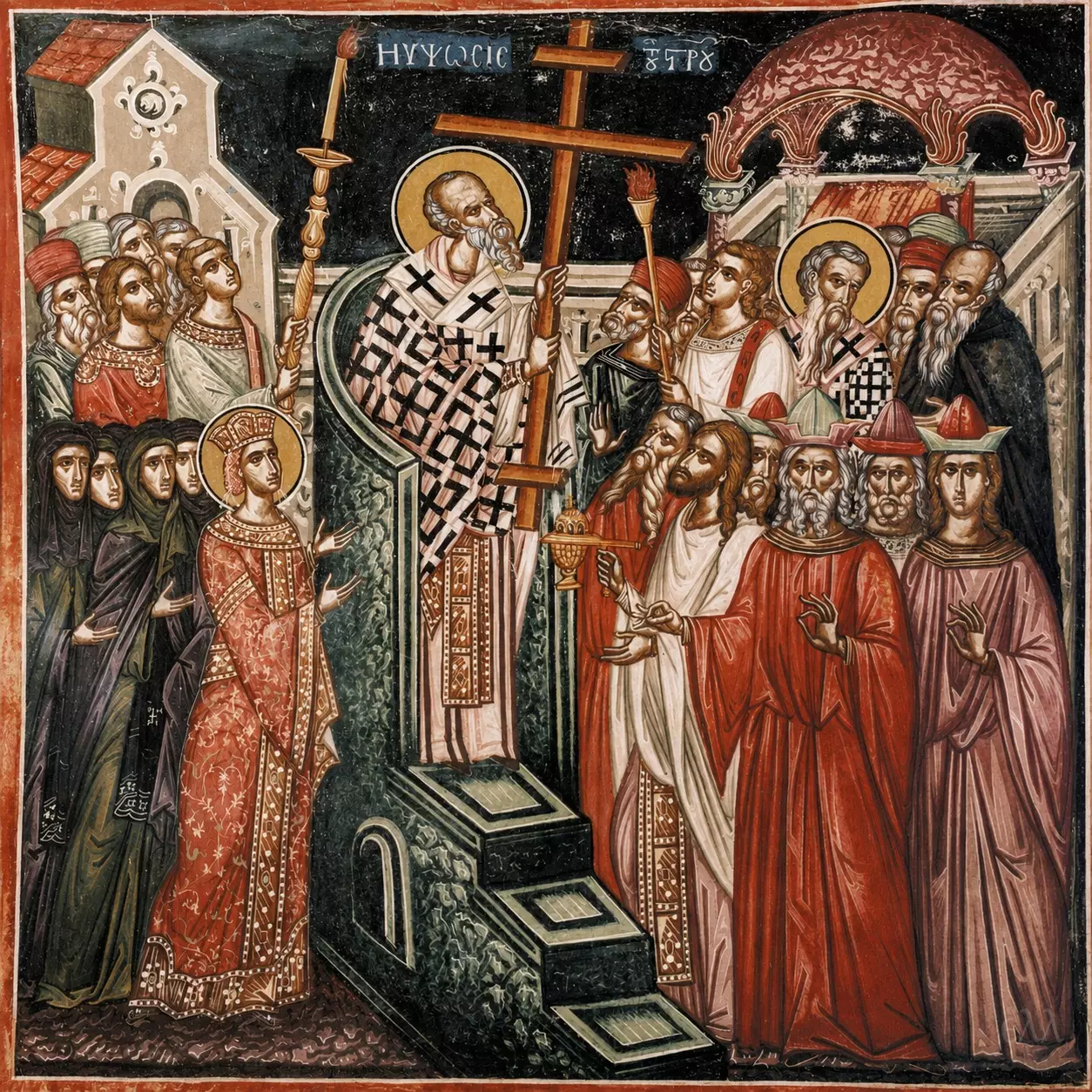
On the island in Lake Ioannina, inside the katholikon of the Monastery of St Nicholas of the Philanthropenoi, a fresco depicts the moment when Makarios, Patriarch of Jerusalem, elevates the Holy Cross before a multitude of the faithful. The episode is placed in the year 335, when the Church of the Resurrection was consecrated over the site where, according to tradition, the wood of the Crucifixion had been found. The scene belongs to the monument’s first phase of painting, dated to 1541 or 1542, a phase associated with the initiative of the hieromonk Neophytos Philanthropenos. The painter remains anonymous; no inscription preserved his name, something by no means uncommon in monuments of the period. Flanked by deacons holding a lit candle in an ornamented candlestick and another candle with a flame, the hierarch stands upon a stepped, green marble ambo, dressed in a polystavrion phelonion on which black crosses, scattered in a dense arrangement, cover the white fabric. On the left, a crowned female figure with a halo approaches, extending her hands towards the Cross, with a group of women wrapped in dark garments behind her. On the right, a second saintly hierarch, a multitude of bearded men, and a deacon with a censer compose the opposite side of the scene. The narrative density of the subject, as will be seen below, clearly reflects the style of the school to which the work belongs.
The Exaltation of the Holy Cross: Figures and Composition
Above the figure of the patriarch, within a blue frame, part of an inscription beginning with the word “Exaltation” can be distinguished, explicitly identifying the subject of the representation. The hierarch, with a thick white beard, holds the Cross high, wrapping his hands in a white cloth, a gesture expressing reverence towards the sacred object and the avoidance of direct contact with it. He is not an isolated figure; to his right and left are crowded pilgrims, clergy, and women. The crowned woman standing on the lowest step of the ambo wears a rich red garment with floral motifs embroidered in a golden hue, an indication of courtly origin that identifies her, almost beyond doubt, as St Helena. Behind her, a group of women wearing dark head coverings watches in silence, some figures with their gaze directed upwards, others looking towards one another.
On the right side of the composition, a younger deacon with a red head covering holds a lit candle, while a group of bearded men, among them some wearing distinctive conical or horseshoe-shaped headgear, stands in a dense arrangement. A middle-aged man in a red himation swings a censer suspended from a chain, a liturgical gesture that strengthens the ceremonial character of the moment.
The Ambo, the Halos, and the Architectural Setting
The green platform upon which the patriarch stands is rendered with three graduated steps, an element referring to actual liturgical structures of the period, upon which the priest ascended so that the crowd might see the Cross from a distance. The halo of each holy figure is rendered in a golden hue and outlined, with no interior decoration visible today. In the upper-left section of the composition, a small building can be distinguished, with a tiled roof, an arched entrance, and a circular rose window in the pediment, an element that probably recalls the Church of the Resurrection itself in Jerusalem, where the historical event took place.
On the right side, correspondingly, rises an architectural structure with a vaulted roof covered in rich red vegetal decoration, an element that frames the scene symmetrically without confining it. The dark, almost black background behind the figures, typical of the Epirote School, brings out the luminous colours of the garments and gives the whole a pronounced plasticity.
The Post-Byzantine Art of the Epirote School
The fresco ensemble of the monastery is regarded as one of the most mature examples of what scholarship calls the School of Northwestern Greece or the Epirote School, a movement that developed in the region during the first half of the sixteenth century, with the Theban painters Frangos and Georgios Kontaris among its principal representatives. This post-Byzantine art is distinguished by the expressiveness of the faces, the theatrical movement of the bodies, and a descriptive fullness that does not hesitate to multiply the secondary figures surrounding the principal subject.
The church underwent three successive phases of decoration, the last being that of 1560 in the exonarthexes, the work of the Kontaris brothers; the scene of the Exaltation, however, belongs to the initial, earlier layer, the one that laid the foundations of the entire iconographic programme. Patriarch Makarios, a historical figure of the fourth century who presided over the consecration of the Church of the Resurrection, appears here not as the simple officiant of a ceremony but as the central axis around which the entire human presence is organised: clergy, dignitaries, women, in a composition where the gaze of every figure is directed, with slight deviations, towards the same point. No face remains inactive, no hand hangs without purpose; even the figures in the background, half-concealed behind the shoulders of those in front, participate in the common direction of the gazes towards the elevated Cross.
(Translated from the Greek text by K. Pappas.)


