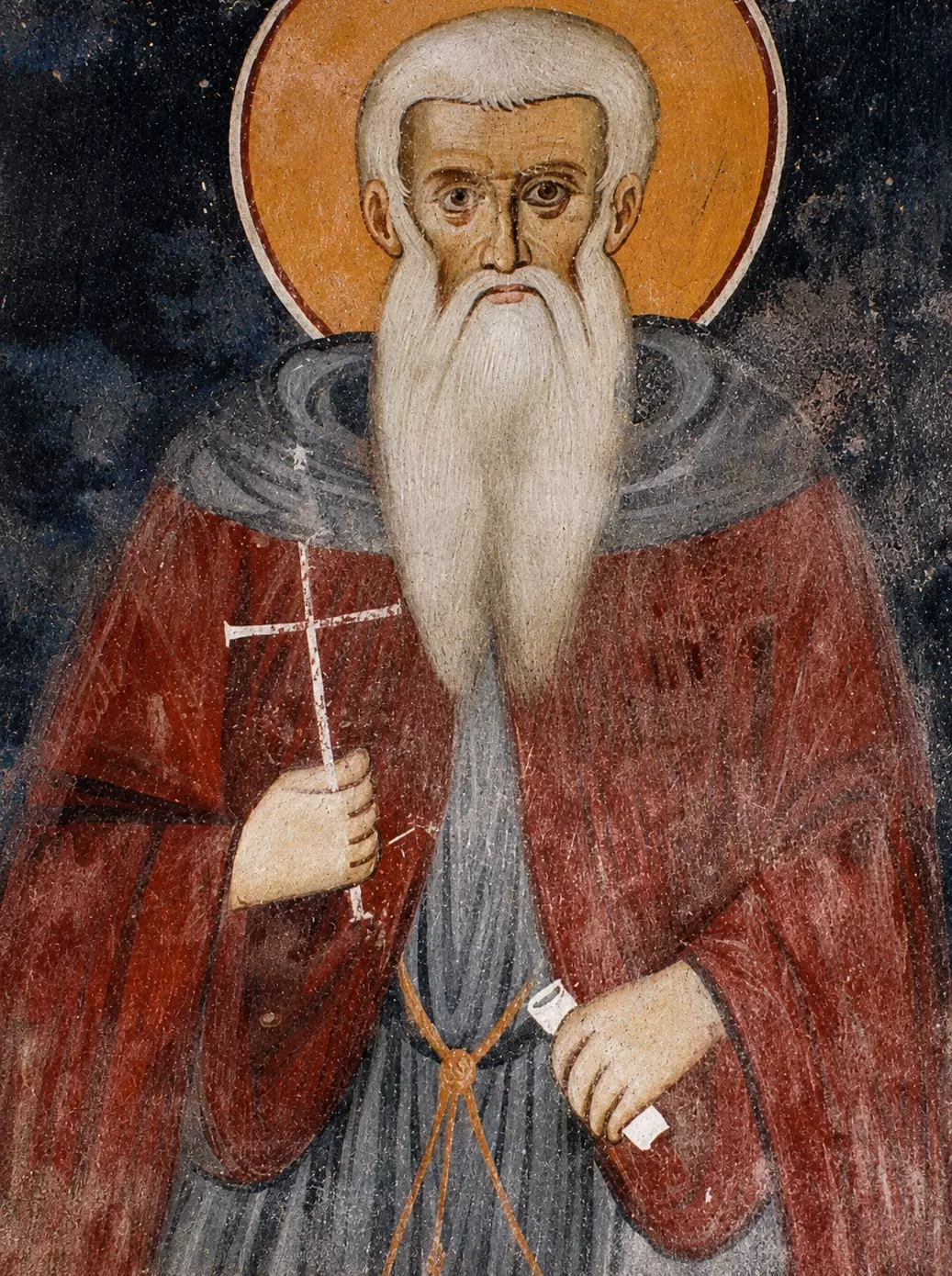
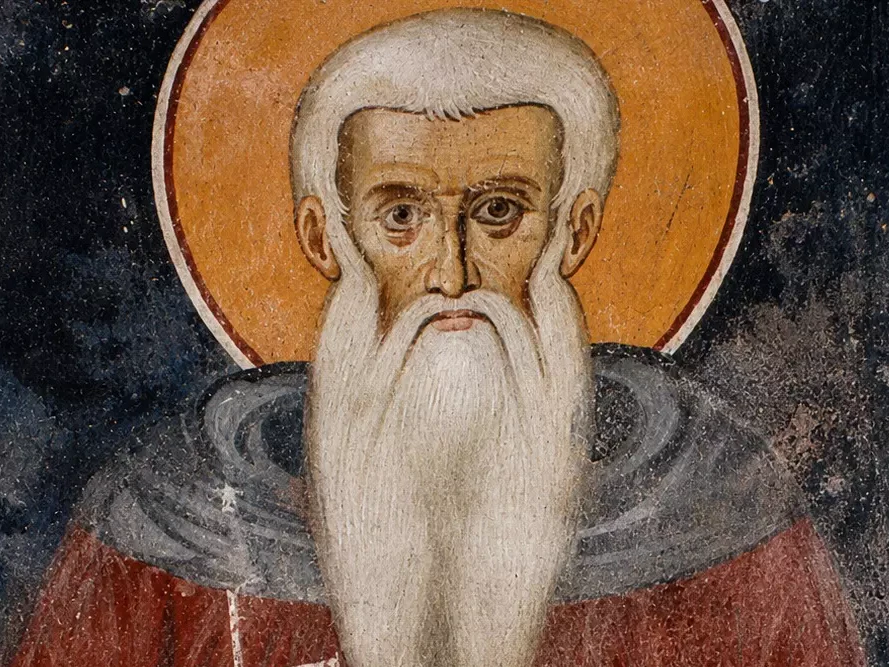
In the refectory of the Holy Monastery of Vatopedi, among a multitude of figures of ascetics and Church Fathers, stands the representation of Saint Maximos Kausokalyvitis, painted in 1786 by an anonymous painter of Mount Athos. The figure belongs to a 14th-century ascetic, known for his habit of setting fire to every hut he built, ceaselessly seeking new places of solitary prayer on the slopes of Athos. The elder is depicted from the waist up, with a long white beard reaching to his chest and a penetrating, almost severe gaze directed straight toward the viewer.
Around his head extends a halo in warm ochre, outlined in red, while the background of the composition recedes into a deep blue sky with dark, almost storm-laden clouds. He wears a red mantle over a blue inner garment, with the crossed straps of the great schema visible at waist level. In one hand he holds a cross; in the other, something white, perhaps a cloth or a rolled scroll, a detail that the worn areas of the paint do not allow to be identified with certainty. In the two upper corners of the composition, fragmentary letters of an inscription are visible, remains of the name inscription that once accompanied the figure, according to the usual practice in the monastic refectories of Mount Athos.
The post-Byzantine fresco art of Saint Maximos
The refectory of the monasteries of Mount Athos did not function merely as a dining space; it was a place of instruction, where the gaze of the monks, seated around the marble tables, met the figures of elders and ascetics painted on the walls, silent teachers of the spiritual life. It is within this context that the representation of the Kausokalyvitis at Vatopedi belongs, a work of 1786, a date that places the composition in the late phase of the post-Byzantine painting tradition, when Athonite painters continued, with remarkable consistency, the iconographic models that had been formed centuries earlier.
The technique follows the familiar practice of fresco painting, with the ochre of the halo and the deep red of the mantle giving the figure a strong presence against the dark background. The painter did not aim at a realistic rendering of the features so much as at a recognizable typology, understandable to every monk who passed daily by that point in the refectory. The beard, exceptionally long, functions as a symbol of a prolonged ascetic path, while the cross in the hand refers to the unceasing prayer that characterized, according to monastic tradition, the life of this particular hermit.
The inscription that would confirm every detail of the identification has not survived in full, but the figure’s place within the broader iconographic program of the refectory, together with the formal elements, allows it to be attributed to Saint Maximos with relative confidence. This fresco, far removed from the splendor of large katholika, belongs to that less-studied category of post-Byzantine art born within the everyday life of monastic communities, not to impress, but to remind.


