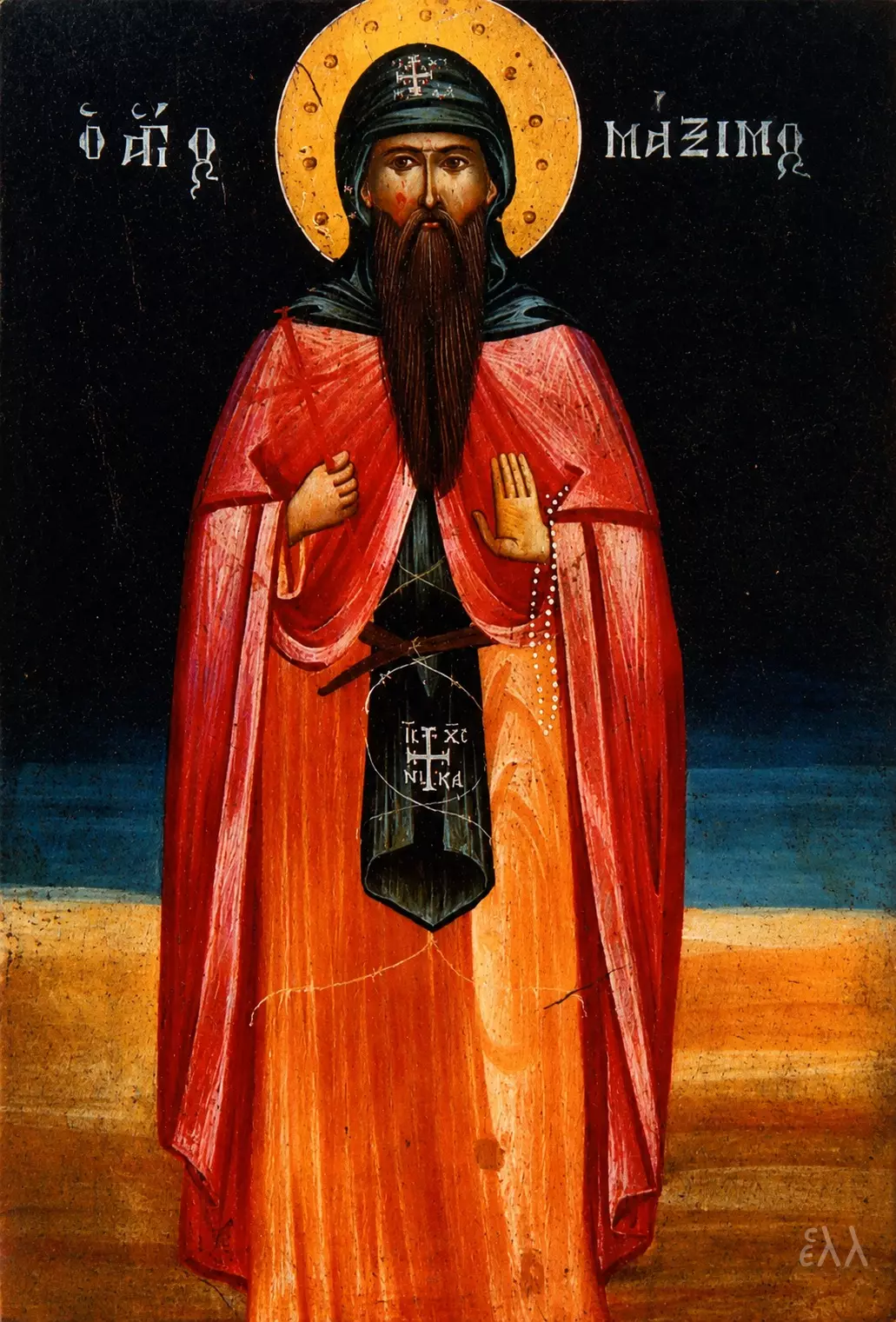
In a dark, almost impenetrable depth, rises the figure of an elder monk with a long brown beard reaching unto his chest, wrapped in a red mantle over a dark-coloured cassock. This is Saint Maximus Kafsokalyvis, a figure whom the tradition of Mount Athos places in the 14th century, whilst the particular portable icon that we examine originates from the Kyriakon of the Holy Skete of Kafsokalyvia and is dated to the 18th century. His epithet, as the toponym of the skete that honours him also shows, is connected with his known habit of burning down the makeshift huts wherein he dwelt, preferring to begin again from nothing rather than adhere to anything permanent. Born in Lampsacus, he abandoned the world when young and sought, through successive stations in Thrace and Constantinople, the most austere path of the eremitic life, until he ended upon the precipitous rocks of the peninsula of Athos. Byzantine iconography, when dealing with such figures, seeks not portraiture in the modern sense so much as the distillation of an entire spiritual biography into a few, coded lines.
Iconographic Elements and Style
The face of the saint, austere and angular, bears the deeply etched cheekbones which the painter repeats in many post-Byzantine figures of ascetics, with the gaze turned slightly to the left, almost piercing. A dark cowl covers his head, an indication of the monastic habit, whilst the golden halo, with the circumferential row of embossed dots, gives to the composition a radiance that contrasts sharply with the black background. His right hand is raised with the palm outward, a gesture that in the language of the icon refers to virginity and the ascetic life, whilst around the wrist a prayer rope of dark beads is distinguished. In his left hand he holds an object recalling the cover of the great schema, dark, with the epigraph IC XC NI KA around a cross, a detail reinforcing the reading of the figure as a monk of the highest rank. At the lower part of the composition, a strip of blue and ochre colour implies a landscape, sea perhaps or parched land, without claiming any narrative autonomy. The two inscriptions framing the head, in typical capital letters of the period, identify the figure without margin of doubt. The palette, limited almost ascetically to red, black, and gold, is not unrelated to the very meaning of the life depicted, as the economy of colours mimics, in a certain manner, the economy of means chosen by the ascetic himself.
(Translated from the Greek text by K. Pappas)


