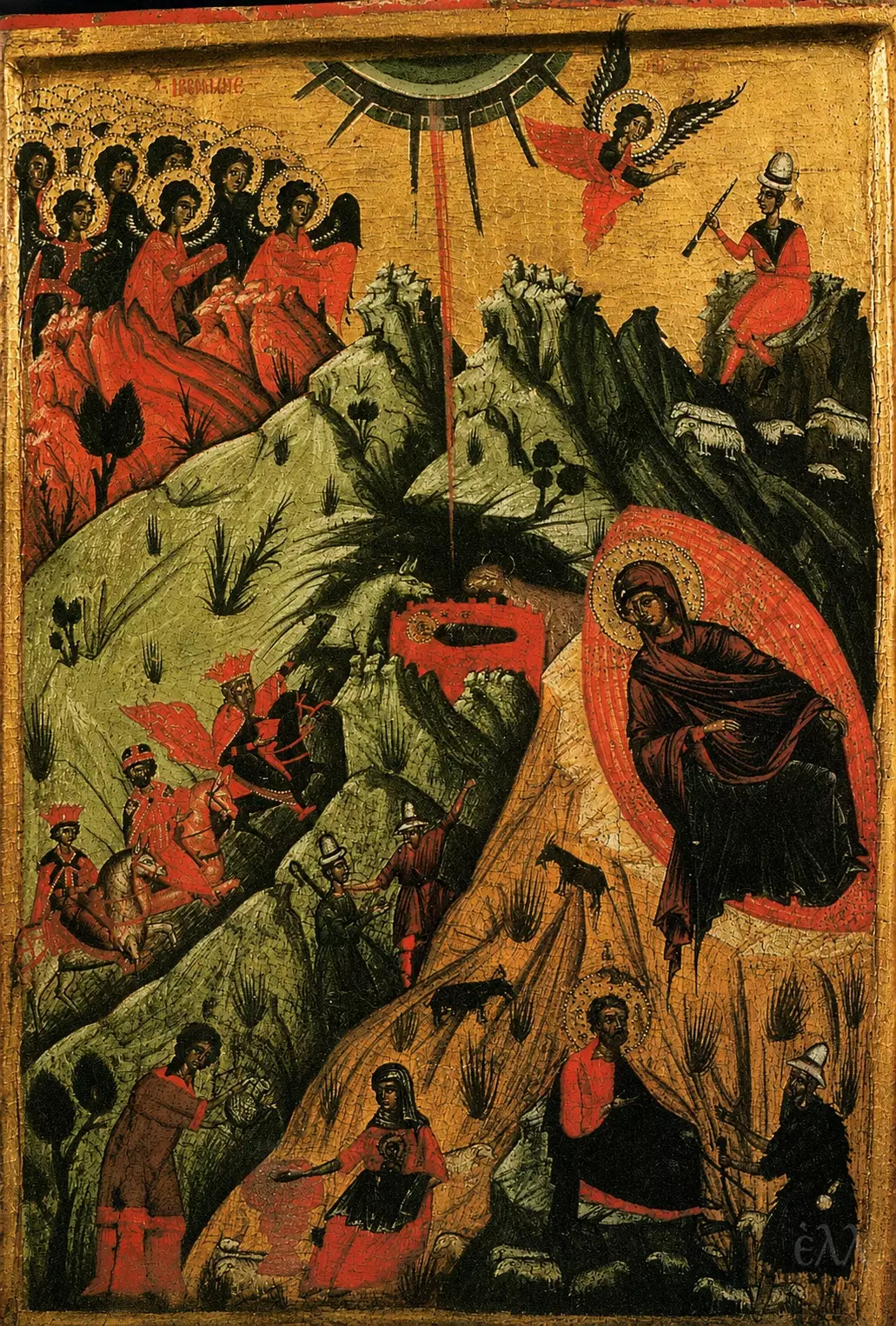
The Nativity of Christ which is kept today in the Onufri Museum of Berat was crafted in the 16th century by Nikolla, son and successor of the protopapas Onufri, in the very same workshop that his father had founded in the city. It originates from the Church of the Dormition of the Mother of God, a temple around which the very museum that houses it today was later established. On this small wooden panel, the painter condensed the entire cycle of events that the Orthodox tradition associates with the birth of the God-man, from the choir of angels to the journey of the Magi and the bathing of the newborn infant. In an inscription preserved in a temple of Kastoria, Onufri himself declared his origin from “the illustrious city of Berat”. He remained in the history of art for a deep, almost blood-like red that research baptized with his name, a colour that his son inherited along with the workshop. In the middle of that century, with the Balkan territories already for decades under Ottoman administration, painters of Nikolla’s generation stubbornly continued the language of Palaiologan painting, enriching it with elements drawn from the landscape and the people of Epirus. The scene faithfully follows the Byzantine iconographic prototype of the Nativity, where time is abolished and multiple episodes coexist within the same pictorial space.
The Post-Byzantine Art of the Nativity of Christ by Nikolla Onufri
At the summit of the composition, a semicircle in deep green emits a ray of light that descends vertically unto the cave, symbolically declaring the heaven and the star that guided the Magi. To its right and left, two heavenly tidings spread out in counterpoint: on the left, a dense company of angels with halos and red garments lift up their hands in a posture of doxology, rendering the “glory in the highest” (Luke 2:14). On the right, a solitary angel with open wings is directed toward a shepherd seated upon a rocky peak amidst sheep, a moment that tradition names the annunciation to the shepherds. Between them, the earth is folded in three hues, the green, the dark green that touches upon black, and the ochre, forming that broken, angular landscape which the post-Byzantine painter inherited from the Palaiologan school, without however resigning from his personal observation. On the lower slopes, goats graze among shrubs drawn with a nervous, almost calligraphic line.
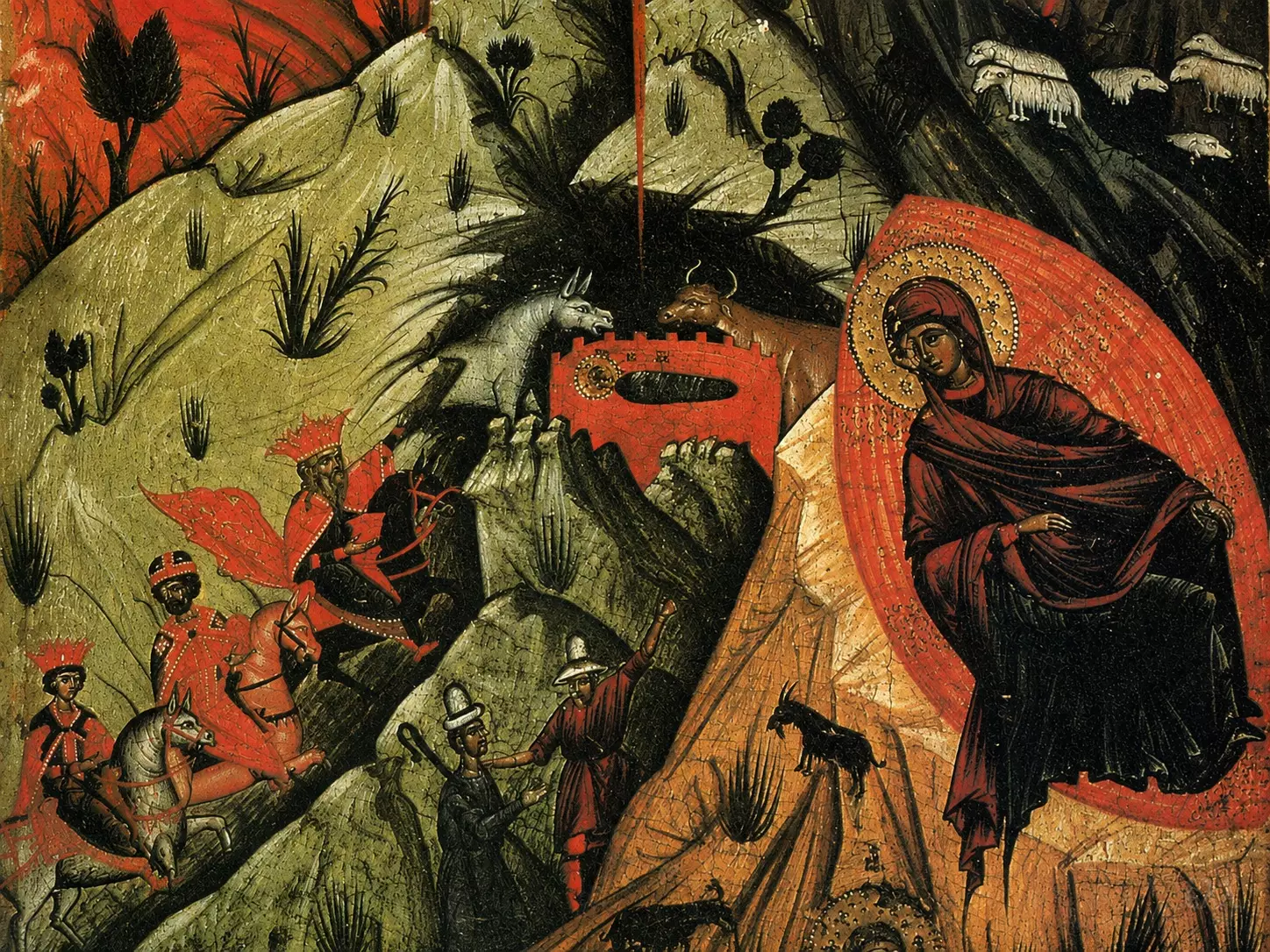
In the centre of the rocky mass, within a dark opening, the heads of the ox and the ass project forth, bowed over a red manger, a detail that refers to the prophetic verse of Isaiah concerning the ox that knoweth his owner, and the ass his master’s crib (Isa 1:3). Further to the right, in a figure that dominates the icon, the Mother of God rests reclining upon a red cushion, wrapped in a deep red maphorion that is illuminated all around by a halo in the same hue, that very same red which Nikolla received from his father and which here acquires an autonomous gravity. Her gaze, turned toward the outside of the composition, does not touch the infant. She keeps instead a distance of contemplation, in accordance with the Byzantine iconographic type that requires the Mother of God immersed in reflection and not in tender embrace.
The Magi, the Shepherds, and the Workshop of Nikolla Onufri
In the lower part of the icon, the narrative continues upon two parallel slopes. On the left one, three mounted lords with crowns and red cloaks ride downward among shepherds who receive them with a lively gesture, the journey of the Magi rendered here with almost narrative movement, far from the stasis of other contemporary workshops. On the right, upon a rock painted in ochre where a black goat grazes, a seated figure with a halo is discerned, whom established iconography identifies with Joseph immersed in his doubt, and beside him two female figures prepare the bath of the infant, a scene that ecclesiastical tradition preserved as a memorial of the real, bodily nature of the Incarnation.
The father Onufri was active throughout the wider region of Epirus and southwestern Albania from the middle of the 16th century, leaving frescoes in Kastoria and icons in temples of Berat, Vlorë, and elsewhere. Nikolla, less studied than his father but equally active, painted in the same spaces works that modern research still finds difficult to distinguish from the paternal ones, so closely did he follow the prototypes and the chromatic language of the workshop. Dozens of such icons were gathered in the 20th century into the interior of the Dormition itself, where today the museum bearing the name of the elder of the two painters is housed, without extinguishing the seal that his son left upon this scene of the Nativity of Christ.
(Translated from the Greek text by K. Pappas.)


