
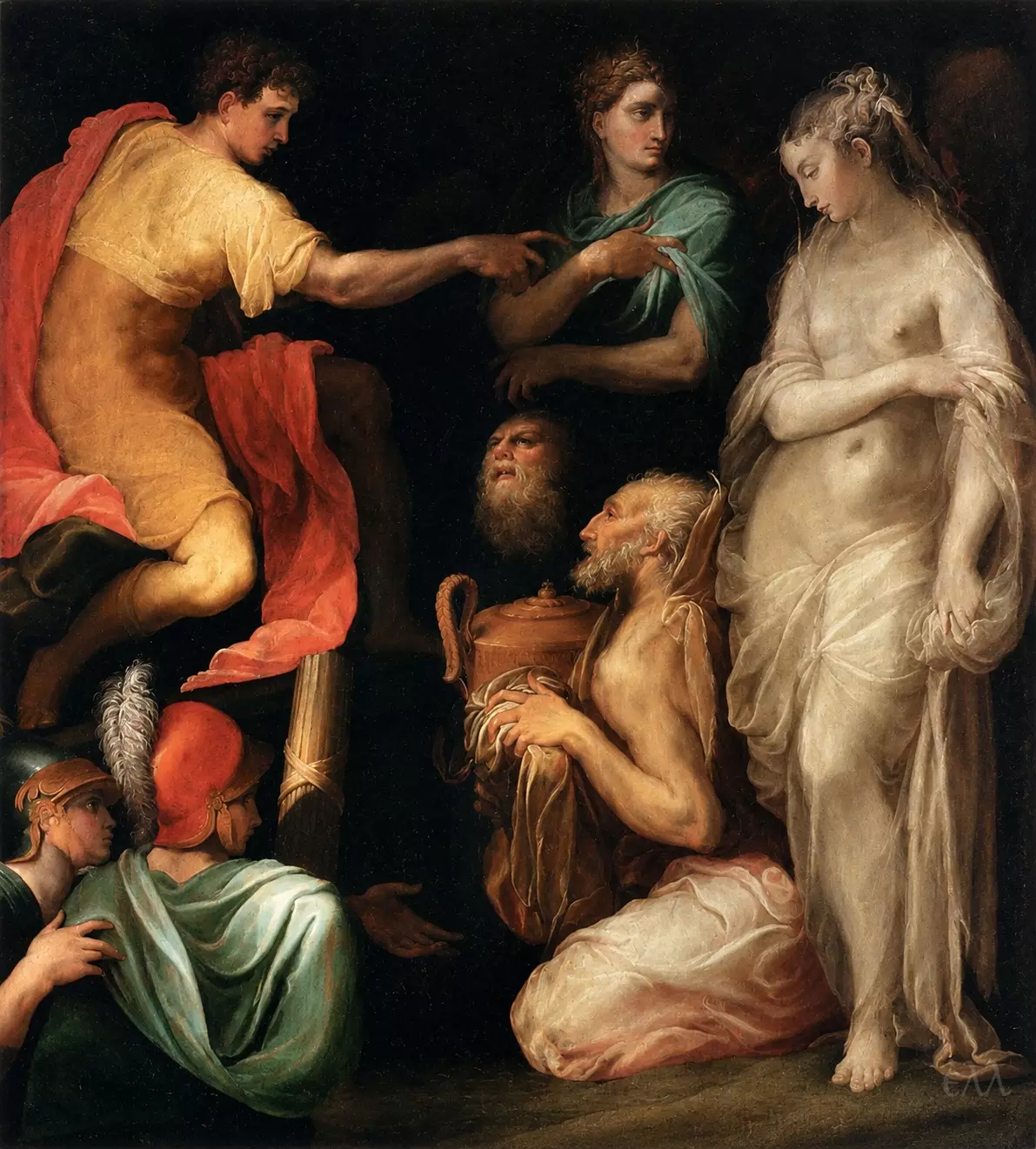
The Louvre preserves a work that depicts one of the best-known narratives of moral greatness in Roman antiquity, The Continence of Scipio, painted around 1555 by Niccolò dell’Abbate, the Italian painter born in Modena in 1509, who died in Fontainebleau in 1571. It is an oil on canvas measuring 127 by 115 centimeters, a work directly associated with the School of Fontainebleau, where the artist worked in the last years of his life alongside Primaticcio. The story comes from Livy and concerns the young general Publius Cornelius Scipio, who, after the fall of Carthage in Spain, had at his disposal a beautiful captive, betrothed to a local ruler. Instead of keeping her as a spoil of war, Scipio returned her unharmed to her fiancé, even adding the ransom that had been offered for her release as a wedding gift. This subject, favored in Renaissance painting because it condensed virtues such as self-control and justice, is rendered here with a dense composition of figures, strong chromatic contrasts, and a dramatic handling of light, elements that reveal the influence of both Venetian painting and the Mannerism then dominant at the French court.
The composition and figures in The Continence of Scipio
Seated on the edge of a table covered with red fabric and dressed in a yellow tunic falling in rich folds, the young man at left extends his hand to the right in a decisive, almost imperious gesture; he is Scipio, at the very moment he announces his decision. His gaze is not directed toward the woman but toward a second figure, a woman dressed in green with something resembling a diadem in her hair, who responds with a similar movement of the hand, as if mediating or confirming what is being said. Between them, sunk into the darkness of the background, only the face of a bearded man is visible, an element that gives depth to the scene without distracting attention from the protagonists.
In the center of the composition kneels an elderly man, bare-chested and white-bearded, clutching a golden vessel with an elaborate handle; he is probably the bearer of the ransom, the one who had brought the gold to redeem the captive and now sees it returned to him as a gift. His gaze rises toward the woman beside him with an expression that mixes awe and relief.
The figure of the captive and the question of virtue
At right, shown full-length and standing, wrapped in a white cloth that leaves her torso bare, stands the woman around whom the entire narrative revolves. Her hands are crossed over her chest, her head bowed, her gaze lowered; this is not so much a gesture of shame as a visual expression of modesty, a virtue that Renaissance iconography systematically attributed to female figures who were victims or objects of moral trial. The white, almost phosphorescent fabric that envelops her sets her apart chromatically from all the other figures, submerged in deep yellow, green, and red. This isolation of color is not accidental; it functions as a visual point of reference, the center around which Scipio’s generosity acquires meaning.
In the lower left part of the painting, two soldiers in helmets, one with a red crest, kneel and watch the scene from a distance, almost invisible in the darkness of the background. Their presence reminds the viewer that what is unfolding takes place in the midst of war, in a camp, among men who had just conquered a city.
Color, light, and the place of the work in sixteenth-century art
Dell’Abbate’s palette alternates warm tones—yellow, red, gold—with cool notes of green, creating contrasts that draw the eye to specific areas of the composition without breaking it apart. The light falls unevenly, leaving parts of the background almost indistinct, a technique the painter had already cultivated in his Bologna years and further developed in France, close to the artists of the School of Fontainebleau. The density of the figures, packed almost one atop another within a restricted pictorial space, is a characteristic feature of late Mannerism, where narrative clarity often gives way to the rhetorical intensity of gesture and bodily pose.
What ultimately remains of this composition is not only the historical narrative itself, but the way dell’Abbate succeeded in translating an act of moral self-control into purely visual terms, through contrasts of color, bodily positions, and glances that never meet directly.


