
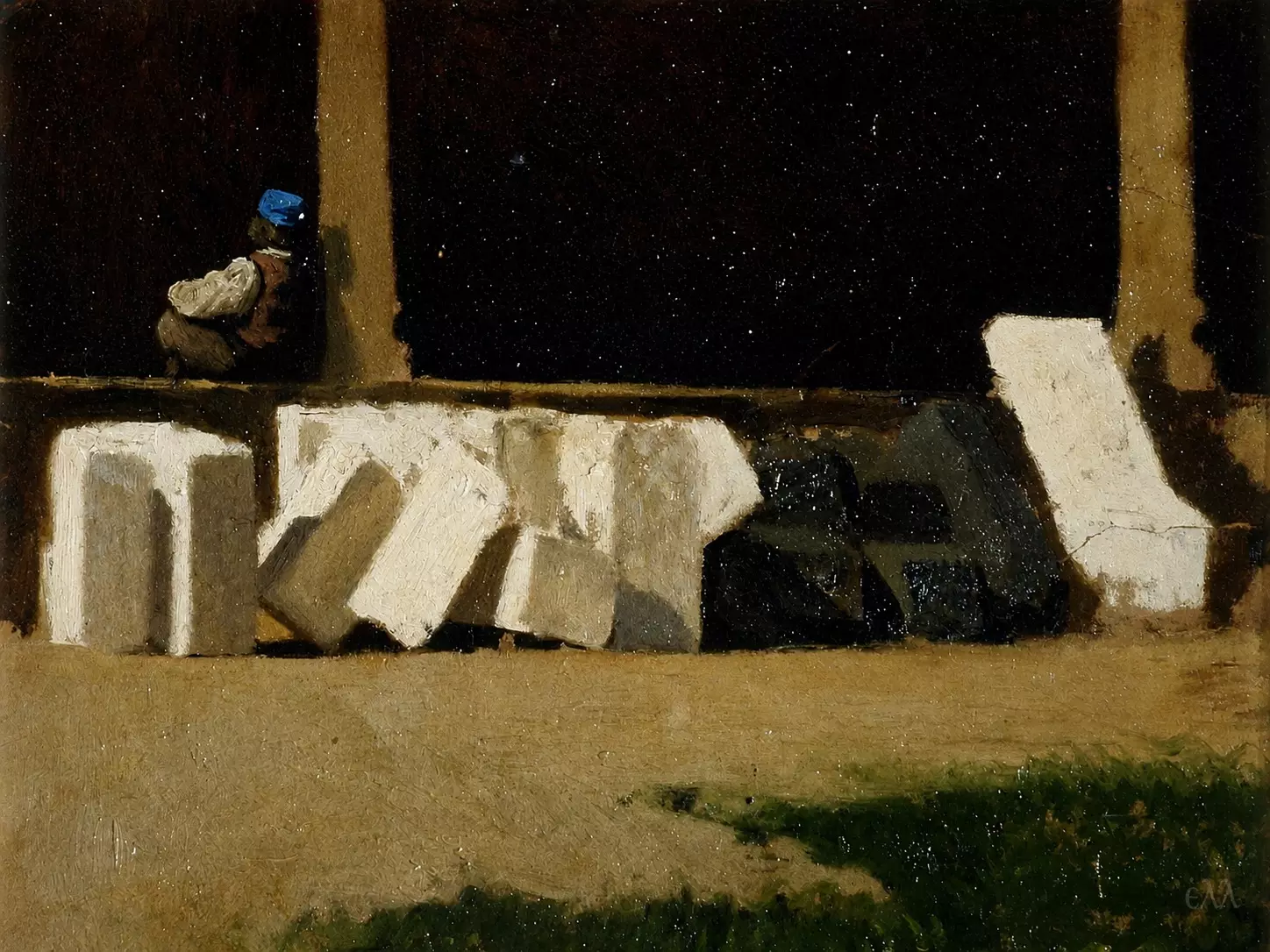
A man sits with his back turned to us, his head wrapped in a pale blue cloth, leaning against a low stone balustrade. Around him lie scattered blocks of white marble, some upright and others toppled sideways one upon another, while farther on dark stones form a mass almost black within the cloister’s shadow. This is the cloister of the monastery, known in Italian as Interno di un chiostro, a work painted by the Italian Giuseppe Abbati around 1861, recording the restoration work then under way in the enclosure of the Monastery of Santa Croce in Florence. The painting is now housed in the Modern Art Gallery of Palazzo Pitti.
Born in Naples in 1836, the artist arrived in Florence in the early 1860s, where he became associated with the circle of the Macchiaioli, painters who sought to render light through broad patches of color set in counterpoint to one another. The Monastery of Santa Croce was then under restoration. The piled materials, the workers, the shadows of the arcades—all these offered the young artist an ideal subject for the art he aimed to practice. Blue, brown, white, dark green: these brushstrokes establish a composition that approaches abstraction, even though the subject remains fully legible.
The cloister of the monastery as a field of art and light
The composition is organized in three horizontal zones, each with its own chromatic logic. In the upper section there spreads a deep darkness, from which only the yellow columns of the arcade emerge, lit from the side as though touched by a ray that never quite reaches the depth behind them. Between this shadowed area and the ground lies the band of cut stone, blocks roughly hewn, some largely cubic, others elongated and leaning, as if they had fallen there at the very moment someone set them down in haste. The darker pieces on the right, perhaps stone of another kind or simply marble dirtied by use, break up the whiteness of the row and lend the whole an irregular, almost musical rhythm.
Seated on the edge of the balustrade with his back to the viewer, the laborer reveals nothing of his face anywhere in the painting. The blue of his cap is the only vivid note of color in the sunless upper section, a trace that catches the eye at once before it descends to the stones. No detail betrays his identity—neither tool nor gesture, only the posture of a body at rest or in contemplation, beside work that has not yet been completed. In the lower part, the ground of the courtyard stretches bare to the corner where grass grows, two textures that Abbati renders with markedly different thicknesses, one smooth and almost transparent, the other dense and faintly relief-like.
The work goes beyond a simple representation of a religious scene or an ethnographic image of labor. The painter’s gaze is fixed on the contrast between light and shadow, on the geometry accidentally formed by stones in a heap, on a moment of repair that he visited repeatedly, leaving more than one version of the same cloister to circulate today in public and private collections. His art here conveys, with austere realism, both the space and the human presence.
(Translated from the original Greek text by D. Alexandraki)


