
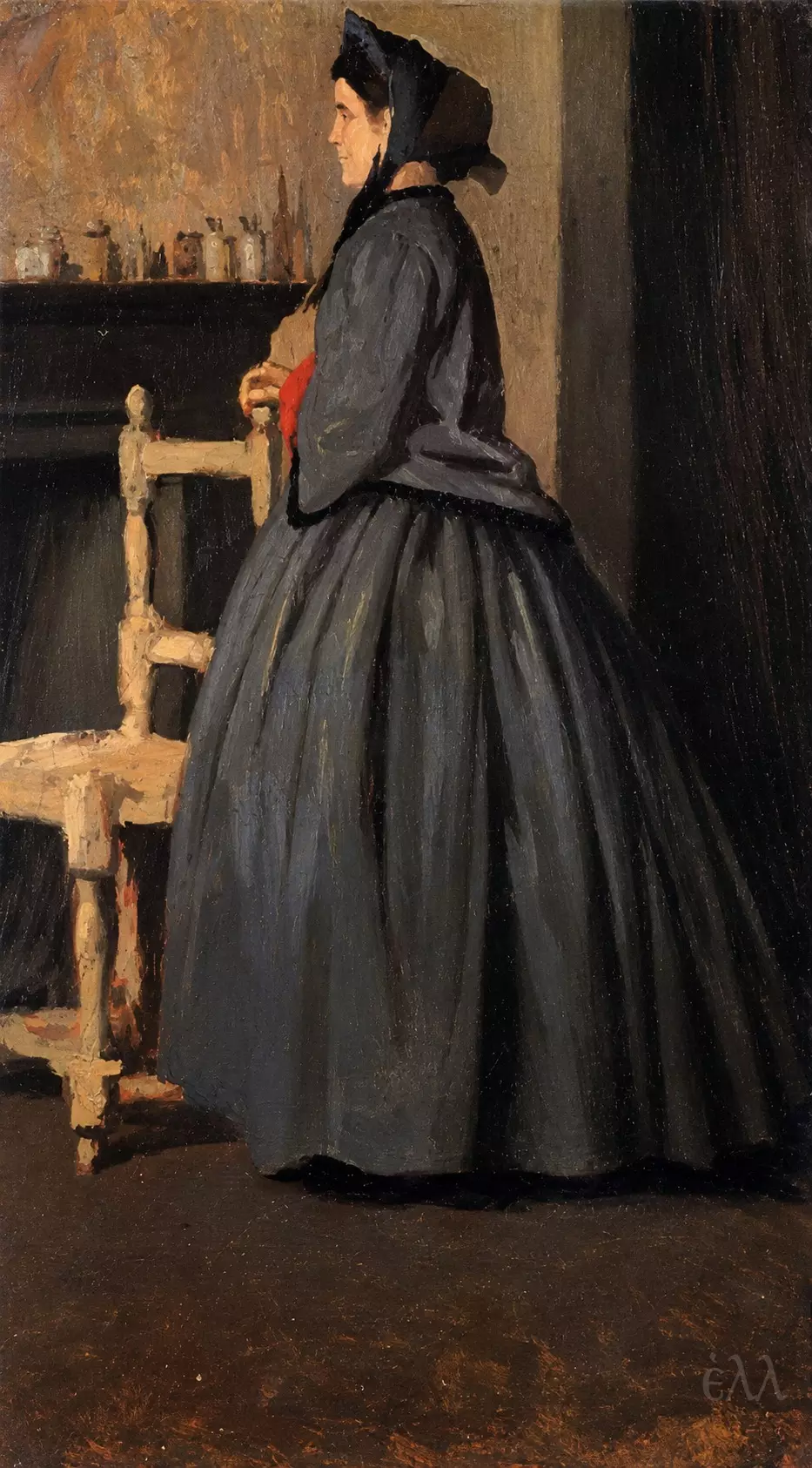
A female figure stands in strict profile beside a rush-seated wooden chair, her gaze directed toward the left, just beyond the picture plane. This fleeting moment was captured by Giuseppe Abbati—a painter born in Naples in 1836 who died in Florence in 1868—in a small panel measuring 26 by 14 centimeters, an oil on wood known as Portrait of a Woman and dated to around 1865–1866. It is housed today in the Galleria d’Arte Moderna at the Palazzo Pitti in Florence, among works by other representatives of that generation of painters who became known as the Macchiaioli.
The figure wears a dark, almost black dress with a voluminous skirt and a fitted bodice, while a small black bonnet tied beneath her chin frames her head. At waist height, she clutches something intensely red—perhaps a scrap of fabric or an accessory—whose chromatic intensity disrupts the somber harmony of the whole. Behind her, a shelf holds a few small jars and bottles, while a heavy, dark textile closes off the composition to the right. The space remains deliberately spare, nearly empty, leaving no extraneous detail to distract from the human presence.
This is the creation of an artist belonging to that generation of Italian painters active primarily in Florence during the mid-nineteenth century who opposed academic instruction, striving instead for a pictorial idiom grounded in the immediate recording of light and shadow through broad patches of color rather than line and drawing.
The macchiaioli technique in Abbati’s Portrait of a Woman
The profile stance is hardly a haphazard compositional choice. It strips the figure of any theatrical pretense, sealing her within herself, detached from the viewer and free of any gaze demanding recognition. Abbati works with broad, nearly flat expanses of color—the famous macchie from which the entire artistic collective derived its name—eschewing meticulous descriptive rendering of textiles or objects in favor of an overarching, almost abstract impression of volume and illumination.
The red element held by the woman serves as the sole note of tension within a palette dominated by dark browns, blacks, and ochres. Its exact nature remains ambiguous: a handkerchief perhaps, a fan, or perhaps something intensely personal that the painting deemed unnecessary to name. The chair with its pale framework provides a visual counterpoint to the shadowed figure, establishing a tonal contrast that recalls how systematically the Macchiaioli studied tone relationships over rigorous draftsmanship.
The art of this Florentine period is intimately tied to the Caffè Michelangiolo, a gathering place for artists seeking a path independent of both Romanticism and academic tradition. Abbati, alongside Giovanni Fattori and Telemaco Signorini, belonged to this inner circle, bringing to his oeuvre a singular sensitivity to interior light, distinct from the plein-air landscapes preferred by many of his peers.
The human form here tells no story. It simply exists, enclosed within the silence of its quotidian reality among a handful of objects that do not explain so much as hint at a domestic, constrained, and perhaps solitary life. The painter died young at the age of thirty-two following an accident, leaving behind a modest body of work distinguished by unyielding quality, within which Portrait of a Woman remains among the most exemplary manifestations of his personal brushwork.


