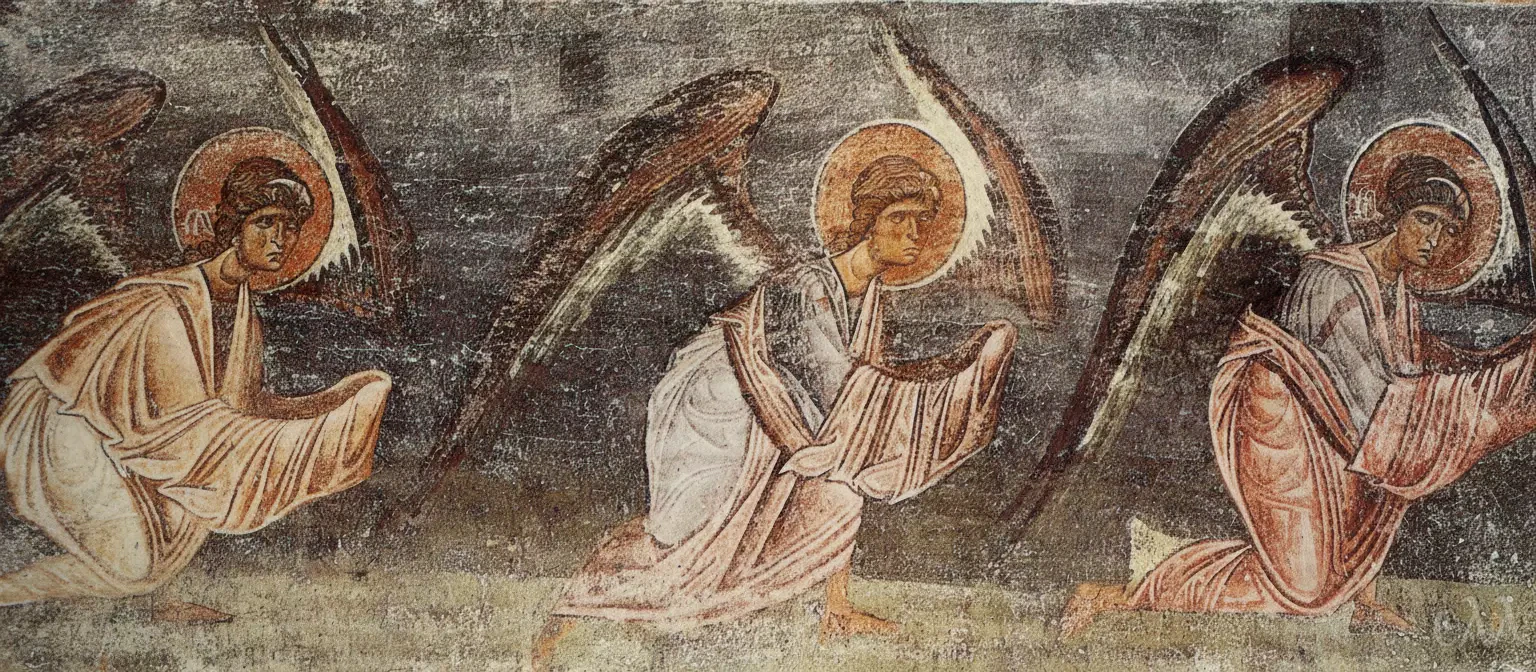
The Procession of Angels at Hagia Sophia, Ohrid, belongs to the celebrated sanctuary decoration created under Archbishop Leo in the mid-eleventh century, broadly dated to 1037–1056 and, in more recent scholarship, more narrowly to about 1052–1056. Ten angels, five approaching from either side, form a ceremonial band beneath the Ascension (Acts 1:9–11), their bodies lowered in genuflection as their covered hands advance towards the sacred centre. The sequence, while firmly ordered within the sanctuary, carries an unexpected urgency: wings rise in long, cutting arcs, garments gather into fine linear folds, youthful faces turn in concentrated, oblique gazes.
In the surviving section considered here, three angels make the character of the larger procession immediately legible. Each appears in three-quarter view, descending onto one knee while extending both forearms before the body. The hands remain concealed beneath the himation. This covering determines the ritual character of the pose, directing attention away from manual action and towards the decorum of service and veneration. The forearms, projecting forward as compact parallel forms, also strengthen the measured advance of the group. Against the dark blue-grey background, the pale garments, warm halos and ochre-pink flesh acquire restrained luminosity; behind them, the wings become almost graphic signs, dark feathers alternating with narrow passages of light.
Hagia Sophia, when its eleventh-century sanctuary programme was created, served as the cathedral of the Archbishopric of Ohrid. The conch above contains the enthroned Virgin and Child; lower in the apse appears the Communion of the Apostles; between those zones runs the angelic procession, while the Ascension (Acts 1:9–11) unfolds on the vault. Recent research has connected the sanctuary paintings with the artistic patronage of Archbishop Leo and has treated this angelic sequence as an important element in the internal logic of the ensemble. A recent study dates the sanctuary murals to c. 1052–1056 and relates the kneeling angels directly to the Eucharistic imagery below.
Procession of Angels at Hagia Sophia: Ritual, Movement and Form
At first comes order. The angels keep rank, all oriented towards the sacred centre. Along the curved architectural surface, at measured intervals, the figures advance one after another, the repeated lowering of their knees creating a visual cadence that belongs as much to the wall as to the bodies. The painter constructs each angel through diagonals: inclination of torso, extension of covered arms, sweep of wing, angle of bent leg. Within a comparatively narrow pictorial zone, the procession therefore retains movement without losing ceremonial restraint.
Foreshortening contributes strongly to the effect. The lower bodies are compressed, particularly at the bent knees and folded legs, while the upper bodies remain broad enough to carry the gestures clearly. In strict naturalistic terms, the spatial construction is unstable; in monumental painting, its function is immediately intelligible. Kneeling, turning, forward movement: three actions perceived almost at once. One figure inclines more deeply, another remains more upright, a third rotates more sharply, and these small differences keep the sequence from settling into ornamental repetition.
The drapery does much of the visual work. Long parallel folds run from shoulder to wrist, tighten around the extended forearms, then open across the lap in sharply controlled bands. Elsewhere they break, curve, double back. Linear structure and tonal modelling remain closely joined: darker channels establish depth, pale highlights lift the ridges of cloth, the contour preserves each figure against the background. Scholarly comparison places this handling within a mid-eleventh-century current in which a monumental, austere inheritance coexists with a more animated treatment of pose, gaze and bodily movement. In the angels at Ohrid, severity and grace occupy the same painted surface.
Especially refined are the heads. Broad discs of warm ochre form the halos behind the hair, while the faces are modelled through compact transitions of brown, rose and pale light. Large, alert eyes direct attention towards the sacred axis of the sanctuary. The heads turn only slightly, enough to register shared direction without breaking the compact relation between face, halo and wing. Curving locks, arranged in controlled clusters, soften the geometry of brow, nose and cheek. Hair, wing, halo, fold: each carries a different kind of line, each interrupts the possibility that the repeated figures might merge into a single decorative pattern.
The covered hands provide the iconographic key. Anna Zakharova has drawn attention to their correspondence with gestures in the Communion of the Apostles: the angels extend veiled or cloth-covered arms in a manner that visually continues the apostolic approach to the Eucharist. The procession consequently occupies an active intermediate zone between larger scenes and binds their meanings together. Above, the image of the Virgin and Child makes the Incarnation (John 1:14) visible; below, the Eucharistic action gives sacramental form to Christ’s sacrifice; between them, the angels advance in perpetual service. Celestial worship, earthly liturgy, hierarchical order—the sanctuary brings these into a vertically articulated image.
This relationship helps explain the unusual intensity of the kneeling posture. The figures are attendants whose entire bodies participate in the act represented. Knees descend, torsos incline, arms reach forward beneath cloth, wings rise and close the space behind them. Gesture becomes liturgical syntax, and the repeated act of approach carries the theological reading across the sequence rather than concentrating it in a single emblem.
Within the broader development of Middle Byzantine sanctuary decoration, such a conception has particular significance. During the eleventh and twelfth centuries, subjects associated with the Eucharist and angelic service became increasingly prominent in apses and domes. The Ohrid sequence stands relatively early in this development. Later variations of worshipping angels appear within the Archbishopric of Ohrid and neighbouring regions, including Vodoča, Kurbinovo and Kastoria, where kneeling figures and covered arms enter altered relationships with the Virgin, Christ, the Hetoimasia or the altar. Flexible in placement and association, the motif retained a recognisable liturgical force.
The wider cathedral also matters. Hagia Sophia carried an ambitious arrangement of bishops, apostles, Old Testament references and Christological imagery within its sanctuary, reflecting both Ohrid’s ecclesiastical status and the cultivated patronage associated with Archbishop Leo. A recent JSTOR monograph surveys the church’s architectural and historical transformations, while scholarship has repeatedly recognised the eleventh-century paintings as one of the major surviving ensembles of Middle Byzantine monumental art. Ecclesiastical order, visual hierarchy, ceremonial movement: the angels participate in all three.
Their style, however, retains a force that cannot be reduced to institutional meaning. Consider the wings. Each pair rises behind the shoulders in elongated masses, dark at the centre and edged by paler feathers; changing angles carry the eye from one angel to the next. The same movement returns in the hems, where repeated curves gather, release, gather again. Rhythm comes from repetition, every repeated form remaining attached to bodily action. The painter varies the spacing subtly, so that the repeated wings read both as individual appendages and as a continuous directional sequence across the curved surface.
Colour reinforces that measured energy. The garments alternate between chalky white, muted rose and warm earth tones, all held against a field deepened and worn by age. Halos provide concentrated areas of warmth. The flesh, softly modelled yet firmly bounded by contour, gives the cheeks and necks sufficient substance while preserving the clarity required at a distance. Small losses and abrasions interrupt the painted surface, although its principal relationships remain readable: light cloth against dark ground, warm face against halo, black-brown wing beside pale drapery.
A striking tension develops between physical humility and visual grandeur. The angels kneel while their wings enlarge them; their bodies descend while the procession extends across a prominent sanctuary zone; their hands remain hidden while the gesture becomes one of the clearest signs of action. Movement gives the solemnity duration.
The Procession of Angels at Hagia Sophia, integrated into architecture, Eucharistic imagery and the wider iconographic programme, holds a distinctive place in the visual language of the mid-eleventh century. Its effect accumulates gradually through kneeling bodies, veiled hands, slanting wings, linear folds, bright halos, sidelong eyes. The procession repeats one ceremonial action without becoming mechanical; each angel appears caught at a different instant within the same continuing movement.
(The translation was edited by N. Jones.)