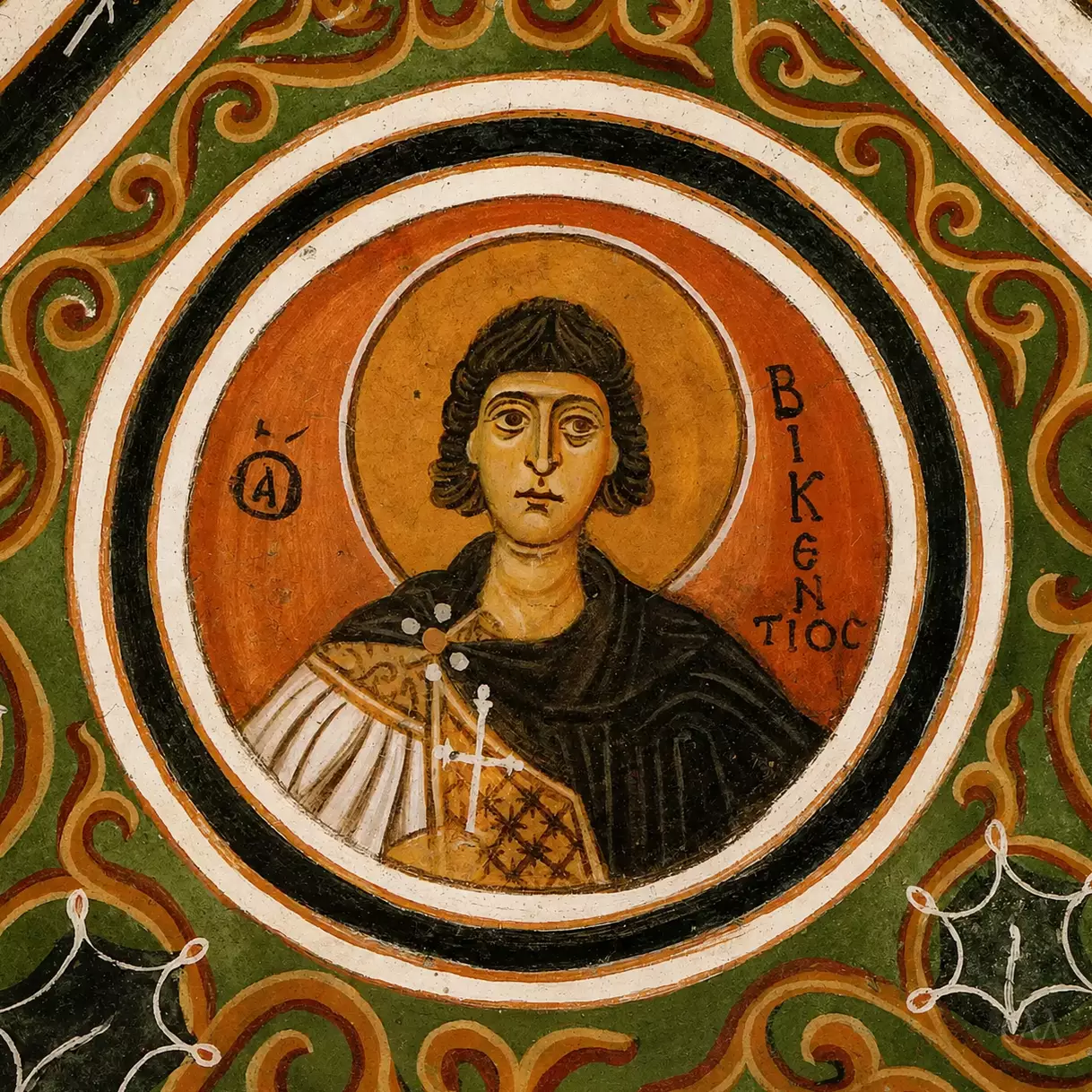
The Saint Vincent Hosios Loukas fresco, painted by an unknown artist and generally dated to the third quarter of the 11th century, belongs to the extensive wall-painting programme of the crypt beneath the Katholikon of the Monastery of Hosios Loukas in Phocis, Greece. The saint appears as a youthful bust within a circular medallion, facing directly outward beneath an orange-ochre halo. His name, ΒΙΚΕΝΤΙΟΣ, descends vertically beside the head, giving the figure an immediate and unequivocal identity. The image forms part of the decoration of the south groin vault, together with medallions of Aniketos, Photios and Arethas.
Within the crypt, roundel portraits alternate with larger narrative compositions and participate in a carefully organised ensemble of apostles, martyrs, monks and other sacred figures. Scholarship has long recognised this underground chamber as one of the significant surviving programmes of Middle Byzantine wall painting, while Hosios Loukas as a whole preserves an exceptional conjunction of architecture, mosaics, frescoes and marble decoration.
Form, Colour and Expression
Frontality governs the portrait. Vincent’s shoulders establish a broad base beneath the comparatively narrow head, while the circular framing concentrates attention upon the face. Large almond-shaped eyes, strong dark brows, a long straight nose and a small closed mouth give the physiognomy its solemn intensity. Slight irregularities between the two sides of the face prevent the image from becoming geometrically rigid. The gaze has unusual force: wide open, steady, almost physically present within the surrounding ornamental field.
Around the forehead and ears, dark hair is organised into dense curling locks. Individual strands are indicated through closely set linear strokes, especially over the crown, where their direction creates a compact triangular rhythm. The youthful face receives its structure from ochre and brown tonal modelling, with lighter passages defining the forehead, cheeks, nose and area around the eyes. Contour remains decisive. Dark lines isolate eyelids, nostrils, lips and jaw; lighter strokes then articulate selected surfaces, producing the characteristic combination of graphic precision and restrained modelling associated with much 11th-century monumental painting. This same use of contour and frontal presentation connects the crypt frescoes visually with the more hieratic language found in the monastery’s mosaic decoration.
The halo occupies much of the roundel behind the head. Its warm ochre-orange tone is enclosed by a fine pale contour and surrounded by the reddish field of the medallion. Beyond it comes a sequence of concentric bands — white, black, white again — which separates the human figure sharply from the surrounding ornament. Around this disciplined circular structure spreads a muted green ground covered with ochre scrolls, curling stems and repeated vegetal forms. Ornament and portrait consequently operate at different rhythms: the face stable and frontal, the vegetation mobile, repetitive, continuously turning.
Drapery and the Painted Surface
At the lower edge of the roundel the costume introduces another group of textures. A very dark mantle passes across the upper body in broad masses, its folds defined by fine parallel strokes. Over the saint’s right shoulder, a fastening with small light circular ornaments marks the transition to a paler garment beneath. Cream-coloured vertical bands, ochre borders and densely patterned areas create a much richer surface beside the almost black mantle. The painter uses these differences economically, allowing ornament, line and colour to establish the costume without extensive volumetric description.
Executed as fresco, the image belongs to a tradition in which the preparation of the wall, the painted contour, the laying-in of broad tones and the subsequent articulation of highlights had to be coordinated across a monumental surface. Byzantine wall painting could combine work on moist plaster with additions made after drying; without specific technical examination of this individual medallion, the precise distribution of these stages should remain open. The surviving surface itself shows the effectiveness of the painter’s concise method: broad fields first, facial structure through contour and tonal passages, hair through repeated strokes, garment through patterned linear detail.
Saint Vincent within the Crypt of Hosios Loukas
The setting gives the depiction much of its meaning. Beneath the Katholikon, the crypt consists of a sequence of groin-vaulted bays whose painted decoration includes narrative scenes associated with the Passion and Resurrection of Christ together with numerous medallion portraits. The recurrence of circular busts creates a network of individual sacred presences across the vaults, each distinguished through physiognomy and identifying inscription. Vincent belongs to the group in the southern vault with Aniketos, Photios and Arethas, a grouping documented in both scholarly descriptions and photographic archives of the monument.
The decorative logic is particularly effective at close range. Each saint occupies an independent roundel, yet the scrolling green field continues around them, binding separate portraits into the architecture of the vault. Circular frames repeat, ornamental bands recur, colours answer one another. Through this organisation the painted ceiling acquires a patterned density that recalls precious textiles or other forms of luxury decoration while retaining the clarity required for individual identification. The extensive integration of painting, mosaic, marble and architectural form is one of the qualities for which Hosios Loukas has been recognised among the outstanding monuments of Middle Byzantine art.
Vincent himself was an early Christian deacon associated with Saragossa and Valencia in Roman Hispania, traditionally placed among the martyrs of the persecution under Diocletian around 304. His cult travelled far beyond the Iberian Peninsula and was known in both Western and Eastern Christian traditions. His presence at Hosios Loukas therefore belongs to the remarkably broad hagiographic repertoire of Byzantine monumental decoration, in which saints of different regions and periods could enter a common visual programme.
Within that programme, individuality still matters. The painter has given Vincent a recognisable youthful physiognomy — smooth face, dense dark curls, wide eyes — while the inscription fixes the identity that appearance alone could not securely establish. Small abrasions and losses interrupt portions of the painted surface, yet the principal contours remain unusually clear: the narrow mouth, dark curling hair, ornamented shoulder, orange halo and, beside it, the compact vertical letters ΒΙΚΕΝΤΙΟΣ.