Within the monastic complex of Hosios Loukas in Boeotia, later wall paintings were added to the celebrated Middle Byzantine decorative ensemble of the katholikon and its associated spaces. Executed around 1400, the Entry into Jerusalem fresco at Hosios Loukas represents a significant local expression of Late Byzantine pictorial tradition during a period of political fragmentation. While the monastery is internationally known for its Middle Byzantine mosaics, these later additions preserve evidence for the persistence of regional workshops and the continued reception of Palaiologan visual forms.
The political setting of Boeotia around the turn of the fifteenth century was complicated, shaped by changing Latin authorities and, in the longer course of the region, by the later advance of Ottoman power. Against such instability, monumental painting could provide continuity within an Orthodox sanctuary. New wall-painting campaigns at Hosios Loukas may therefore be understood within the continuing devotional and liturgical use of the monastery, where scenes from the life of Christ remained part of sacred use.
Entry into Jerusalem Fresco at Hosios Loukas: Composition and Iconography
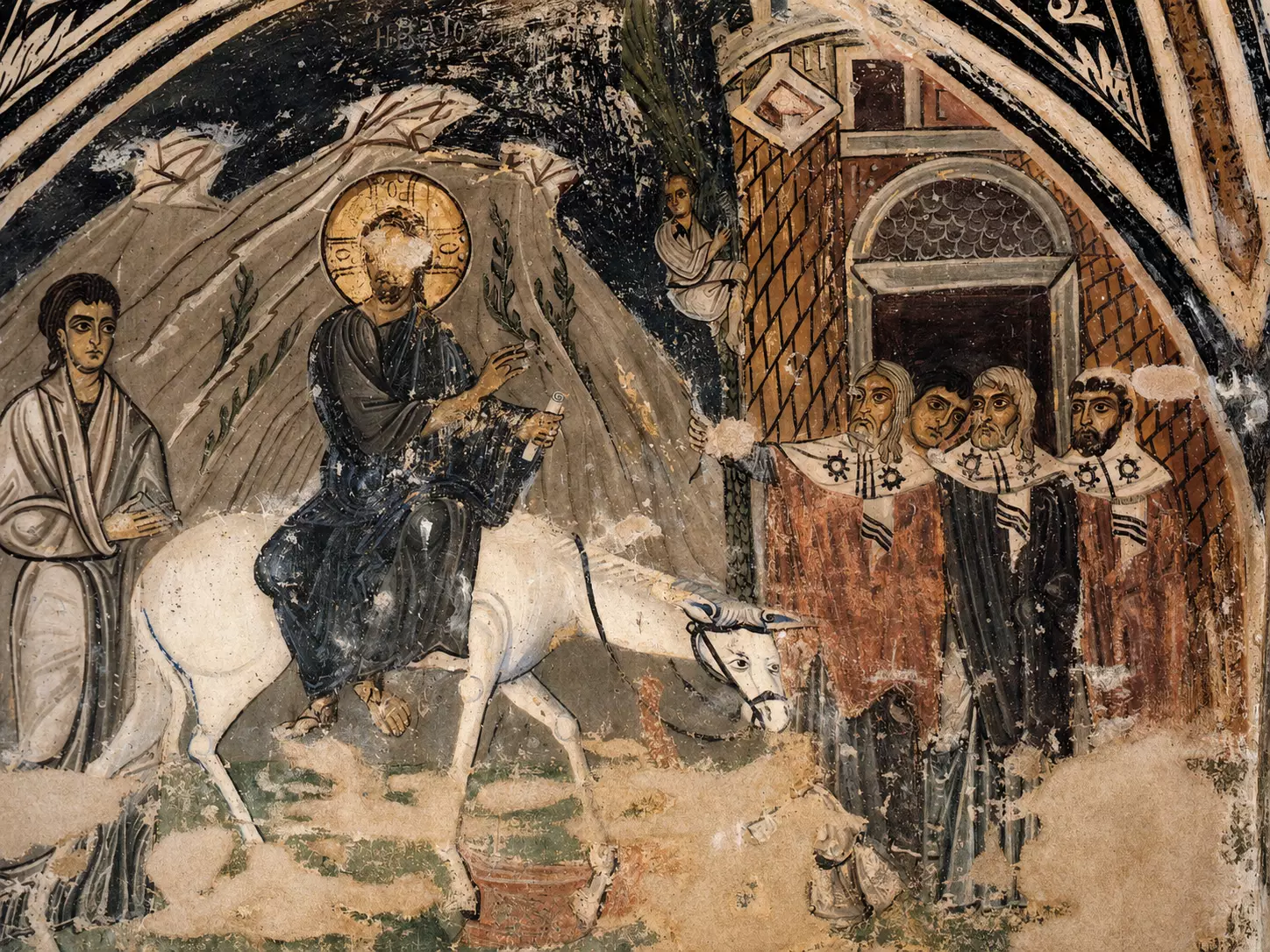
In this composition, the narrative of Christ’s triumphal entry into Jerusalem (Matthew 21:1–11; Mark 11:1–11; Luke 19:28–40; John 12:12–19) is compressed into a closely organised pictorial field. Christ, the clear focal point, rides a white ass towards the right side of the image. He sits sideways in the customary Byzantine manner, his torso turned sufficiently towards the viewer to preserve the iconic visibility of the figure. His right hand is raised in a gesture of benediction, while his left supports a tightly rolled scroll. A dark blue, almost black, himation falls over the chiton, its folds defined by firm linear passages rather than sustained volumetric modelling. The light body of the ass stands sharply against the darker garments and muted tones of the landscape.
At the far left, a single attendant disciple follows behind the mount. The surviving figure is youthful and appears beardless, with his hands gathered before his body; no codex is visible in the preserved section. Since no identifying inscription can be read, a more specific apostolic identification cannot be made securely from the image alone. His restrained posture nevertheless establishes a quiet counterweight to the compact group awaiting Christ opposite him.
On the right, the inhabitants of Jerusalem emerge from a dark arched portal to receive Christ. The architecture is highly schematised, formed from vertical masonry planes, narrow openings, patterned brickwork and a tiled or scaled upper surface that acts as a framing device rather than an illusionistic cityscape. The group is tightly compressed, with overlapping faces suggesting depth within a shallow space. Particularly noticeable are the broad white shoulder bands or collar-like garments worn by several figures, each marked with dark rosette or star-shaped motifs and linear ornament. These details may reflect a workshop convention for distinguishing the citizens of Jerusalem; broader parallels in Byzantine art should be approached comparatively rather than treated as proof of a specific costume source. From the foremost group, an arm extends towards Christ with a slender branch.
Above the ass’s head, a small youth climbs a stylised tree and reaches into its upper growth, a feature associated with the branches spread or cut for Christ’s approach (Matthew 21:8; Mark 11:8; John 12:13). The figure interrupts the horizontal movement of the procession and introduces a strong vertical accent between Christ and the architecture of Jerusalem.
The landscape rises steeply behind Christ, following the spatial compression familiar in Late Byzantine painting. Instead of receding gradually, the rocky forms mount in angular tiers and close much of the background, pressing the narrative towards the picture plane. Their ridges are articulated by strong linear accents and contrasting passages of light and dark. Figures, mountain, tree, city: each occupies a sharply delimited zone, yet the whole remains interlocked. The result is compressed sacred space in which the principal action stays immediately legible.
Surface Condition and Late Byzantine Pictorial Language
The present condition of the Entry into Jerusalem fresco at Hosios Loukas is visibly fragmentary. Large areas of abrasion and paint loss affect the lower part of the composition, the body of the ass, several garments and, most conspicuously, the face of Christ. Their precise causes, however, cannot be established from visual inspection alone.
Most severe is the damage to Christ’s face. The central facial features have largely disappeared, leaving the surrounding hair, beard and cruciform halo to preserve the contour of the head. The halo retains traces of its cross divisions and inscriptional elements, although the lettering is incomplete and abraded. In several places the painted surface has thinned enough to expose lower layers, but the photograph does not permit their secure identification as intonaco, limewash or another specific preparation.
The same caution applies to technique and pigment. The mural may preserve passages executed on wet plaster together with details added later, as is common in Byzantine wall painting, but the photograph alone does not justify a precise division between buon fresco and a secco passages. Likewise, the visible reds, ochres, browns, greens, whites and dark blue-black areas can be described chromatically without assigning individual pigments such as terre verte, azurite or lapis lazuli.
The garments of the Jerusalem group are built through broad colour areas controlled by dark outlines and lighter linear accents. Their white shoulder bands, patterned with compact dark motifs, remain among the clearest decorative details. The architecture is treated with similar economy: masonry is indicated by repeated diagonal and vertical lines, while the arched portal forms a firm geometric frame around the group.
The background is now dominated by a dark field that shapes the fresco’s present sombre appearance. Whether this field was originally lighter, bluer or materially different cannot be determined securely from the photograph. Ageing, surface loss, dirt, chemical change or earlier intervention may alter a wall painting, but without conservation documentation it would be unsafe to assign a specific original pigment or a single cause for the present tone.
Liturgical Context and Artistic Significance
The Entry into Jerusalem belongs to the narrative of Palm Sunday, when Christ enters the Holy City amid branches and acclamation (John 12:12–19), immediately before the events of the Passion. In the fresco, that movement towards Jerusalem is expressed without excessive theatricality. The ass advances, the citizens extend their gestures from the city gate, and the youth in the tree marks the activity of the crowd; Christ himself remains comparatively self-contained, his dark drapery and measured blessing holding the centre.
This balance between movement and restraint is one of the composition’s strongest formal qualities. The architectural mass on the right answers the steep mountain on the left, while Christ occupies the transition between them. The arrangement is not strictly symmetrical, yet the opposing masses create a stable equilibrium. The disciple forms a quiet vertical boundary at one side; the clustered citizens, a denser boundary at the other.
Within Late Byzantine painting, such a structure accords with a broader preference for compressed space, emphatic contour and strongly organised narrative groupings. Here the painter avoids excessive agitation. Drapery folds remain linear, the mountain surfaces angular, the architecture schematic, but the scene is held together by measured rhythm.
The scene also carries the liturgical association of triumph moving towards Passion. Branches and reception belong to the public acclamation of Christ (Matthew 21:8–9); the narrative that follows leads towards the Crucifixion (Matthew 27:32–56). The mural does not depict the later event, yet within the festal calendar it acquires that double resonance. Its solemn expressions and compressed setting intensify the reading for the modern viewer, although the present darkened surface should not be confused automatically with the painter’s original intention. Discussion of Palm Sunday therefore belongs principally to the iconographic and liturgical setting of the subject.
The survival of the fresco contributes to the study of later painting at Hosios Loukas and to the wider history of Late Byzantine artistic transmission in central Greece. Monastic centres could preserve older iconographic models while receiving newer stylistic habits through painters, workshops and travelling patterns of artistic practice. The Entry into Jerusalem at Hosios Loukas is consistent with that process: an established feast subject rendered through compressed landscape, schematic architecture, linear drapery and a tightly grouped reception scene.
The identity of the painter remains unknown, and the image itself does not permit a secure reconstruction of workshop origin or training. Stylistic comparison may connect the work with wider Palaiologan traditions in the Balkans and southern Greece, but such comparison should remain distinct from documentary attribution. What survives on the wall is more certain: the youthful disciple at the left, Christ mounted at the centre, the branch-bearing reception at the gate, the boy in the tree, the steep mountain forms, the damaged surface. Together they preserve a Late Byzantine interpretation of one of the major festal subjects of Orthodox Christian art.
(The translation was edited by N. Jones.)