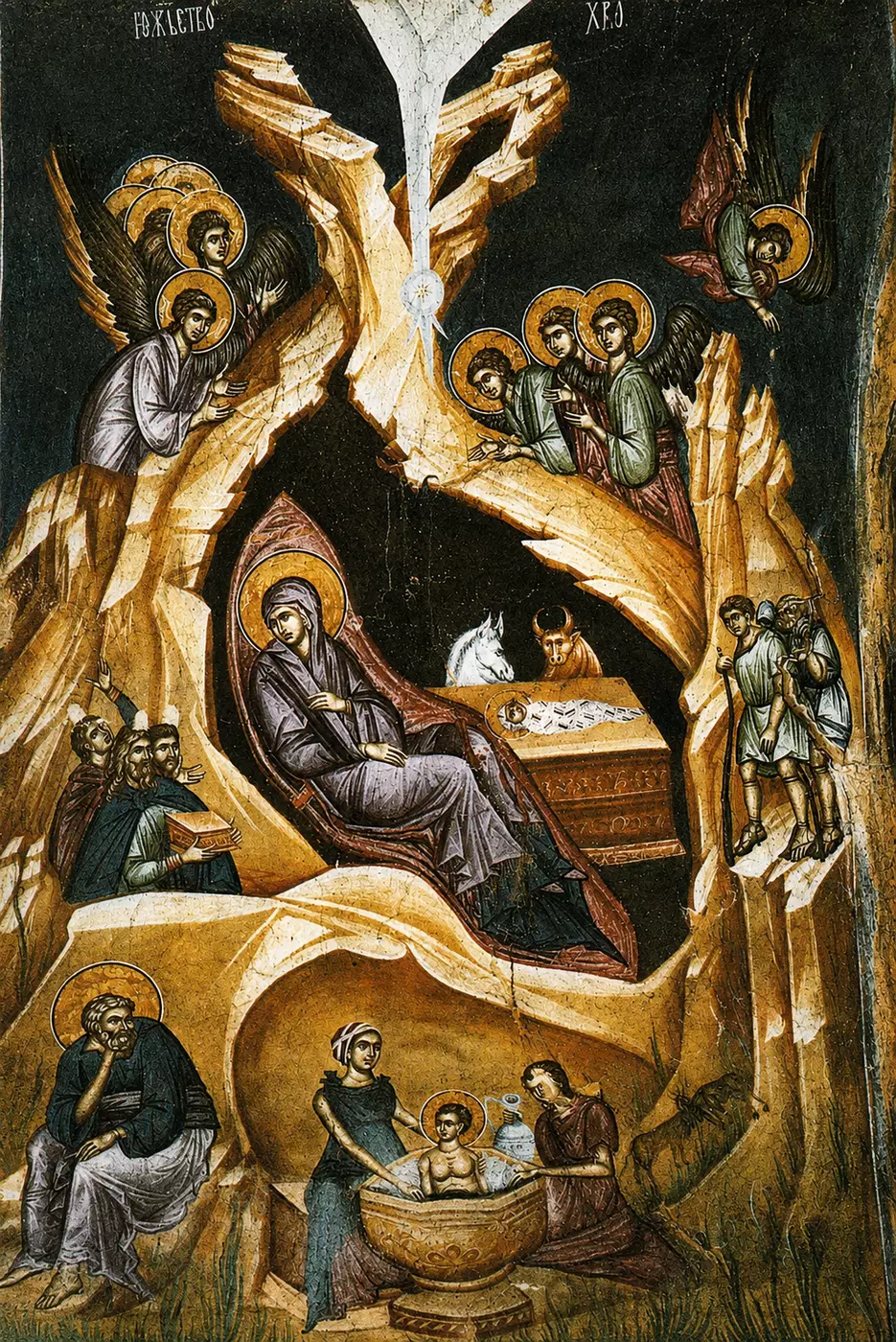
The Nativity of Christ at Peć, painted around 1335–1337 in the Church of the Virgin Hodegetria within the monastic complex of the Patriarchate of Peć, belongs to one of the most accomplished phases of fourteenth-century monumental painting in the Balkans. Occupying the eastern half of the vault over the south arm of the cross, the composition unfolded vertically across a steep, fractured landscape. Built around 1330 by Archbishop Danilo II as his funerary foundation, the church received its extensive painted decoration only a few years later, generally between 1335 and 1337.
By then, the artistic language associated with the Palaiologan period had travelled far beyond Constantinople, being received in Peć with unusual sophistication. Slender figures, restless contours, sharply broken rock formations and a narrative enriched with subsidiary episodes show painters thoroughly conversant with forms cultivated in the major artistic centres of the Byzantine world. While the inscriptions belong to the local Serbian written tradition, the iconographic programme draws upon established Eastern Christian models. Evidence of artistic transmission across political frontiers, the fresco preserves, enlarges and adjusts an inherited visual language to the particular requirements of a major Serbian ecclesiastical foundation.
Nativity of Christ at Peć and the Palaiologan pictorial language
From the uppermost part of the composition descends a narrow white beam, widening briefly as it reaches the star above the cave (Luke 2:9). Against the dark background its brightness appears abrupt. The ray establishes a vertical axis, yet the surrounding composition remains fluid: ochre-coloured mountains divide, intersect, and rise in sharp planes; angels gather on their slopes; human figures occupy cavities and ledges, while the principal figures rest within the broad dark opening of the cave. Rather than imitating a continuous natural setting, the landscape functions directly to structure the narrative.
At its centre, displaced slightly from the strict middle of the pictorial field, lies the theological and visual nucleus of the scene. The Christ Child, tightly swaddled, rests in a rectangular manger (Luke 2:7); immediately behind emerge the pale and reddish-brown heads of the ox and the ass from the darkness. Nearby reclines the Theotokos upon a long reddish-purple mattress, monumental in scale and enclosed by the curve of her dark maphorion. Her body follows the diagonal created by the mountain, while her head turns away from the manger, giving the figure an inward, contemplative quality. The painter has made her the largest human presence in the composition without isolating her from its movement.
Around this central group, time expands. Groups of angels occupy the upper rocks: some incline towards the event below, while others turn outward or gather together in quiet conversation-like gestures. On another rocky ledge an angel bends towards the shepherds (Luke 2:8–10), whose animated postures introduce a distinct register of movement, and nearby approach gift-bearing visitors toward the central scene. Successive incidents remain unified within a single pictorial space, combining Annunciation to the shepherds, adoration, angelic praise and the domestic aftermath of the birth according to a Nativity tradition that harmonized canonical Gospel material with episodes developed through apocryphal literature.
This multiplication of incident is particularly clear in the lower zone. Sitting apart from the Theotokos and the Child, Joseph rests his head upon one hand. His bent body forms a compact, closed shape that contrasts with the angular movement of the surrounding rocks, giving him visual weight. The gesture belongs to the established iconography of the Nativity, in which Joseph frequently occupies the margins of the principal event, absorbed in thought. The fresco painter presents his uncertainty with restrained gravity, rendering the figure quiet, heavy, and human.
Beside him unfolds the far more active bathing episode. Two women attend to the haloed infant Christ in a large ornamental basin, one supporting the Child while the other handles a vessel beside the bath. Derived from the apocryphal enlargement of the Nativity narrative, the episode had become deeply embedded in Eastern Christian iconography, introducing an intimate domestic action into a composition framed by mountains, angels and supernatural light. Yet this visual relationship remains carefully controlled: the Child in the basin repeats, on a smaller scale and in a different narrative moment, the infant placed in the manger above. Fourteenth-century discussions of imagery at the Virgin Hodegetria church have drawn attention to baptismal associations within its wider visual programme, especially in relation to Danilo II’s funerary foundation and the interconnected ideas of rebirth, resurrection and salvation.
Across the painted surface, line joins the figures more effectively than perspectival space. Drapery folds are sharply articulated; gestures continue the direction of mountain ridges; wings, limbs, rock faces and garments create repeated diagonals. Even the angels seem fitted into the geological structure. Above the manger, a cluster of angels forms a closely packed sequence of inclined heads and overlapping haloes, their restrained gestures directing attention downward, while on the opposite side another angel extends the rhythm into the surrounding landscape. The spatial ambiguity is deliberate and characteristic of Byzantine narrative construction, in which pictorial hierarchy and intelligibility take precedence over optical consistency.
Colour performs an equally structural role across the vault. Luminous ochres, pale flesh tones, muted greens, violet-grey garments and the stronger red of the Virgin’s bedding punctuate the large areas of black, while halos define the space in repeated circles of gold and yellow. Against an austere ground, narrow passages of white gain prominence through the celestial ray at the summit, the swaddling cloth around Christ, the pale animal, and highlights caught along dynamic folds.
With notable skill, the Peć painters developed this chromatic and spatial balance. Elongated proportions, linear refinement and expressive mobility define the figures, yet the scene maintains its compositional integrity despite its narrative density. A severe mountainous framework holds together the diverse elements: human actions below, angelic assemblies above, and the reclining Theotokos between them. The Nativity becomes a sequence of simultaneous presences arranged around one small swaddled figure resting in the dark cave.
(The translation was edited by E. Alexandraki)