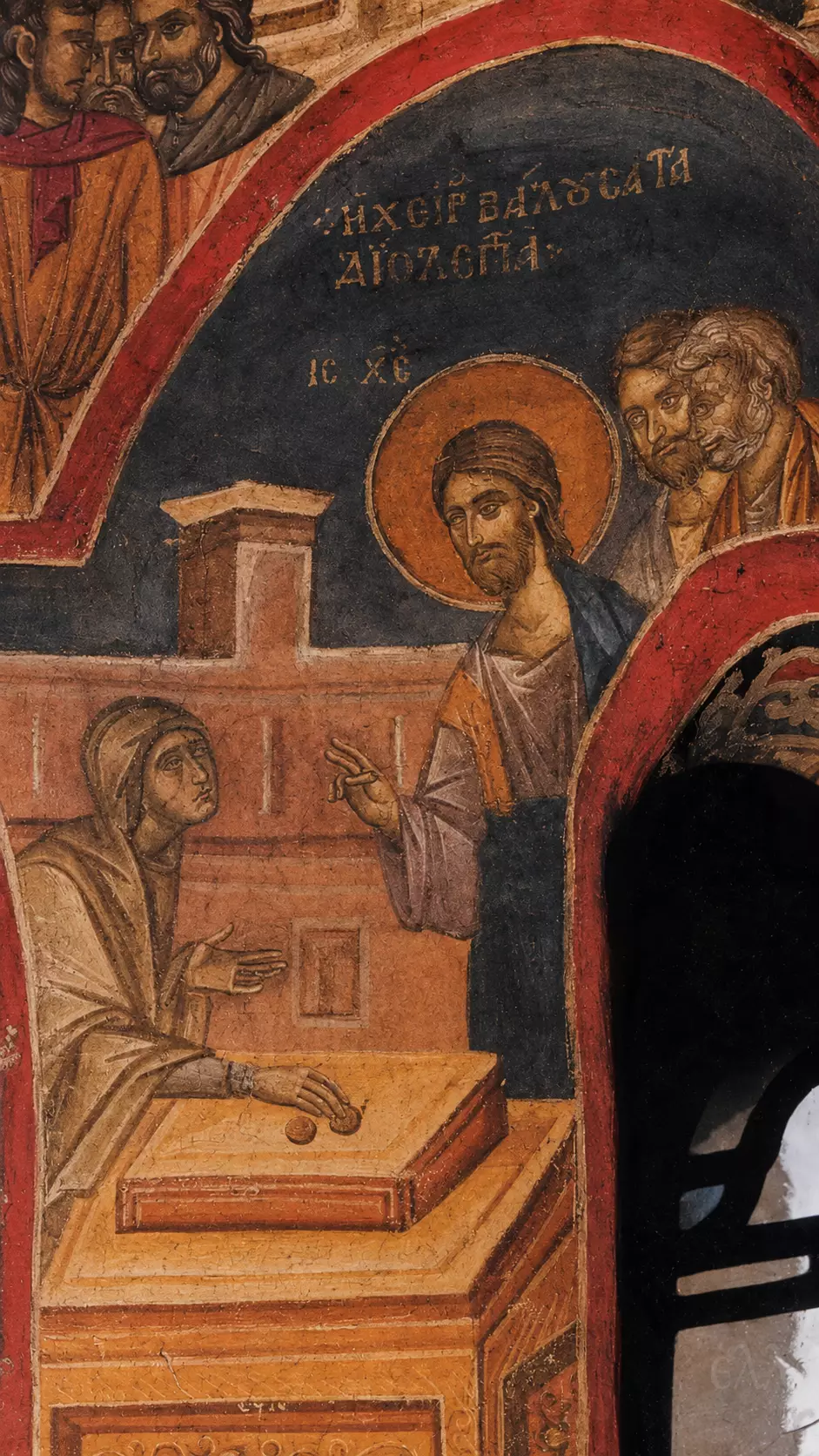
In the katholikon of Hilandar Monastery on Mount Athos, the Widow’s Mite Byzantine fresco gives monumental form to a Gospel episode built around something almost invisible: two coins of negligible monetary value. The scene, generally dated to the second decade of the fourteenth century, belongs to the early Palaiologan decoration of the church associated with the patronage of the Serbian king Stefan Uroš II Milutin. The main body of the katholikon itself dates from the early fourteenth century, a period of exceptional prosperity for Hilandar, whose architectural history and surviving monuments are extensively documented in the Princeton Hilandar archive.
The subject comes from the Gospel account of the widow’s offering (Mark 12:41–44; Luke 21:1–4). Christ observes wealthy donors placing substantial offerings in the Temple treasury, followed by a poor widow who contributes two lepta. He then tells his disciples that she has given more than the others because they offered from their abundance, whereas she surrendered what she possessed for her livelihood. In the Hilandar composition the theological argument is compressed into gesture and proximity. Christ stands beside the widow, speaking with his raised hand; she bends towards the treasury, her attention fixed upon an action so slight that the painter has had to make the receptacle itself a major element of the scene.
The Widow’s Mite Byzantine Fresco and Its Narrative Structure
The pictorial field is enclosed by a broad red arch, and within it the figures occupy an architectural setting reduced to a few emphatic forms. A low wall extends across the middle distance; behind it rises a narrow pier or architectural projection, while the upper field remains a deep blue approaching blue-black. Such spatial abbreviation is characteristic of Byzantine narrative painting. Architecture establishes the Temple setting through a limited group of forms — wall, pier, arch, treasury — without attempting to reconstruct an archaeological interior.
At the lower left, the widow approaches a large rectangular treasury chest whose scale immediately arrests the eye. Bands of ochre, muted red and brown articulate its structure, while an ornamental panel survives on its front. The upper surface forms a sharply tilted plane, bringing the act of donation visibly forward. One small circular coin can be distinctly recognised upon it; the Gospel narrative and the identifying inscription specify the offering as two lepta. Her hands remain close to the chest, one extended across its surface, so that a remarkably small physical action organises the entire lower portion of the scene.
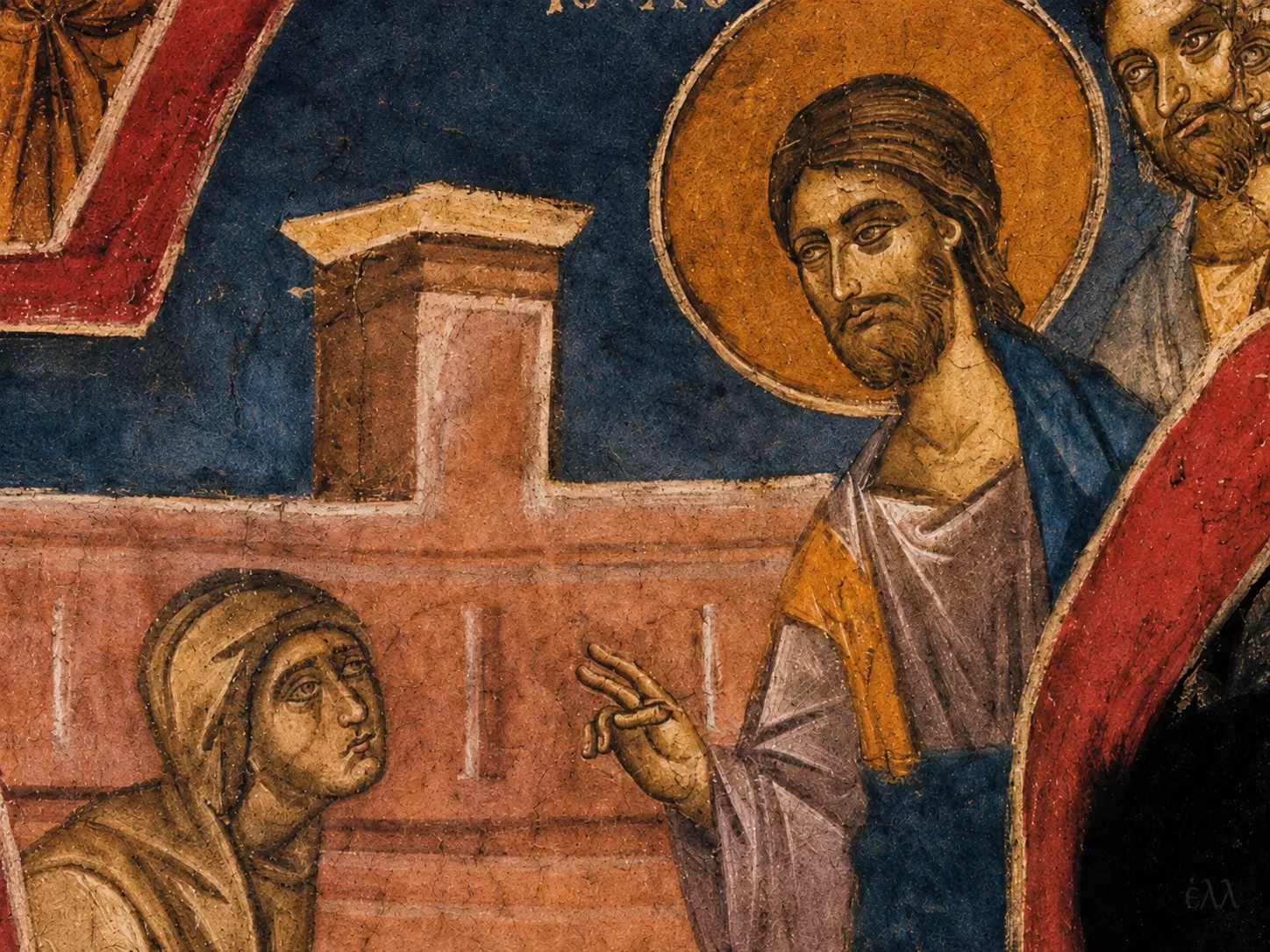
Christ provides the counterweight. He stands above and to the widow’s left from his own orientation, his body elongated and firmly vertical, the head inclined towards her. A warm reddish-brown halo, edged by a light contour, separates his face from the dark ground. His garments combine a rose-ochre chiton with a much darker blue-grey himation, the latter descending in a broad vertical mass that gives weight to the figure. The right hand rises between Christ and the woman in a gesture of speech and benediction. It is a finely judged interval. Turning the empty space between the two protagonists into part of the narrative, the fingers do not merely identify him as speaking but direct attention towards the widow.
Behind Christ appear two male figures, compressed into the available field and partially overlapped by his halo and body. Additional heads are visible in the upper left section beyond the red framing arch. Their subordinate scale and restricted visibility are important. The central exchange does not require an elaborate crowd. What matters is that the act has witnesses and that Christ’s judgement transforms a private donation into a lesson addressed beyond the woman herself.
Above the principal figures survives the painted Greek inscription identifying the subject, apparently reading Ἡ ΧΗΡΑ ΒΑΛΟΥΣΑ ΔΥΟ ΛΕΠΤΑ, “the widow casting in two lepta,” while the familiar contracted Christogram IC XC accompanies Christ. The inscription does more than provide a title. Byzantine narrative cycles regularly depend upon the cooperation of image and text, and the brief phrase fixes the precise Gospel moment represented: not the widow as an abstract personification of charity, but the widow performing the action upon which Christ immediately comments.
The woman herself is strikingly restrained. Her head is covered, the face shown in three-quarter view and lifted towards Christ. The painter does not isolate her through a halo or enlarged scale. She remains socially anonymous, visually modest, distinguished by the action of her hands. Beside a box of offerings, a nameless widow occupies a different register of narrative significance than the strongest visual landmarks ordinarily found in Byzantine interiors, supplied by Great Feasts, miracles, the Passion, hierarchs, martyrs and holy figures.
Her anonymity is therefore part of the iconography. The Gospel gives no name, lineage or later history to this woman, and the image does not attempt to supply one. The viewer is directed instead towards a calculation of value that overturns the visible evidence. Large gifts appear large; two lepta, barely perceptible. Yet the verbal judgement of Christ reverses that hierarchy. The pictorial arrangement participates in the same reversal: an apparently insignificant movement at the treasury becomes the reason for Christ’s commanding gesture and the attention of the surrounding figures.
This concentration upon hands deserves notice. The widow’s hand moves downward towards the offering while Christ’s hand rises above it, the one relinquishing what little she owns and the other interpreting its worth for those who watch. Between them lies the narrative meaning of the fresco. Their gazes strengthen the connection, yet the hands make it legible from a distance, an especially effective solution in monumental painting, for which clarity of gesture had practical as well as expressive value.
The colour structure likewise keeps the scene legible. Warm ochres and terracotta tones predominate in the architecture and treasury, while the dark blue background isolates heads, halos and gestures. Red framing elements mark the borders of the episode and separate it from neighbouring scenes in the painted cycle. Recorded in scholarship on Palaiologan painting, the katholikon’s extensive overpainting of 1803 necessarily complicates any attempt to distinguish the chromatic subtleties of the original fourteenth-century layer solely from its present appearance.
Even with that later intervention, the older compositional logic remains readily perceptible. Faces are narrow and serious, contours decisive, gestures economical. The figures inhabit a shallow pictorial space, yet they are not inert. Christ turns gently towards the widow; she responds through the upward movement of her face and the differing directions of her arms, small shifts of posture together creating the exchange between them.
The fresco belongs to a wider artistic environment in which Thessalonian and Macedonian painting played a major role in the development of Palaiologan monumental art. Hilandar’s fourteenth-century decoration has consequently been discussed in relation to the artistic currents of Thessaloniki, although the individual painter of this scene remains unidentified. Such anonymity is normal for large Byzantine mural programmes, whose surviving evidence more readily preserves patrons, inscriptions and iconographic structures than the personal identities of the craftsmen responsible for them.
What remains unusually memorable is the disproportion at the centre of the story. A large treasury, several witnesses, the standing figure of Christ; on its surface, a coin scarcely larger than a painted fingertip. The composition allows that disproportion to remain visible. Nothing enlarges the gift itself. Its significance is disclosed through Christ’s response, and thus the tiny offering becomes the point around which the entire scene turns.
(The translation was edited by P. Alexiou.)