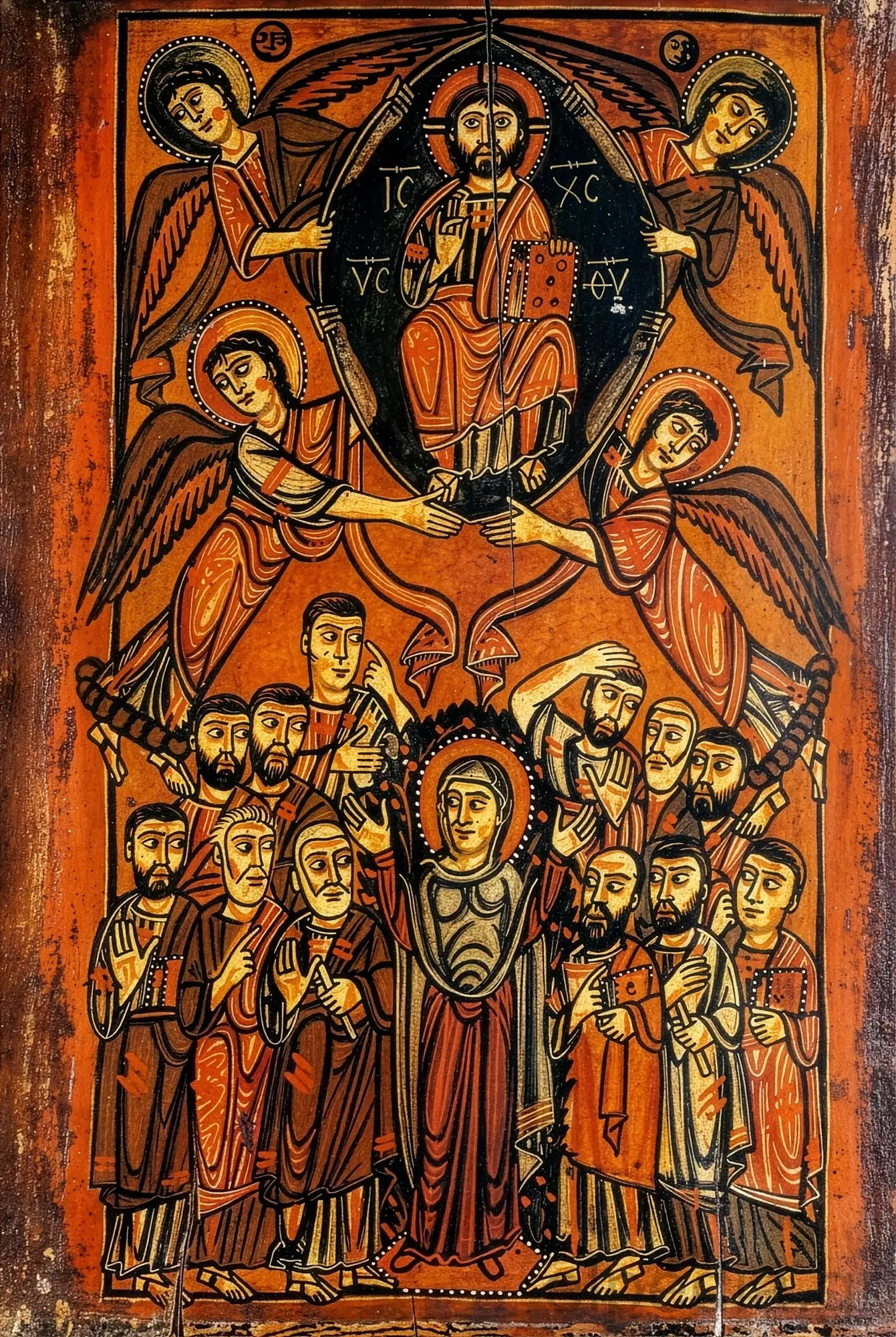
A small wooden panel, its dimensions not exceeding forty-two by twenty-seven centimetres, is preserved in the Monastery of Saint Catherine on Sinai, and depicts one of the most densely meaningful moments of the Christian narrative: the ascent of Christ into the heavens. It is dated to the ninth or tenth century, a period in which the workshops of the wider Palestinian region, without the resources of Constantinople, were shaping works with their own recognisable character. The painter of the icon of the Ascension remains anonymous, as indeed does the greater part of early Byzantine production.
The isolation of the monastery, built at the foot of the biblical mountain, proved decisive for the survival of such works through the period of Iconoclasm, even as icons and wall-paintings were being systematically destroyed elsewhere. In the same sacristy there is also preserved a remarkable collection of manuscripts of the monastery, evidence of a spiritual life that never entirely ceased, even in its most difficult moments. The composition is arranged in two superimposed registers: above, Christ within an oval mandorla held by four angels; below, the Mother of God amid twelve apostles, several of whom hold a book or a scroll and turn their gaze upward. It is an iconography with a long prehistory, yet here with peculiarities unusual enough to merit a closer look. The feast depicted falls forty days after Pascha, closing the cycle of appearances of the risen Christ to his disciples, and a portable icon such as this could be used both for the celebration of the feast and as an object of personal study or prayer, depending on the setting in which it happened to be found at any given time.
Two Worlds in One Composition: The Icon of the Ascension
Red dominates almost the entire surface, both in the background and in the garments, giving the icon of the Ascension a visual warmth rarely encountered on so small a surface of wood. The interior of the mandorla, by contrast, is immersed in a dark blue verging on black, speckled with small white dots recalling stars. The four angels do not merely hover around it; they hold it, gripping its edge with their hands as though it were a metal or wooden frame and not a luminous manifestation of the divine.
In the two lower angels the tunic acquires a swollen hem recalling an animal’s fur, while the edges of their mantles billow, forming a design that is almost lyre-shaped. It is thither that the viewer’s gaze is led, straight towards the Mother of God, without this being stated explicitly anywhere. Linearity dominates every detail, with the outlines strongly emphasised and the folds arranged in parallel lines without plastic gradation. The result approaches a popular, folk-like interpretation of the figure, far from the refined plasticity one will encounter later in Constantinopolitan painting.
Pearls adorn the border of the halos and of the codices held by the figures, an element of luxury within a work otherwise austere in its materials. A precious detail, given the small size of the panel. Kurt Weitzmann’s systematic cataloguing of the Sinai icons, in the late 1950s, places works such as this within a group of portable icons attributed to a Palestinian workshop, on criteria concerning the drawing, the colour, and the lettering of the inscriptions. Decades later, the expeditions of the University of Michigan, of Princeton, and of Alexandria photographed the whole of these works systematically, providing research with material that is still being studied today. The preference for red over gold, which will later dominate as background in the middle Byzantine painting of the capital, reveals a workshop with its own resources and its own habits, not merely a poorer version of Constantinopolitan models.
Christ in Glory: A Detail of the Icon of the Ascension
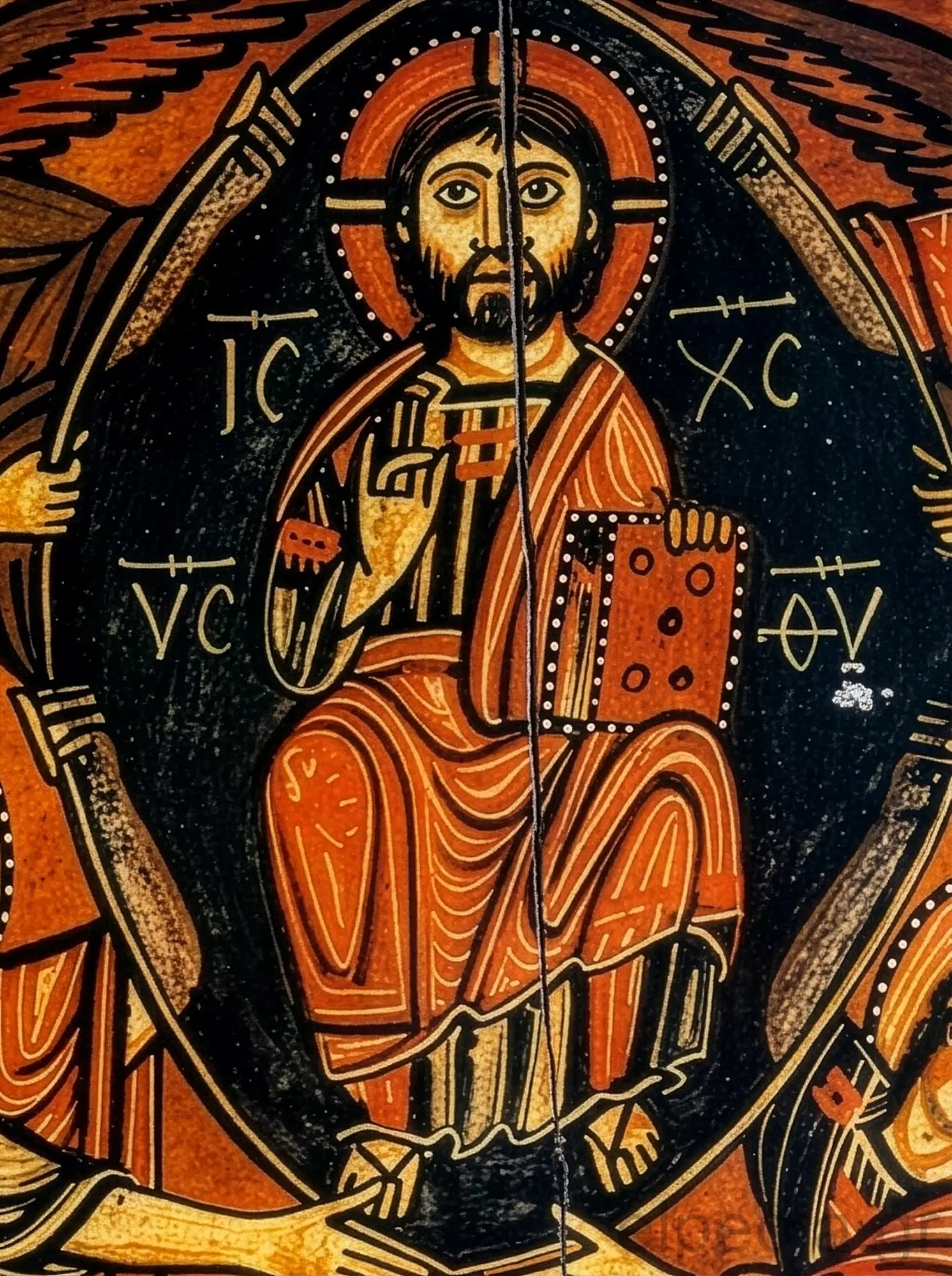
At the centre of the oval mandorla Christ sits with his gaze turned straight upon the viewer, the eyes large, the eyebrows emphasised, the beard brown and short. With the right hand he blesses, the fingers arranged in the established manner, while with the left he holds a red codex, adorned with pearls and small circular ornaments recalling precious stones. Unusual for the scene of the Ascension: Christ neither sits nor stands upon a rainbow, as one would expect from the established iconographic formula. He hovers within the mandorla without any intermediate support, a rare solution that perhaps betrays the earliness of the rendering.
On either side of the head are read the usual IC and XC, abbreviations of the name Jesus Christ. Lower down, at the height of the hands, a second inscription, ΥΣ ΘΥ, renders the title Son of God, a formulation that occurs chiefly in early works and grows rare in later centuries. The halo, red with a white speckled border, bears a cross discernible within it, while the background around the figure, dark and full of small dots, creates a strong contrast with the brightness of the face. The rendering remains simple, almost coarse, without any pursuit of realistic anatomy, for it serves hieratic stability, at the very moment when the figure stands upon the threshold between earthly and transcendent space. The very hand that blesses, larger in proportion than a realistic scale would allow, draws the eye before one has even had time to meet the eyes of the figure, a choice that reveals precisely where the painter wanted the viewer’s eye to alight first.
The Mother of God among the Apostles
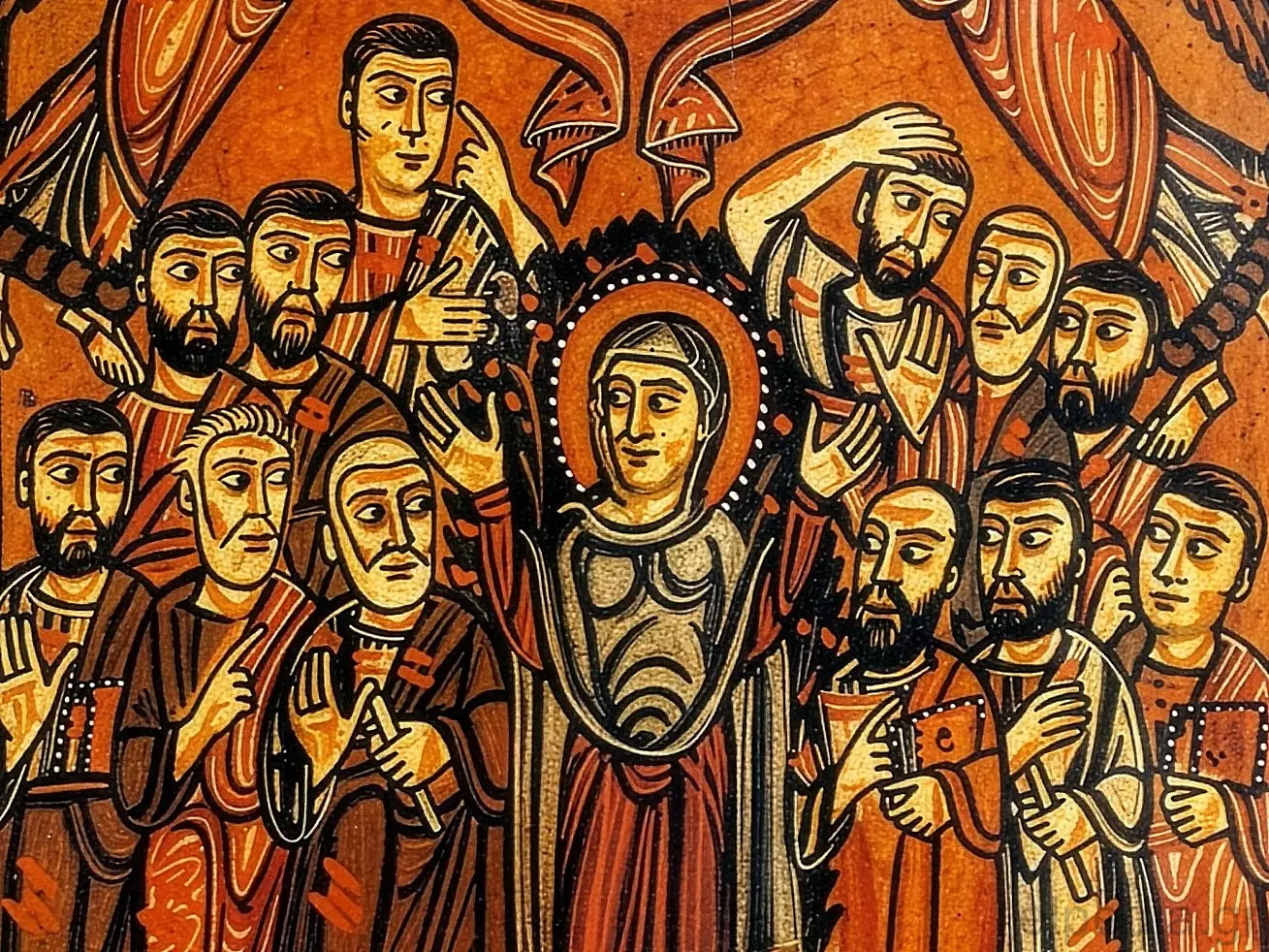
In the lower part of the composition, the Mother of God stands with her hands raised in the posture of supplication, clothed in a red mantle over a bluish tunic on which wavy lines can be discerned, perhaps an allusion to the Burning Bush which, according to tradition, burns without ever being consumed. Her halo bears the same lace-like border of white dots as that of Christ, declaring visually the kinship of the two figures without words. Around her crowd twelve apostles in two groups, most of them bearded, others younger and beardless, with expressions ranging from silent recollection to unconcealed wonder.
A young man in the background points upward with his finger, while beside him a bearded man shades his eyes with his palm, as though the light of the mandorla were truly blinding and not merely a pictorial convention. Several hold codices with a red cover and a similar border of pearls around the edge, while some others simply raise their hands as a sign of astonishment. According to the established arrangement of such compositions, to the right of the Theotokos are usually placed Peter and Andrew, to the left Paul, although the absence of inscriptions in this particular case does not permit a certain nominal identification of each figure individually.
The whole company of twelve figures, crowded within the narrow frame of the panel, conveys a sense of collective movement rather than individual calm. There is no hierarchical distance between the figures, only differences of age and of expressive intensity, perhaps because the painter wished to show that astonishment before the miracle knows no degrees. In an icon of such small dimensions, where every centimetre carries narrative weight, the workshop that produced it evidently knew very well how to condense a many-figured subject without the legibility of each individual gesture being lost. The young man who points upward and the man who shades his eyes are not looking towards exactly the same point, a small inconsistency of design that is probably owed to the haste of execution rather than to any deliberate narrative choice. Small in size, the icon of the Ascension from Sinai carries within it the technique and the theological thought of an entire workshop, in an age that left few records behind it.
(This is a translation from the Greek original text, translated by K. Pappas.)

