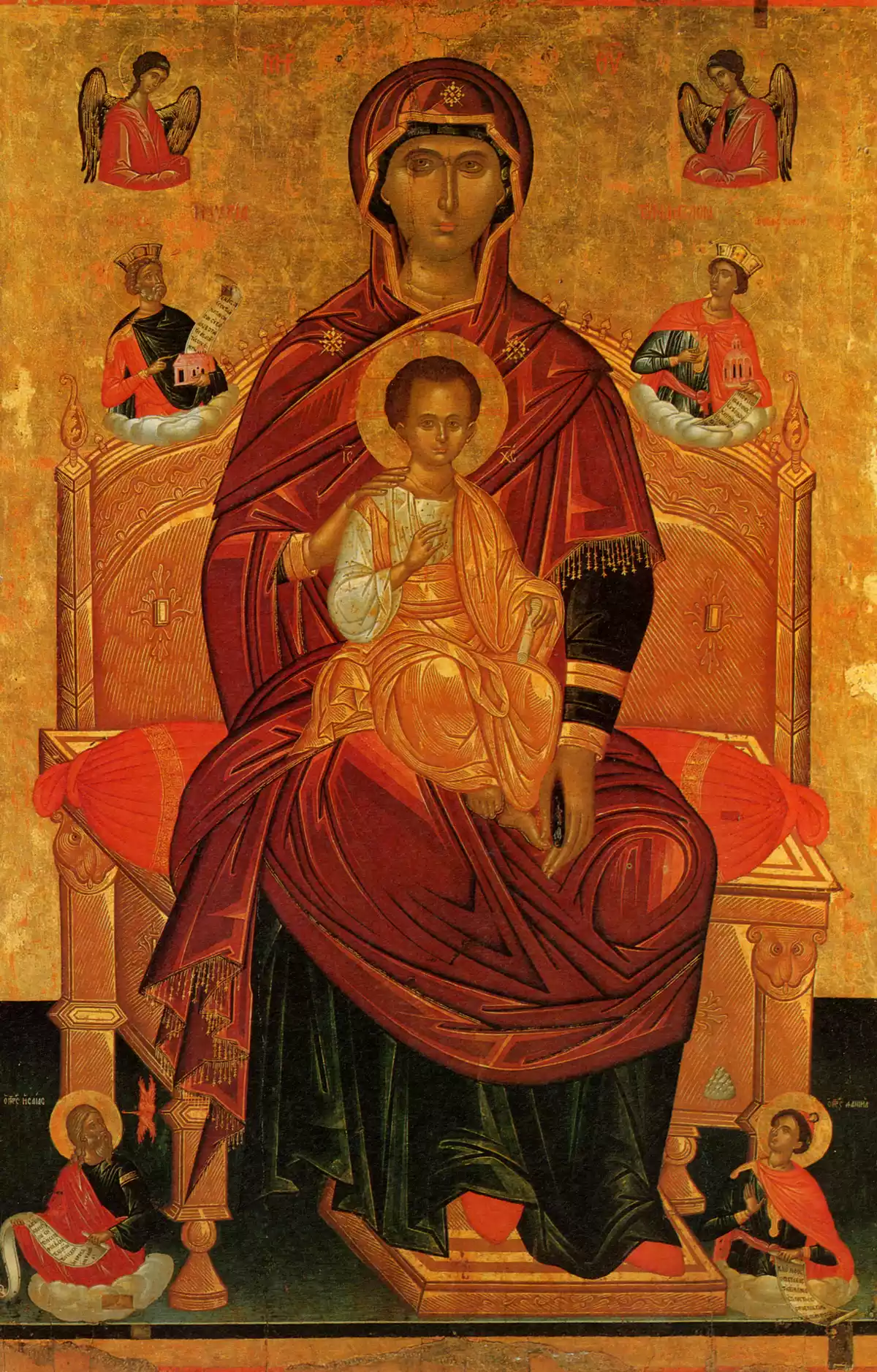
On a wooden board one hundred and twenty by seventy-seven centimetres, covered with gold leaf and coloured with egg tempera, there is kept in the Church of Saint Anthony in Corfu an icon known as the “Lady of the Angels“. It is dated around 1500, the time, that is, when the Cretan School was reaching its apogee, and is attributed to an anonymous painter of the circle of Andreas Ritzos, the artist who established the specific iconographic type in Chandax. The Theotokos sits upon a throne elaborately carved, holding upon her knees the little Christ, while above and around them there unfolds a composition of archangels and prophets, each of whom bears a symbol, a prophecy, a link which binds the Old with the New Testament. This type, of the enthroned virgin holding the infant, circulated most widely from the workshops of Crete in the fifteenth and sixteenth century, conveying together with the form also an entire language of images that had begun to be formed centuries earlier, when Christian art sought ways to make the invisible visible. The text which follows approaches the icon as a historical document, studying its composition, technique, and visual characteristics one by one, commencing from the face of the Virgin and reaching unto the prophets who flank her.
Iconographic analysis: composition, faces and symbols
The composition: throne, colour and hierarchy
The entire composition is organised around the throne, a wooden piece of furniture carved with such care so as to resemble an architectural structure more than a seat. On its armrests there is discerned a relief head of a lion, a motif borrowed from the decorative sculpture of the era, while two red cushions flank the figure of the Theotokos, imparting to the whole a sense of royal ritual. Behind her, a dark green cloth falls in folds which break the monotony of the gold background, which dominates the entire surface and illuminates every corner with that metallic brilliance which the Cretan painters transformed almost into their trademark.
The Virgin sits frontally, with her right hand resting upon the shoulder of Christ in a gesture tender and simultaneously protective, as if she restrains him from something which the spectator does not see. Her left hand touches the foot of the child. The little Christ sits upon her knees in a formal posture, with the aura of a little ruler who poses, blessing with the one hand and holding a closed scroll with the other.
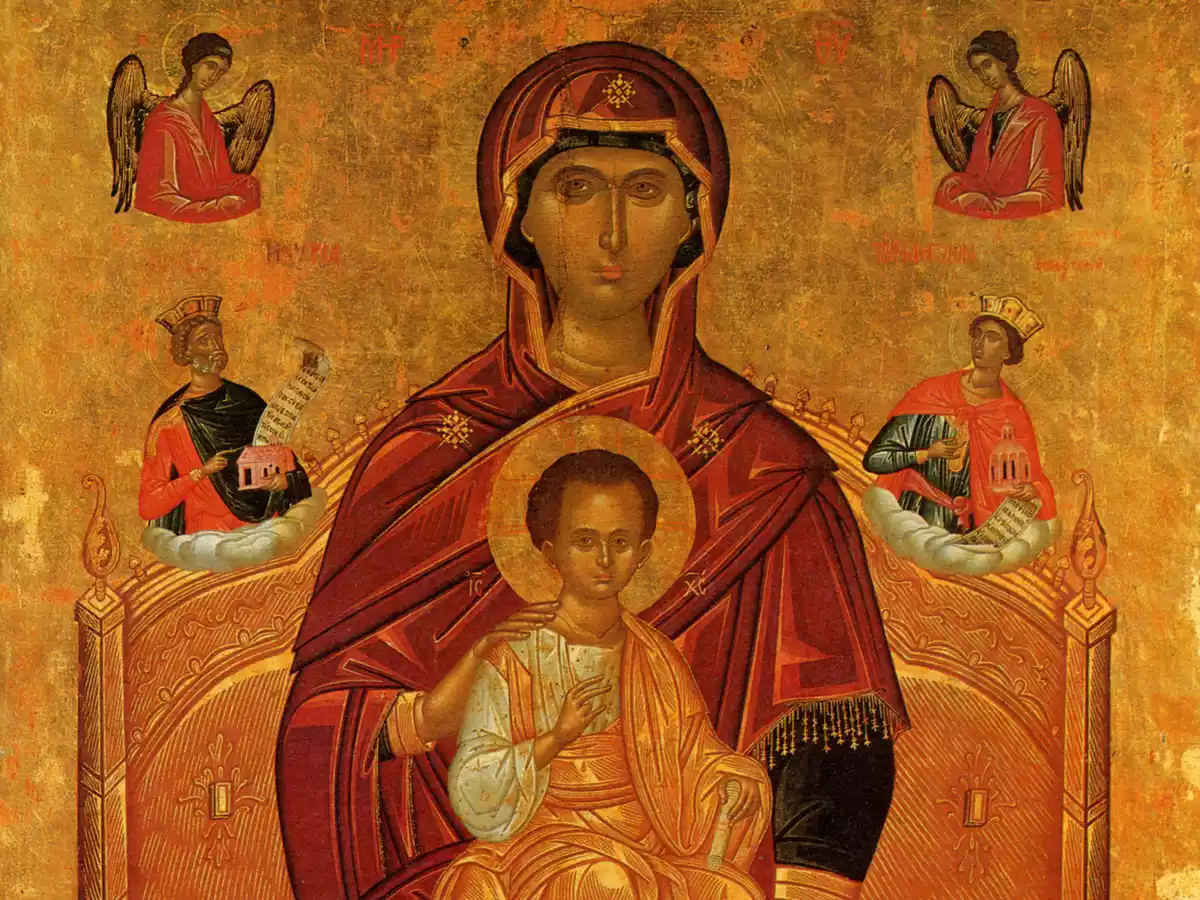
Above the two, in each corner, two archangels with red chitons and open wings stand half-visible amidst layers of clouds. Lower down, at approximately the same height as the head of the Theotokos, two crowned prophets hold open scrolls with text, while at the lower part of the composition, kneeling on either side of the footstool, another two prophets complete the schema, so that the totality of the six figures surrounds the Virgin as a heavenly court.
The face of the Virgin
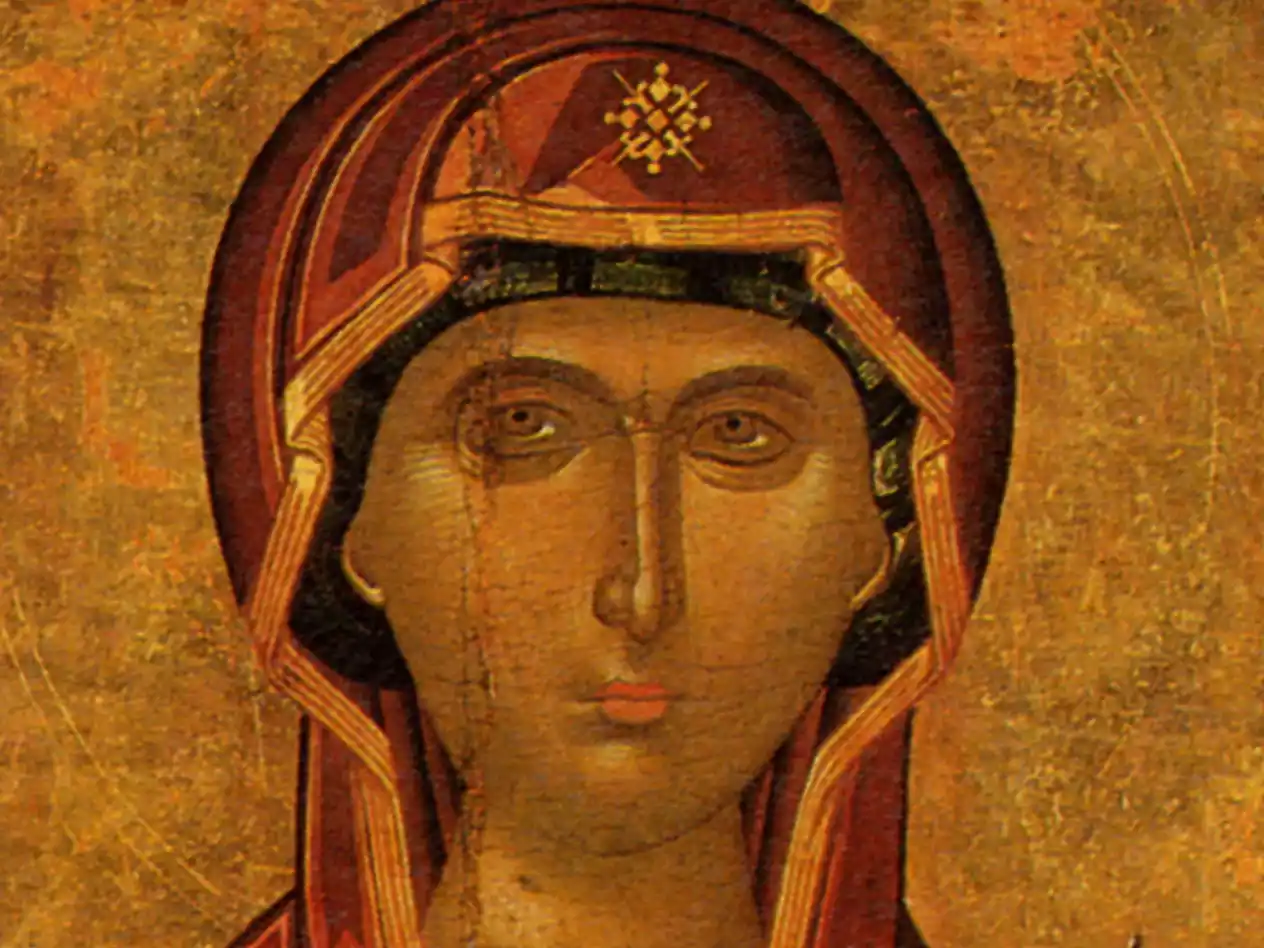
The face of the Theotokos reveals what technical precision signifies in egg tempera. Beneath the warm, ochre colour of the skin there is discerned still, in places where time has worn the surface layer, the greenish underpainting which the iconographers named proplasmos, a base upon which the chiaroscuro was gradually built. The nose is long and straight, the eyes almond-shaped, the gaze directed slightly downwards, not at the spectator, a thing which confers upon the figure a distance almost hieratic. The lips, small and fleshy, are painted in a coral hue which one rarely encounters in so good a state of preservation in an icon of this age.
Upon the forehead there is discerned the familiar eight-pointed star, symbol of perpetual virginity, embroidered with gold lines upon the deep red maphorion. The same maphorion bears at its edges chrysography, those fine, parallel lines of gold which simulate folds of light upon the fabric, a technique which is identified almost exclusively with the workshops of Crete of the fifteenth century and especially with works attributed to Ritzos and his circle. The halo around her head is incised with concentric circles, while the gold background around her, rough in its texture, shows the marks of a surface that has lived five centuries.
The child Christ
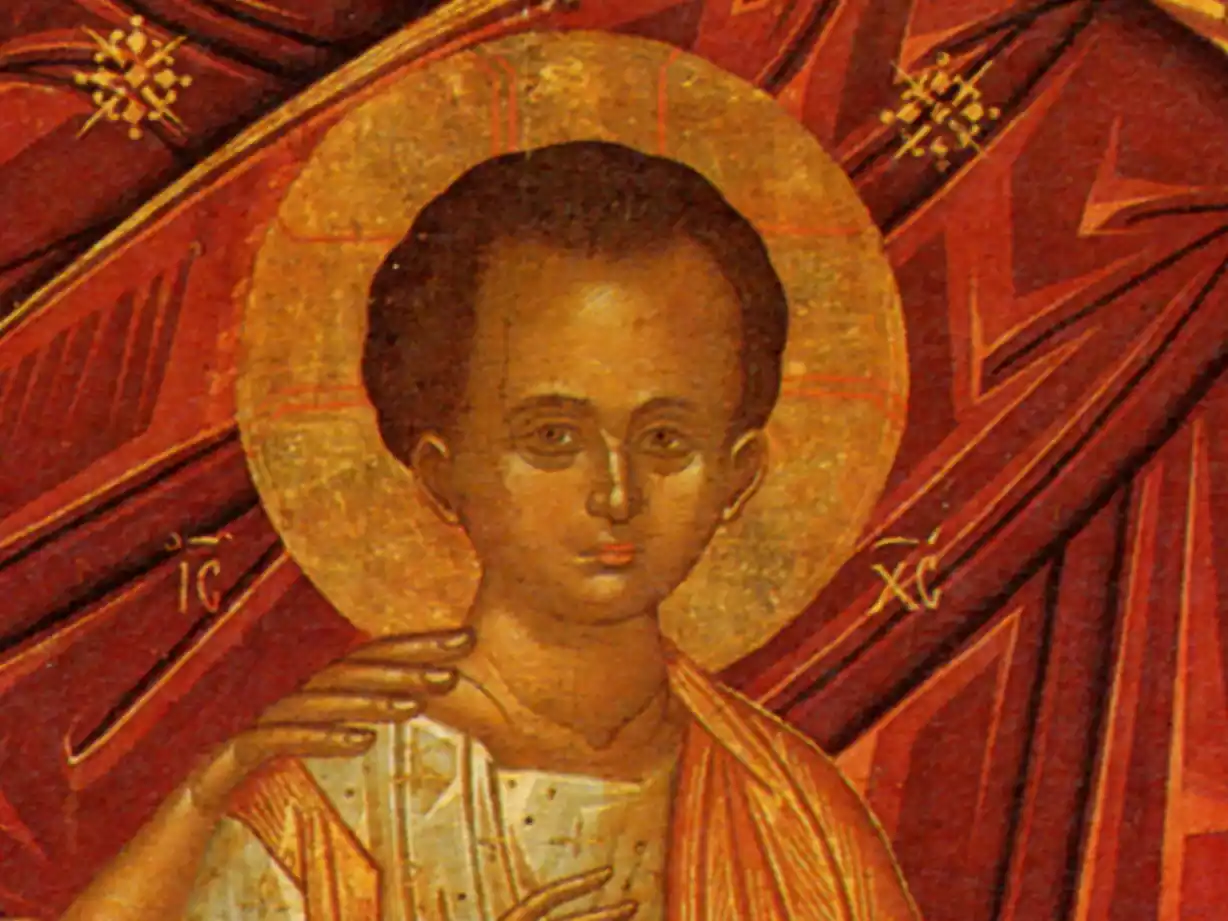
If in the face of the mother serenity dominates, in the face of the child there dominates something more difficult to be rendered in words: the sense that this is not a commonplace infant. The features of Christ, the high forehead, the grave eyes, the mouth without a trace of childishness, follow the familiar Byzantine convention of the “little old man”, where the physiognomy of the infant borrows adult characteristics in order to declare his pre-existing divine wisdom. His hair, brown and curly, frames a gold halo where the monograms IC and XC are discerned.
His garment combines a white chiton with an outer himation in ochre and gold, worked again with dense chrysography which gives the impression of moving light upon the fabric, a bidirectional technique which scholars connect with the Italo-Cretan tradition. His right hand is raised in blessing, the fingers form the familiar symbol, while the left retains a closed scroll, the law which he himself was to fulfil. The slight inclination of the head towards the mother, almost imperceptible, is perhaps the sole detail which reminds that he is, ultimately, also a child.
The prophets and the theme “From Above the Prophets”
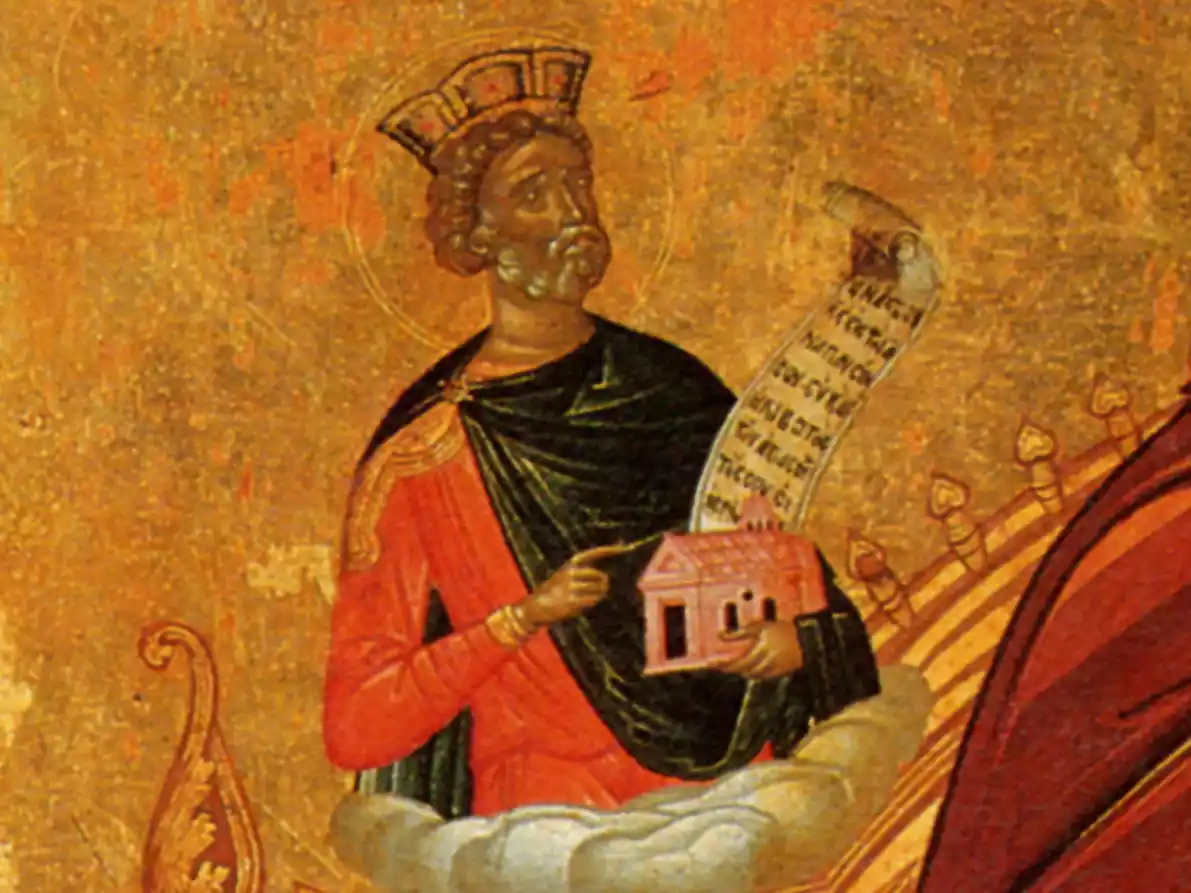
The four figures which flank lower down the composition are not simple bystanders. They belong to an iconographic cycle known as “From Above the Prophets”, a type which bound firmly the Old Testament with the person of the Theotokos, presenting the prophets as witnesses of a promise which the Incarnation was coming to fulfil. One of them, crowned and with an expression of intense attention, holds in his hands a miniature building, a pink edifice with small windows, which refers to the prophecies concerning a temple, whether it is the Temple of Solomon or the vision of a new, spiritual house.
The scrolls in their hands bear text written in minuscule script, difficult to read anymore owing to wear, a practice nevertheless widespread in the icons of this type, where each prophet “recites” a passage which tradition connected with the birth of the Messiah. Similar compositions with the same appellation, Lady of the Angels, are encountered also in other collections of post-Byzantine art, usually attributed to the same Cretan environment and to the same generation of workshops which worked around Ritzos.
This icon, with the six persons flanking her like an invisible court, does not function solely as an object of devotion. It functions also as a dense text, written with colour instead of words, where every detail, from the star upon the forehead of the Virgin to the edifice in the hands of the prophet, bears a meaning which the contemporary spectator needs to decode.
The place of the icon in the history of art
The transfer of such an icon from the workshops of Chandax unto Corfu does not constitute an unusual occurrence for its era. The Cretan painters worked frequently for two markets simultaneously, the Orthodox and the Catholic, adapting their style according to the commission, a practice which scholars describe with the terms alla maniera greca and alla maniera latina. The Ionian Islands, and particularly Corfu, received a great part of this production, since they found themselves under Venetian administration and maintained close commercial ties with Crete until the end of the seventeenth century, when the island fell to the Ottomans and many artists relocated definitively towards the west.
That which makes the specific Lady of the Angels distinct is, beyond the quality of execution, also the good state of preservation of the gold background and of the colours, a rare find for a work of five centuries that passed through so many hands and so many displacements. It suffices for one to observe the hierarchical arrangement of the figures, the relation between mother and child, the symbols of the prophets, in order to perceive the depth of the theological programme which is concealed behind the composition.
The study of such works as historical documents, beyond their liturgical use, permits one to discern the commercial routes, the artistic influences and the technical innovations of an entire era. The Lady of the Angels of Corfu, with her gold background and her six guardians, remains today in the same church where she was found centuries ago, continuing to receive visitors who do not always know what exactly they are looking at.
(This is a translation from the Greek text and the translation was done by Kostas Pappas.)

