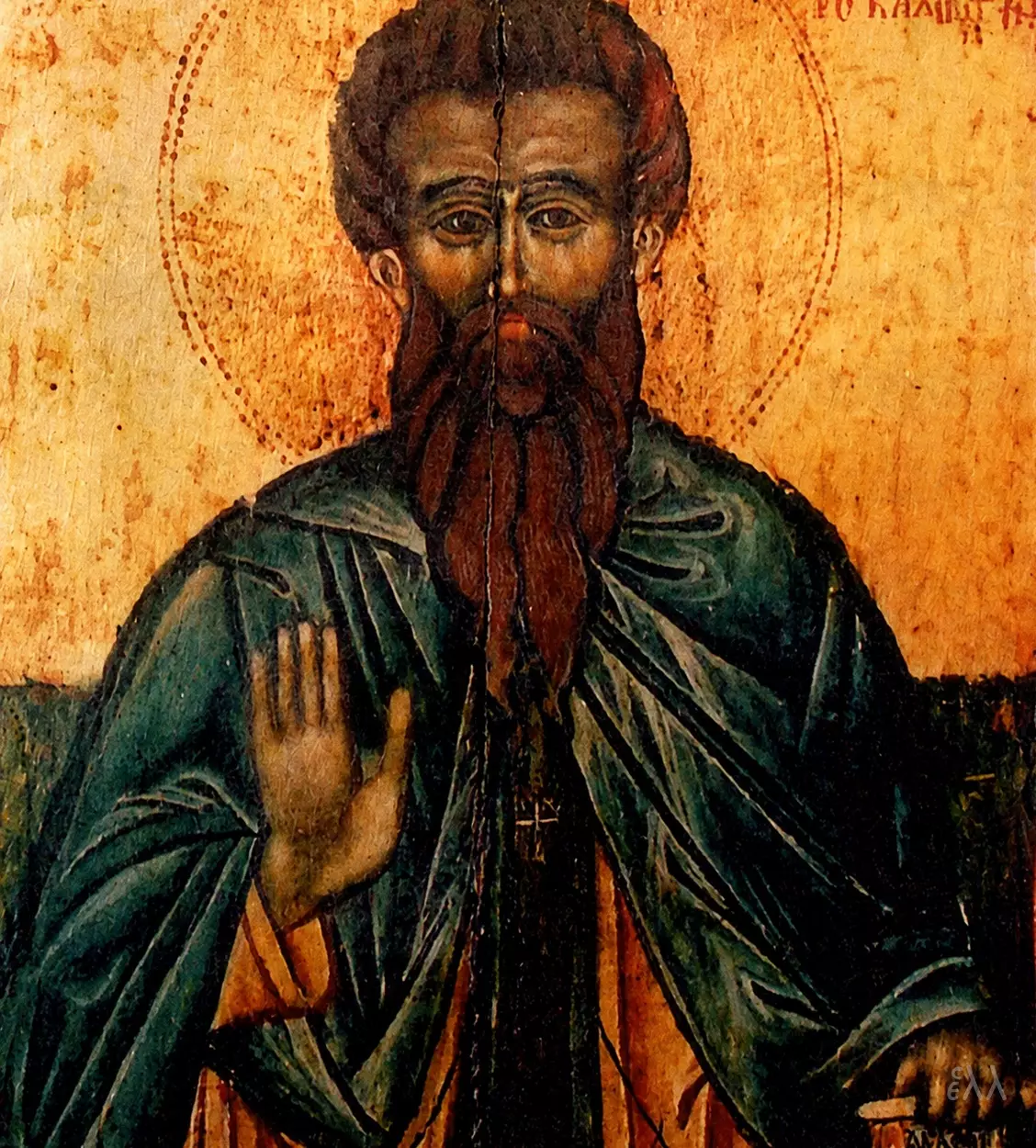
An unknown hagiographer of the seventeenth century fashioned this portable icon, which is kept in the Kyriakon of the Holy Skete of Kausokalybia on Mount Athos, depicting the form of Saint Maximus Kausokalybes, a monk who lived around 1365 and was closely connected with the history of the Athonite eremitic tradition.
Manuel in the world, born in Lampsacus of Asia Minor, abandoned the paternal home when he was scarcely seventeen years old, seeking first monasticism on Mount Ganos and later, after wandering through ascetic centres of Thrace and Constantinople, the path toward Mount Athos. This icon, a sample of the post-Byzantine art that flourished in the Athonite workshops, does not merely depict a face; it records an attitude toward life.
The Art of the Icon of Saint Maximus Kausokalybes and the Life of the Hesychast
The face of Maximus, with auburn hair and a long split beard, emerges before a halo delineated with a double dotted line, a technique frequent in the Athonite painting of that era. His right hand is raised in blessing, while the left rests quietly upon a scroll with a red-letter inscription, almost as if he were still continuing his discourse.
He wears a deep green mantle with rich folding, beneath which is visible an inner garment in an ochre shade, and a small cross suspended from a chain upon his chest. In the upper part of the composition, a red inscription declares the identity of the honoured saint. The life behind this iconography is equally dense.
At the peak of Athos, according to tradition, the Theotokos appeared unto Maximus, calling him to live in complete poverty; from that time he dwelt in desolate places, building a makeshift hut and, as soon as he grew accustomed to it, burning it and departing elsewhere, a habit that granted him the surname Kausokalybes. The icon itself, with the simplicity of the background and the severity of the gaze, seems to wish to render precisely this ascetic rupture with every permanent habitation.
(Translated from the Greek text by K. Pappas)


