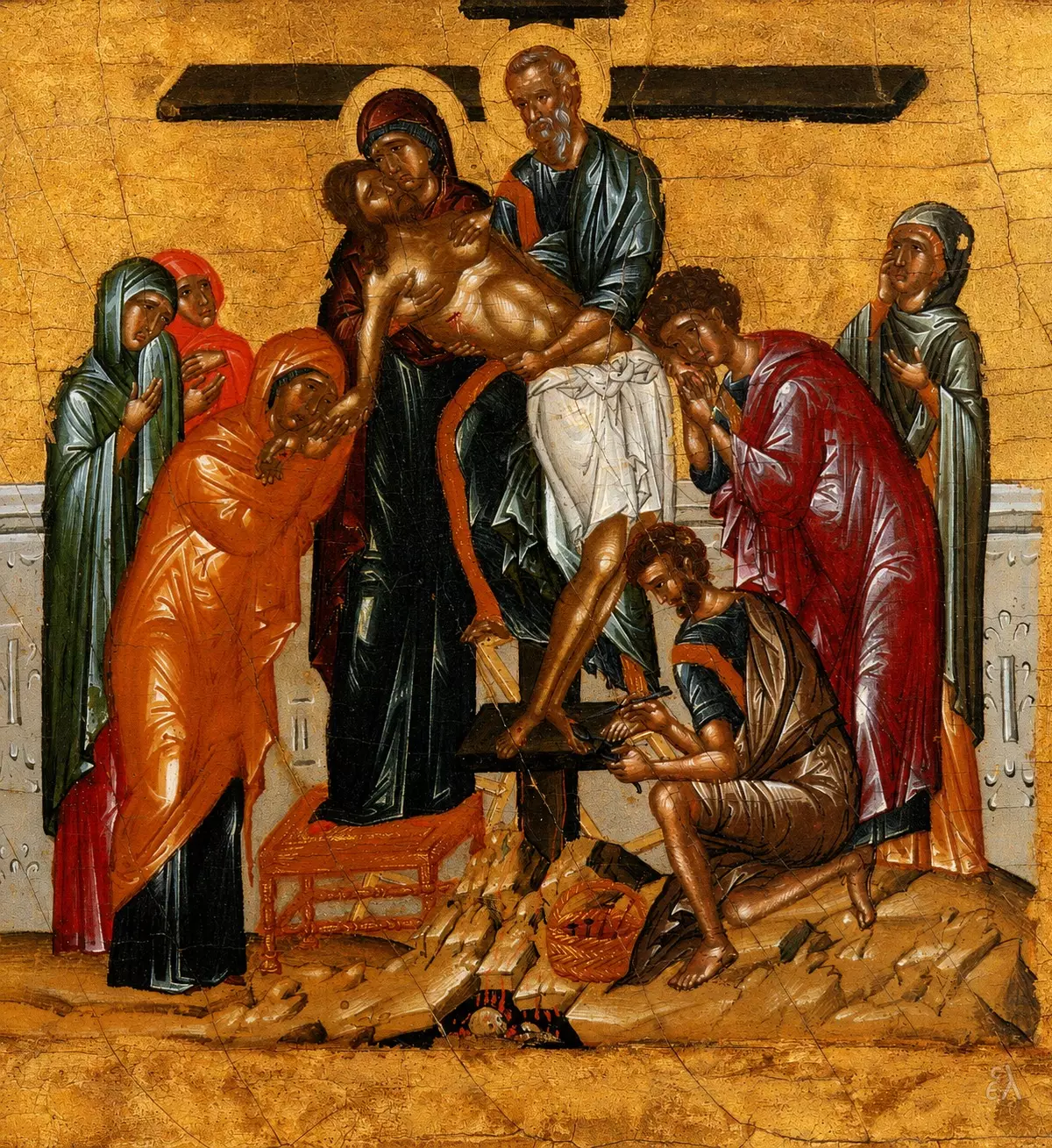
In the Benaki Museum is kept a portable icon measuring 0.87 by 0.65 metres, dated to the second half of the 15th century, which depicts the scene of the Descent from the Cross, namely the taking down of the body of Christ from the Cross immediately after the Crucifixion. It is the work of an unknown painter, most probably originating from a workshop of Crete, of a period during which the island emerged as an important centre of production of religious painting, especially following the fall of Constantinople in 1453 and the relocation there of many painters of the capital.
The composition is organised around the dead body, with the figures, protagonistic and secondary, forming an almost circular nucleus of lamentation, a technical choice that is frequently encountered in the post-Byzantine icon of the Descent from the Cross of the period. The gold ground, a mark of luxury and at the same time a conventional declaration of the transcendent space, covers the entire surface behind the figures, while the cross is faintly outlined in the upper part, with a section of an inscription visible in the right corner.
The icon bears the marks of time; cracks that run vertically through the wood, small flakings in the paint, without however the legibility of the representation having been altered. The subject belongs to the wider iconographic cycle of the Passion and is closely akin to the scene of the Lamentation, although here the emphasis is given to the very moment of the descent, with Joseph mounted upon the Cross delivering the body into the hands of the Theotokos.
The Composition of the Descent from the Cross in Post-Byzantine Icon Art
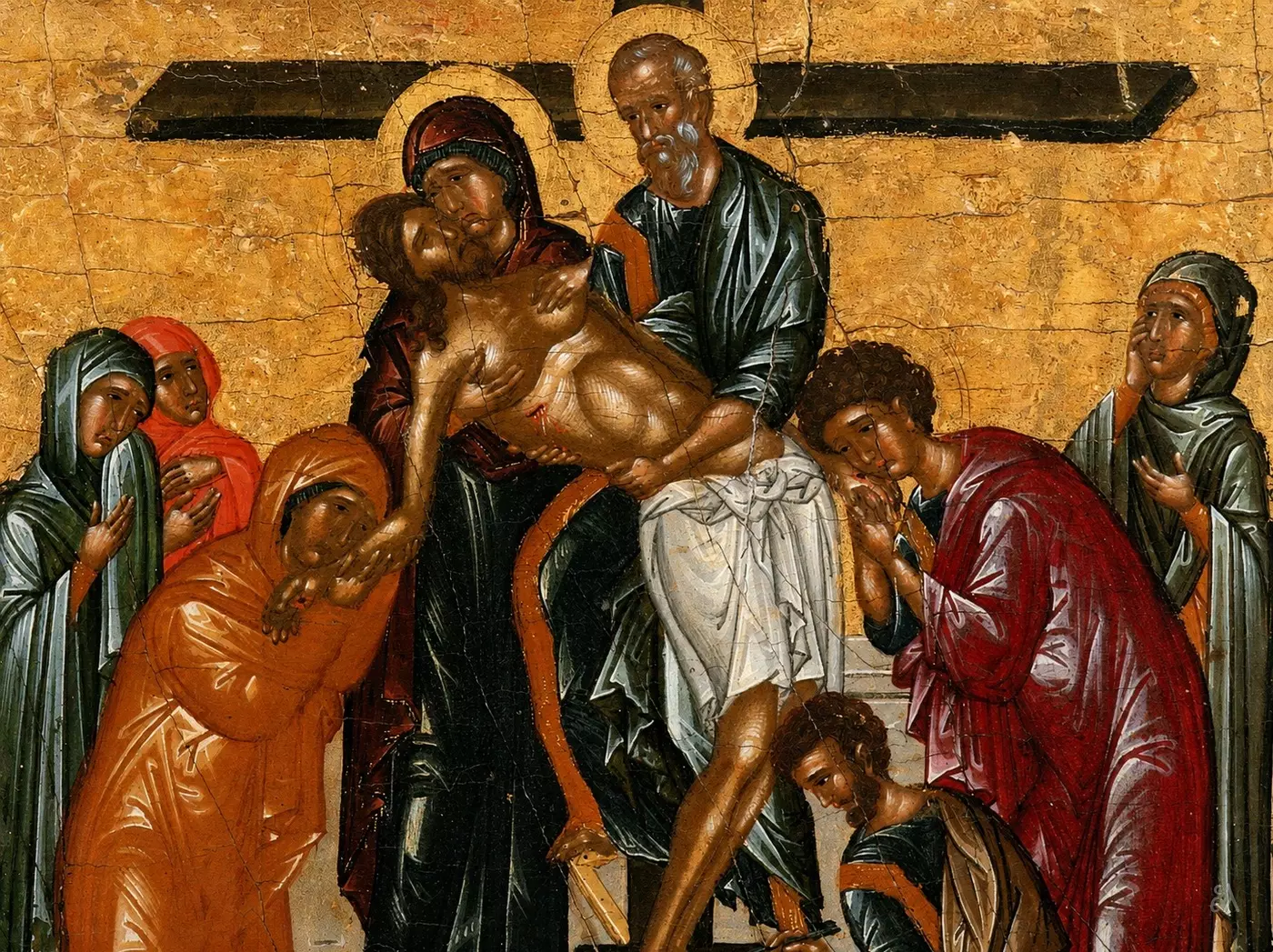
In the centre of the representation Joseph, with a grey beard and deep blue garment, stands on the uppermost step of a yellowish ladder that is barely discernible behind the footrest, his left foot treading upon it, turned towards the Panagia. She, with her deep red maphorion, brings her face close to His and supports Him by the armpits, sharing with Joseph the weight of the body.
The naked body, with the characteristic ochre of the post-Byzantine flesh tones and a fine red brushstroke on the side, hangs between them, clothed only in a white perizoma that folds in sinewy, almost linear pleats. His right hand, low towards the left side of the composition, is brought to her lips by a woman in an orange garment, bowed in a posture of near genuflection; behind her, two further figures, in green and red, look on with hands raised, in a gesture of grief which Byzantine painting had established from early on.
On the right side a young man with a red mantle leans towards the face of Christ, his hand near his mouth in the hesitation of a kiss; behind him, a woman of older age, bringing her palm to her cheek, closes the circle of the lamentation.
The Detail of the Base: The Young Man with the Pincers
In the lower section of the composition, kneeling upon the rocks of Golgotha, a young man with a chiton in brown-gold hues works with small pincers, removing the last nail from the foot of Christ, which extends downwards and rests upon a wooden footstool beside the base of the Cross. A woven basket, where the nails that were removed have already been deposited, stands near him; the rock, cloven in the middle, allows a dark opening to show through, an allusion to the tradition that places beneath Golgotha the tomb of Adam.
This detail, rarely so analytically rendered, adds to the scene an almost narrative tone, closer to the immediacy of an unfolding event than to an abstract theological convention. Works such as this connect the Cretan production of the 15th century with the wider post-Byzantine art that will flourish in the subsequent decades, when painters from Constantinople and the Peloponnese will transfer to the island models and techniques that this workshop appears already to know. The wear on the wood, the cracked gold ground, even the faint inscription in the corner, do not function as deficits; they are evidences of a journey of centuries, which the icon itself carries upon it without commenting upon it.
(Translation from the Greek text by K. Pappas.)


