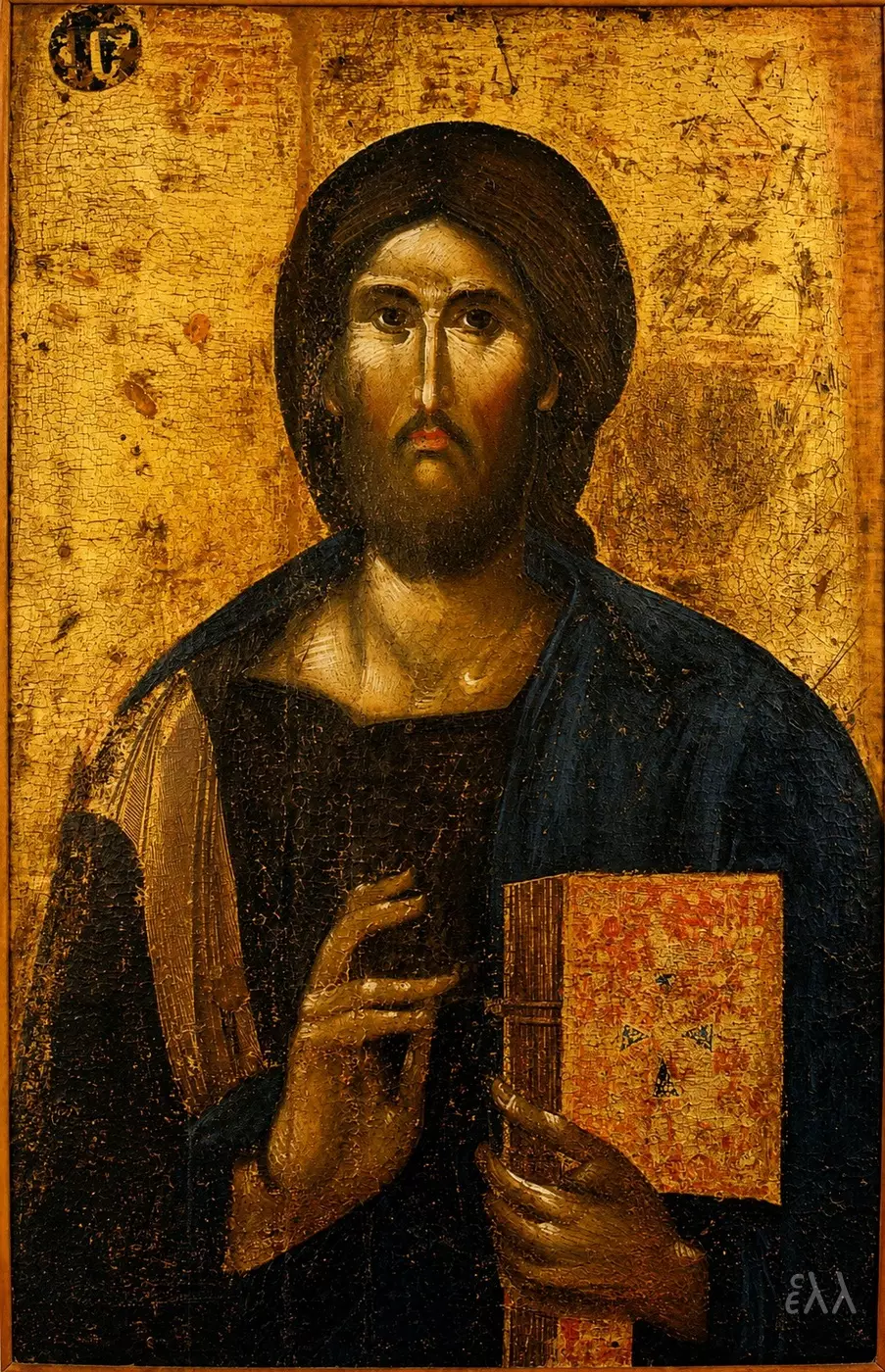
A deep-purple garment, a heavy blue mantle, and a closed gospel resting upon the chest compose the figure of Christ in a rare portable icon of the 14th century, which is preserved today in the Ecclesiastical Museum of Mytilene. Unknown remains its painter, as happens moreover with many works of Palaeologan art which reached us without signature, yet its style places it with relative certainty in the middle of the century, in close affinity with Constantinopolitan workshops of the epoch.
The bust, which reaches down to the waist, follows the established iconographic scheme of Christ Pantocrator, with the static and hieratic presentation of the face overpowering every narrative intention. In his gaze and in his expression coexist the human element and the divine dimension, a balance which the research on the narrative role of sacred representations in late Byzantine painting has repeatedly pointed out. It constitutes a document of painterly thought which renders with density the dogma of the two natures, within a surface slightly larger than a metre.
The Christ Pantocrator Byzantine Icon
Christ is depicted in a frontal posture, with the torso slightly turned towards his right and the gaze turning oppositely, towards his left, giving to the figure an interior tension that scarcely passes unnoticed. With his right hand he blesses, uniting the thumb with the ring finger and the little finger, while in the left he holds a closed gospel with thick pages, so large in dimensions as to cover almost the whole height of the bust.
The deep-blue mantle falls heavy upon the shoulders, leaving free the right hand and bare the robust neck, while the purple tunic is distinguished by a broad gold-purple mark upon the shoulder, the sole precious element upon the austere garment.
The Art of Chiaroscuro in the Detail of the Face
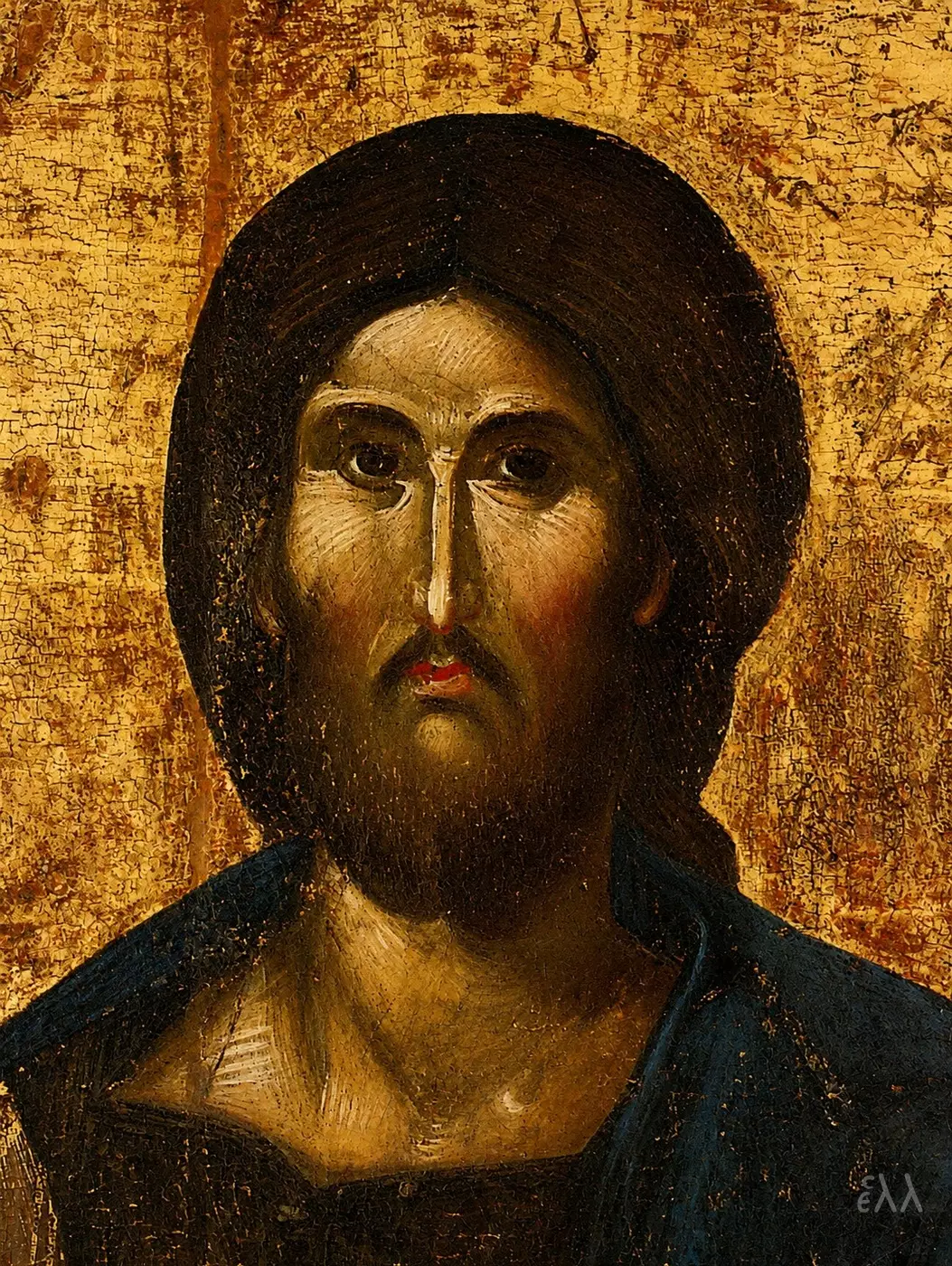
In a closer shot, the face reveals the detailed work of the illumination which gives to the figure its character. The lights are gathered densely upon the forehead, upon the bridge of the nose and around the eyes, creating a harsh, almost unearthly radiance upon the living, reddish colour of the cheeks.
The hair, brown and without superfluous curls, falls simply upon his left shoulder, while the lips retain at least three shades of rose. The gold background around the halo has suffered, as is expected for a work of seven centuries, cracks and small damages, which however do not destroy the lucidity of the composition. The iconographic affinity of the Mytilene icon with a corresponding representation of Christ which is preserved today in the Hermitage, connected with a Constantinopolitan workshop around 1363, led the research formerly to place our work in the third quarter of the 14th century. Particular elements however differentiate the figure from its prototype, an element which transforms it from a simple copy into an autonomous interpretation of an already known iconographic type.
(Translated from the Greek by K. Pappas)


