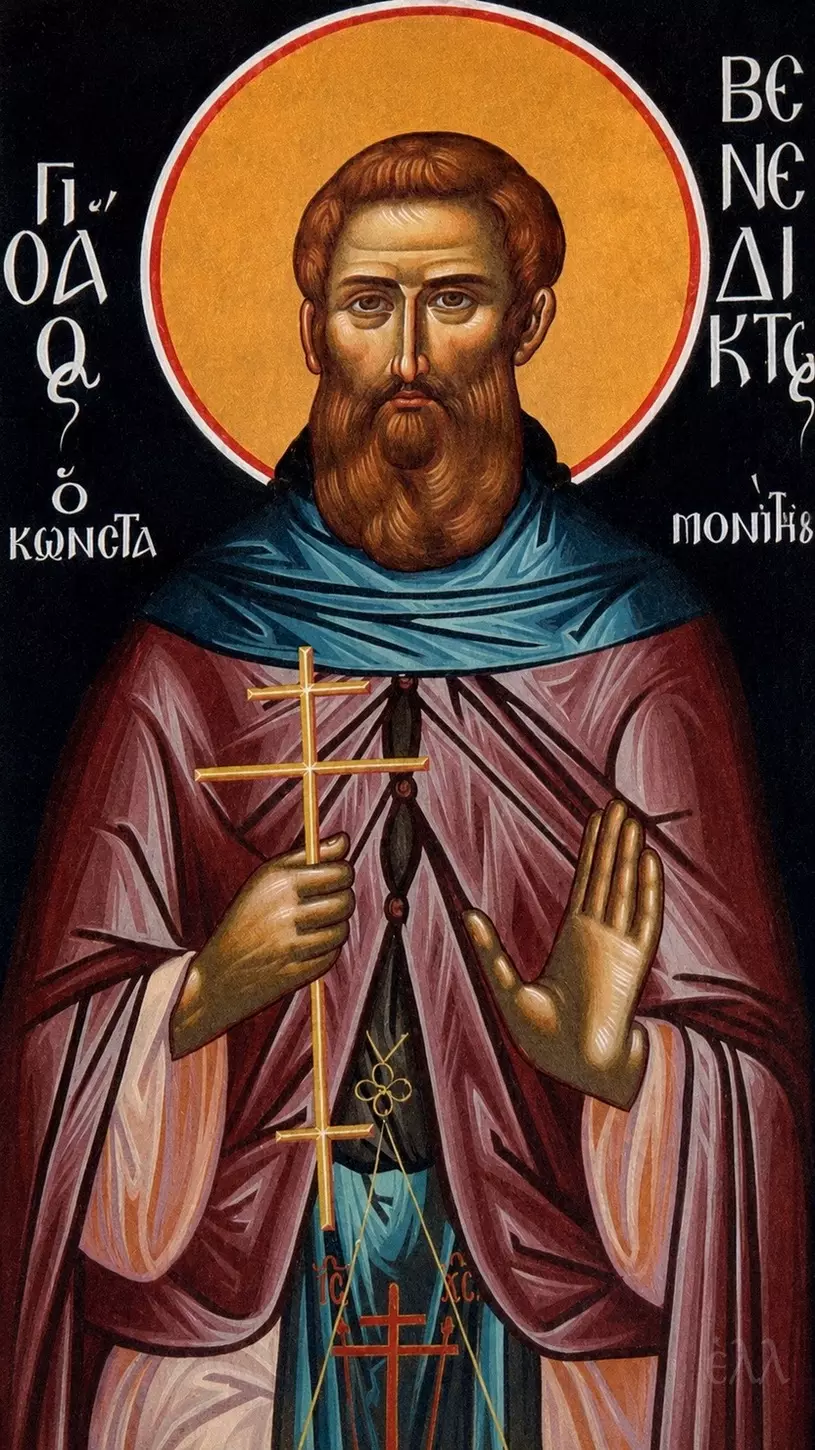
Shown in bust and frontally, with his gaze fixed directly on the viewer, Hieromartyr Venediktos is depicted on the wall of the refectory of Konstamonitou Monastery, among the figures of the Athonite fathers who gave their lives in the years of Ottoman rule. The monk wears a deep blue-green head covering falling in broad folds over the shoulders, while beneath it a purple mantle can be discerned over a dark inner garment, fastened at the chest with a row of small buttons. In his left hand he holds a double blessing cross, made by hand, while the right is raised with the palm open toward the pilgrim, a gesture that in Athonite iconography often alludes to the virginity and ascetic life of the depicted saint. The face, with dense brownish-red hair and a beard framing severe features, is enclosed within a yellow halo bordered by a double perimeter line, red and white. To the right and left of the head, parts of the inscription with his name have been preserved, while lower down his monastic affiliation as a monk of Konstamonitou can be read. The fresco, post-Byzantine in style, continues a long tradition of Athonite painting without being signed by a known painter, which, after all, is a common practice in the workshops of the monasteries. The saint’s life is linked to the years before the Revolution of 1821, when persecutions against Christians in Macedonia intensified, though the image allows nothing of this to surface in the rendering of the face, serene and unmoved despite knowledge of its end.
The figure of the hieromartyr and the technique of the fresco
What first draws the eye in the refectory fresco is not the face but the contrast of colors around it, the deep green-blue of the head covering against the dark background, the purple of the mantle warming the composition. The technique follows the rules of late post-Byzantine mural painting, with a firm drawing and chromatic planes that do not seek the naturalism of Western painting but remain faithful to the abstract logic of the Byzantine tradition. Looking closely at the hand holding the cross, one can see how the painter has rendered the fingers with elongated, almost linear strokes, a technique common in Athonite workshops where anatomical exactitude yields to the symbolic function of the gesture. The cross he holds, with its double crossbar, refers to a type of blessing cross common in monastic liturgical use, not a mere decorative element but an object bound to daily devotional practice. The halo, yellowish and bright, carries no relief ornament, a feature pointing to a simpler, more austere version of the mural tradition, perhaps because of the functional setting of the space, a refectory where the figures of the saints were not intended for veneration but for daily viewing by the monks during meals.
The saint himself was born in the village of Ezova, present-day Dafni in Serres, and at a young age was taken by his father to Mount Athos, to Konstamonitou Monastery, where he too was destined to become a monk for the rest of his life. He was sent to Polygyros in Chalkidiki to be taught the holy letters, returned to the monastery, and received the monastic habit, afterward serving in various obediences of the coenobium, from refectorian to nurse. In advanced age he was ordained priest. The needs of the monastery led him to the metochion of Kalamaria, where he was seized by the Ottomans and taken captive to Thessaloniki. There, after trials, he was beheaded on 12 June together with other Christians. Tradition relates that on that evening a radiant cross appeared above the relics of the martyrs, a sight that convinced the Muslims to allow the burial of the relic. The exact date of his martyrdom remains unknown to the earlier synaxarists, yet details were preserved by his fellow monk Dositheos of Konstamonitou the Lesbian, a source from which the later accounts of his life also draw.


