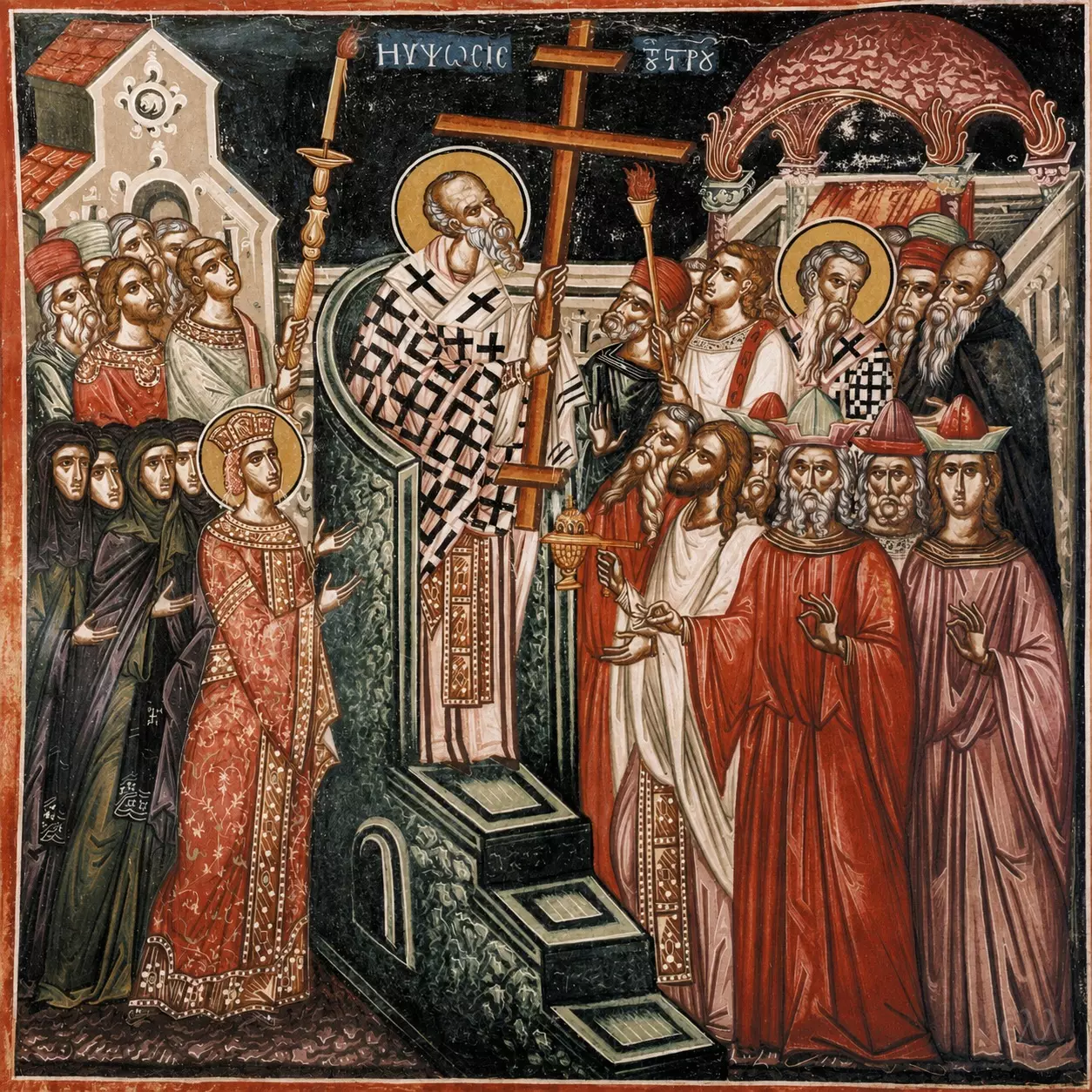
Among the extensive sixteenth-century wall paintings of the Monastery of Saint Nicholas of the Philanthropenoi, on the island of Lake Ioannina, the Exaltation of the Holy Cross occupies a particularly dense and ceremonial pictorial field. The Exaltation of the Holy Cross fresco, dating to the painting campaign of 1542, represents Patriarch Macarius of Jerusalem raising the Cross before an assembled congregation. The monastery itself was an older foundation, associated with the Philanthropenos family from the late thirteenth century, and underwent substantial architectural and pictorial renewal during the sixteenth century under members of the same family. The 1542 campaign covered the remodelled upper parts of the church and the narthex with an ambitious programme of post-Byzantine monumental painting.
At the centre of the scene stands Macarius upon a high, stepped ambo faced with green, marble-like panels. His elevation is physical as well as iconographic. Around him, clergy, women, bearded elders and younger attendants press closely together, while the Cross rises far above their heads, cutting firmly into the dark background. Above the patriarch, a fragmentary Greek inscription begins with the word Hypsosis, “Exaltation,” identifying the event represented beneath it.
The Exaltation of the Holy Cross fresco and its iconography
The subject belongs to the iconographic tradition surrounding the discovery and public elevation of the True Cross in fourth-century Jerusalem. According to the tradition associated with the feast, Patriarch Macarius lifted the Cross so that the gathered people could see and venerate it; representations of the event consequently place the hierarch upon an elevated pulpit or ambo and make the Cross itself the highest visual point of the composition. In the Philanthropenoi wall painting, this basic scheme expands into a crowded ceremonial gathering in which distinctions of clerical rank, imperial status, age and costume are carefully preserved.
Macarius is immediately recognisable as the governing figure. Grey-white hair frames his high forehead, his long beard descending in curling locks over the chest. He wears a white polystavrion phelonion densely patterned with black crosses, its emphatic geometry separating his body from the deeper green of the ambo. Over the vestment, broad bands marked with crosses and ornamental borders reinforce his episcopal identity. His hands, partly enveloped in a white cloth, support the Cross without direct contact. In that cloth appears a small yet significant ritual detail, the handling of the sacred object with ceremonial reverence.
Above him, unusually large, rises the Cross. Its long vertical shaft extends almost from the patriarch’s hands to the upper border, crossed by substantial horizontal members rendered in warm ochre and brown. The painter has given it enough pictorial weight to resist the compression of the surrounding crowd. Around Macarius: beards, embroidered garments, head coverings, candles, architecture; above them, the severe construction of the Cross, immediately legible against the nearly black ground.
Saint Helena and the assembled congregation
Beside the steps stands a crowned and haloed woman in an elaborate red garment, generally identified with Saint Helena. Her status is communicated before any narrative explanation is required. A jewelled crown encloses her veil, ornamental bands articulate the neckline and cuffs, delicate scrolling patterns cover the red fabric from shoulders to hem. Both hands extend toward the elevated Cross in an open gesture of attention and veneration. The traditional narrative associates Helena with the search for the True Cross at Jerusalem under Constantine, while Patriarch Macarius accompanies her in accounts of its discovery.
Behind the empress, several women, wrapped in dark mantles and pressed tightly together, form a compressed group. Their subdued clothing establishes a sharp chromatic interval against Helena’s red and gold. Individual faces remain distinct: one looks upward, another appears to turn toward a neighbouring figure, others direct their attention toward the central action. Overlapping heads repeatedly suggest a congregation larger than the available wall surface could comfortably contain.
A comparable compression governs the opposite gathering. Close to Macarius stands a young attendant holding a tall burning candle, while another clerical figure carries a censer suspended from chains. A second haloed hierarch, white-haired and bearded, appears among the men farther back. Around him rise different forms of headgear—red caps, pale conical coverings, broad-brimmed forms—which give the assembly marked social and visual variety. Several bearded faces project from behind one another so closely that bodies virtually disappear, leaving physiognomies, hands and head coverings to carry much of the narrative.
Ceremony, gesture and visual hierarchy
The scene gains much of its force from vertical ascent and lateral crowding. Horizontally, the congregation presses inward from both sides. Vertically, the steps, Macarius’s tall figure and the Cross create an ascending axis that continues almost to the painted border. The patriarch’s raised arms belong to that movement, as do the candle shafts and the smaller flame nearby. Shorter verticals echo the principal one without disturbing its visual dominance.
Behind the figures rise two architectural zones. A pale building with a steep roof and ornamental façade encloses the group beside Helena; across the composition, a much more elaborate structure rises under a large reddish dome or canopy. Columns, arches, stair-like forms and marble-patterned surfaces create a setting suggestive of ceremonial architecture, shaped through the visual language of the painter’s own period. Between them opens the dark background against which Macarius and the Cross become sharply isolated.
Crowding is handled with considerable discipline. Faces overlap, shoulders vanish behind neighbouring bodies, silhouettes narrow or disappear. Even so, the painter preserves the principal gestures with exceptional clarity: Helena’s extended hands, the patriarch’s grasp of the Cross, the deacon’s raised candle, the hand operating the censer, the attentive movements of the men closest to the ambo. Through these small, carefully separated actions passes much of the narrative information.
The 1542 Philanthropenoi painting campaign
Within the katholikon of the Philanthropenoi survive several successive phases of decoration. An earlier campaign around 1531/32 covered parts of the nave and sanctuary; the remodelling of 1542 was accompanied by another extensive programme, while the three exonarthexes received their decoration in 1560. Official documentation identifies the complete ensemble as a major work of the so-called School of Northwestern Greece, whose monuments occupy an important position in sixteenth-century post-Byzantine painting.
No surviving signature securely names the painter of the Exaltation of the Holy Cross. Scholarship has associated the 1542 decorative campaign with Frangos Katelanos, either through direct attribution or through recognition of his artistic influence. The distinction matters: inscriptional authorship remains absent, while attribution rests upon stylistic comparison. The later campaign of 1560 is connected with the brothers Frangos and Georgios Kontaris.
Within the Exaltation, qualities associated with this northwestern Greek artistic environment are readily visible. There is a pronounced appetite for narrative detail, richly differentiated costume and densely inhabited compositions. Faces receive sustained attention. The elderly men possess narrow, furrowed foreheads, long noses and elaborately separated strands of grey or white beard; younger figures, smoother and more compact features. Helena’s face, surrounded by crown and veil, is treated with a controlled dignity that sets her apart from the darker female group behind her.
Colour, too, carries structural weight. Vermilion and muted crimson dominate the lower half, balanced by deep greens, off-whites, ochres and areas approaching black. The patriarch’s white vestment establishes the brightest large surface in the centre; Helena’s red dress answers the crimson robes and head coverings across the gathering. Small flames introduce points of orange-yellow, while halos create regular circles of warm gold around selected heads.
Line, ornament and the human figure
The painter’s line is firm and highly descriptive. Drapery folds are defined by long highlights and darker interior strokes, sometimes angular, sometimes flowing down the length of a garment. Helena’s robe receives another treatment altogether: its surface becomes an ornamental field of fine vegetal patterns, narrow jewelled bands and repeated decorative motifs. The bishop’s polystavrion is equally patterned, though by a strict grid of black crosses whose repetition gives his vestment ceremonial severity.
Such ornament never completely absorbs the figures. Hands remain active, heads incline at different angles, eyes establish small directional movements through the crowd. Among the bearded men nearest the Cross, especially, slight variations of profile and three-quarter view keep the assembly from settling into a static row. Movement passes in short intervals from figure to figure, then turns toward the raised object.
The surviving painted surface retains a visible network of fine cracks and scattered abrasions. Across architecture, clothing and background alike run these marks, while the principal contours and much of the chromatic articulation remain strongly legible. Along the outer edge, a narrow painted border still encloses the scene and separates its concentrated action from the neighbouring decoration.
At the centre, the extraordinary scale of the Cross determines the arrangement of every surrounding element. Macarius supports it from the elevated ambo; Helena approaches from below; clergy and laity crowd toward it; candles and incense introduce the material signs of ceremony. The dark field behind its upper arm contains little competing detail. Against that near-black expanse rises the warm wooden form above crowns, halos, architecture and the densely gathered heads of the congregation.
(The translation was edited by K. Brown.)