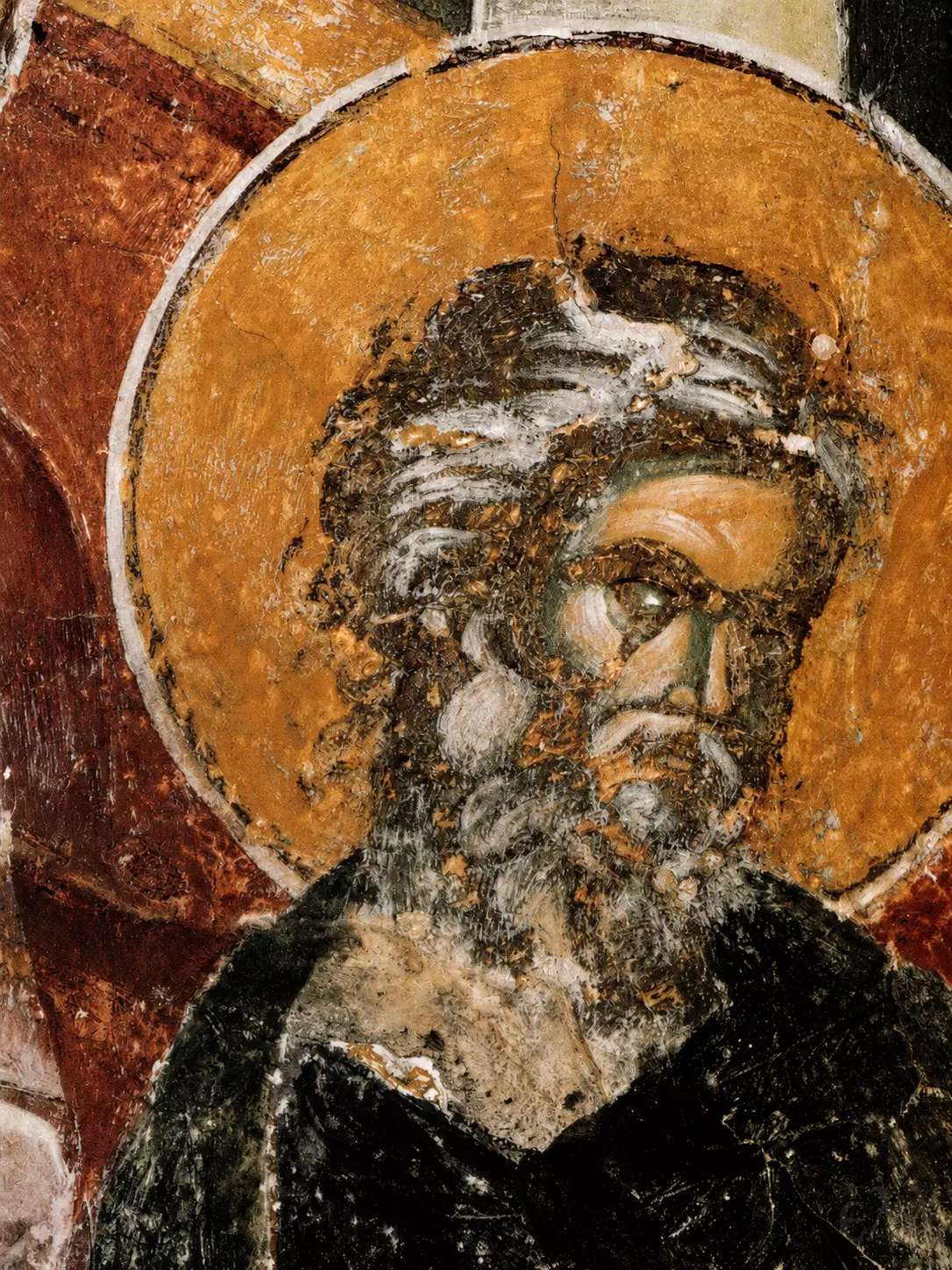
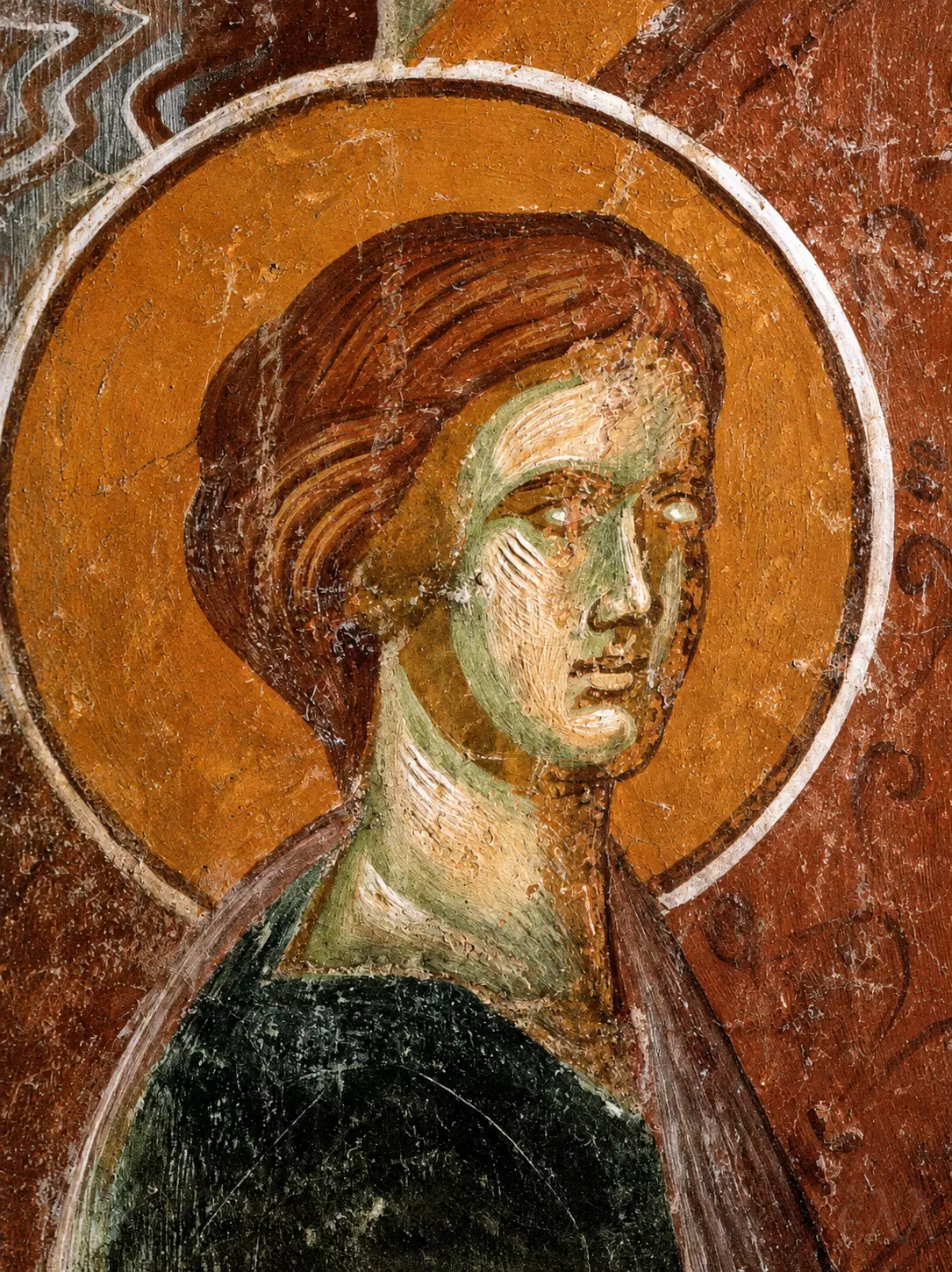
The Unknown Apostles of Pentecost belong to the northern section of the Pentecost wall painting in the katholikon of the Monastery of Pantanassa at Mystras, part of the painted ensemble generally dated to around 1430. Their individual identities cannot be securely established from these surviving details. The two heads nevertheless preserve enough of the original pictorial language to show how carefully the painter differentiated the members of the apostolic group: one is youthful and beardless, the other markedly older, with abundant grey hair and a long, densely articulated beard.
Pantanassa belongs to the final flourishing of monumental painting at Mystras. The church was founded under the patronage of Ioannis Frangopoulos, an important political and military figure of the Despotate of the Morea, whose association with the monument is documented by monograms and an inscription. Within its extensive iconographic programme, Pentecost and the Ascension occupy the upper sanctuary area and bring the Christological cycle towards its conclusion. In the sanctuary, within the vaults and across subsidiary cycles, this distribution follows the carefully differentiated system characteristic of Palaiologan church decoration at Mystras, a subject examined systematically in Dufrenne’s survey.
Doula Mouriki devoted a major study to the Pantanassa paintings, regarding the monument as an especially important witness to artistic developments connected with Constantinople during the last decades of Byzantium. Her published illustrations include two separate details from the Pentecost at Pantanassa, corresponding to the paired close views of apostolic figures considered here. Mouriki’s study places the paintings within the broader artistic circumstances of fifteenth-century Mystras.
Unknown Apostles of Pentecost: Faces, Colour and Late Palaiologan Painting
The younger apostle has a compact oval face framed by a striking mass of reddish-brown hair. Large locks follow the curvature of the skull and turn inward above the ear, their direction established by repeated dark and lighter strokes. The painter does little to soften this structure. Hair becomes almost an independent linear pattern surrounding the quieter geometry of the face, while the broad ochre nimbus, bounded by a pale circular line, enlarges the figure beyond the narrow limits of the surviving bust.
Colour modelling is particularly revealing. Greenish tones remain conspicuous across the face and neck beneath warmer passages of ochre, pink and reddish brown. Against them, pale linear highlights pass over the cheek, run along the nose and continue across the neck. The method gives the face volume while keeping the modelling closely bound to the painted surface. Around the eye the transitions become denser; the dark contour of the upper lid, the iris and the strongly marked eyebrow concentrate expression into a very small area. His gaze is alert yet contained. The mouth, finely drawn and slightly compressed, adds another point of control.
Below the neck, the almost black garment gives the head greater visual prominence. Only limited portions of the clothing remain within the detail, and its dark field leaves the complexion, hair and nimbus to carry much of the chromatic activity. Surface wear interrupts these passages repeatedly. Small losses, scratches and abraded areas are visible around the forehead, cheek and perimeter of the hair, although substantial stretches of the original brushwork remain legible.
The elderly apostle is conceived differently. He has a heavier head and a more rugged physiognomy, the surrounding hair and beard broken into numerous curling strands. Grey, white, brown and dark accents accumulate around the temples and lower face until the beard takes on an unusually dense texture. A broad forehead and powerful eyebrow frame the visible eye; the nose is long and sharply defined, while the mouth is largely absorbed into the complex movement of moustache and beard. Between the two figures, the contrast of age was clearly intentional, introducing internal variation into an assembly whose members share the same sacred narrative space.
Damage is more extensive on the older figure. Abrasion has disrupted parts of the hair, forehead and beard, and a vertical crack crosses the ochre field of the nimbus above the head. These losses can make the surviving modelling appear harsher than it probably was originally. Around the eye and nose, however, enough paint survives to reveal a more controlled handling: warm flesh tones are set beside cooler or greenish areas, followed by sharply placed pale accents defining the projecting forms. The face emerges through successive zones of colour and line, some broad, others reduced to a narrow stroke.
Seen together, the two heads reveal much about the ambitions of the Pantanassa paintings. Apostolic identity is conveyed through differences of age, hair, facial structure and expression rather than through the repeated use of a single physiognomic formula. Such differentiation should not automatically be read as portraiture; the figures remain types within a sacred historical composition. Each, however, has been given a distinctive physical presence, so that the wider Pentecost appears as an assembly of individually characterized apostles.
Mouriki situated the Pantanassa ensemble within the complicated artistic environment of fifteenth-century Mystras and treated it as evidence for the transmission and adaptation of contemporary Constantinopolitan developments. The church itself was built and decorated around 1430, very near the political end of Byzantium, although artistic production at Mystras continued to display considerable refinement. In these two details, that wider setting can still be approached through the surviving handling of individual forms: the curved stroke dividing hair from nimbus, pale lines crossing the flesh, green beneath warmer tones, areas where abrasion now interrupts the beard and forehead.
(The translation was edited by D. Smith.)