
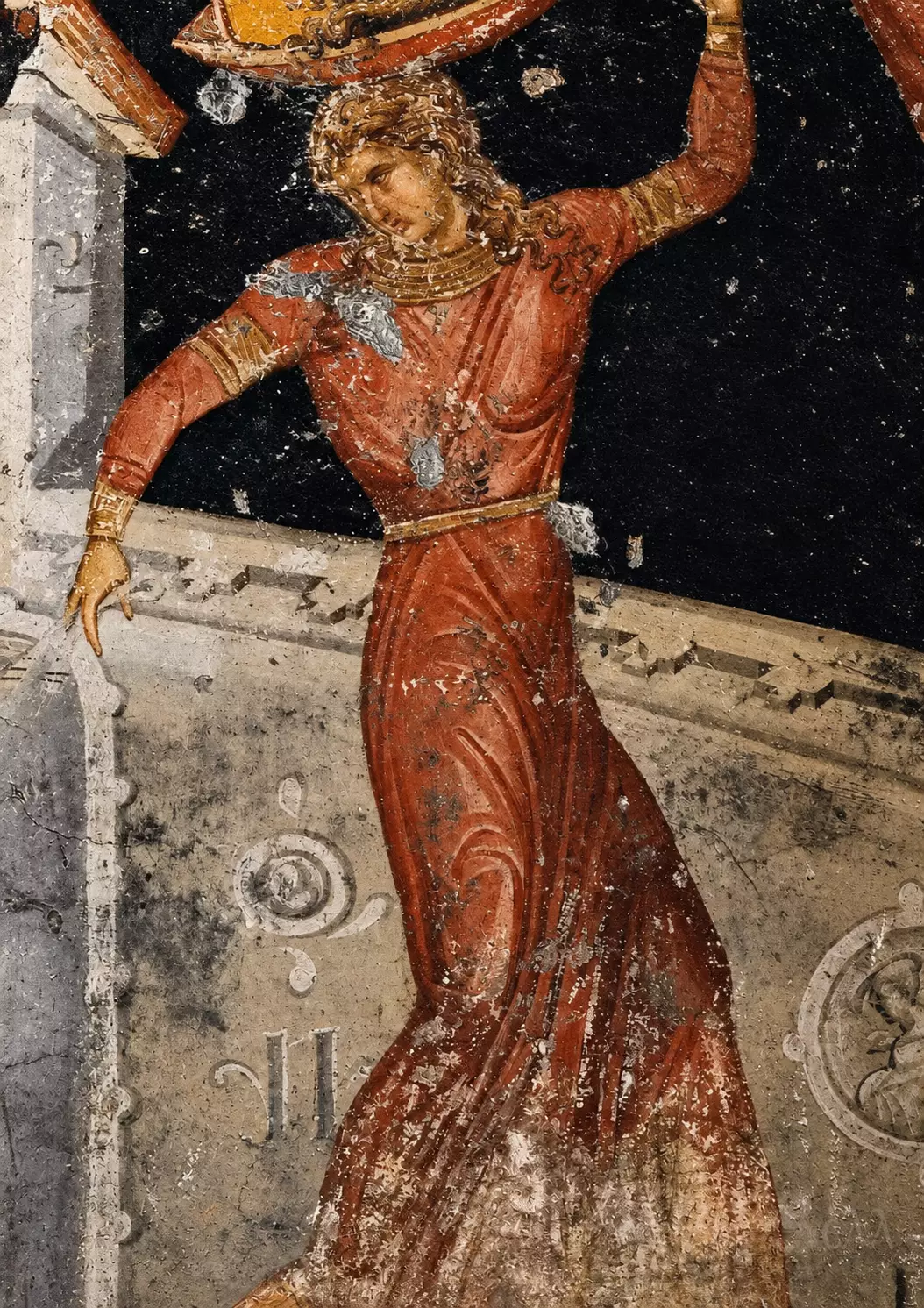
The Salome’s Dance fresco in the Church of the Holy Apostles at Thessaloniki belongs to the cycle of Saint John the Baptist and is generally placed in the early fourteenth century, within the flourishing Palaiologan culture of the city. More precisely, the dancing figure forms part of the Banquet of Herod on the north wall of the chapel dedicated to the Baptist, a composition usually dated to about 1310–20. The church itself had been founded through the patronage of Patriarch Niphon I between 1310 and 1314; after his deposition, his pupil Paul, abbot of the monastery and later remembered as its “second founder”, continued the work. The chronology of the wall paintings is not completely settled, since official documentation also links their execution with Paul’s abbacy after 1314, or even with the years 1328–34.
Within this historical uncertainty, the painting speaks with unusual visual assurance. Salome is not a marginal accessory to the banquet. Her body commands the pictorial field, bent into a long diagonal and set against a dark ground that isolates the red of her garment with exceptional force. The scene belongs to the wider Gospel narrative (Matthew 14:6–8; Mark 6:21–25) in which her dance before Herod leads, at the prompting of Herodias, to the request for the head of John the Baptist. Byzantine painting condenses the episode into movement, gesture and proximity: celebration and consequence occupy the same narrative space.
Salome’s Dance Fresco and Palaiologan Movement
The painter builds the dancer from a sequence of opposed directions. Salome’s torso inclines towards one side, her head turns and dips, one arm falls sharply downward while the other rises above her shoulder. The contour therefore never settles into a stable vertical. It twists, opens, contracts. Even with substantial abrasion across the painted surface, the underlying rhythm remains legible, especially in the curve of the waist and the cascading folds that gather towards the lower hem. The long red tunic does not simply cover the body; its linear folds record the displacement of weight and give the figure a supple, almost calligraphic momentum.
Jewellery and costume sharpen that movement. Bands encircle the wrists and neck, while lighter ornamental elements interrupt the red field at the shoulders, breast and waist. Their small scale contrasts with the broad sweep of the garment. Above the pale marble-like parapet, the black background removes almost every incidental distraction, leaving the dancer suspended between decorative architecture and narrative action. The parapet itself, with circular and linear motifs, supplies a horizontal counterweight to the figure’s diagonal stance.
This sensitivity to rhythm belongs comfortably within the sophisticated visual language of Palaiologan Thessaloniki. The wall paintings of the Holy Apostles have long been connected with Constantinopolitan artistic practice and, in particular, with the refined pictorial world associated with the Chora monastery. Official descriptions of the monument emphasise their idealism, grace and close relation to the capital. Such qualities do not imply immobility. In narrative scenes, elegance could become a vehicle for rapid gesture, psychological transition and the controlled animation of drapery. Salome’s figure is a concentrated example: aristocratic in costume and proportion, yet restless in posture.
The complete Banquet of Herod extends beyond the surviving view of the dancer. The composition is arranged on either side of a small window, with the banquet occupying one side and the dance the other, so that the architecture of the chapel participates directly in the narrative division. Salome consequently performs in a pictorial zone that is both connected to and separated from Herod’s table. The arrangement gives her a remarkable degree of autonomy. Her movement becomes an episode in itself before the eye returns to the sequence of cause and outcome.
The representation also belongs to a broader Byzantine concern with the social and moral ambiguity of dance. Discussions of women in dance show how female movement could acquire sharply different meanings according to narrative context. In the Salome story, grace is deliberately unstable. The painter gives the young woman elegance, ornament and fluidity without converting the image into simple admiration. Her physical poise belongs to a story whose outcome is already present above her.
The Head of John the Baptist: Detail
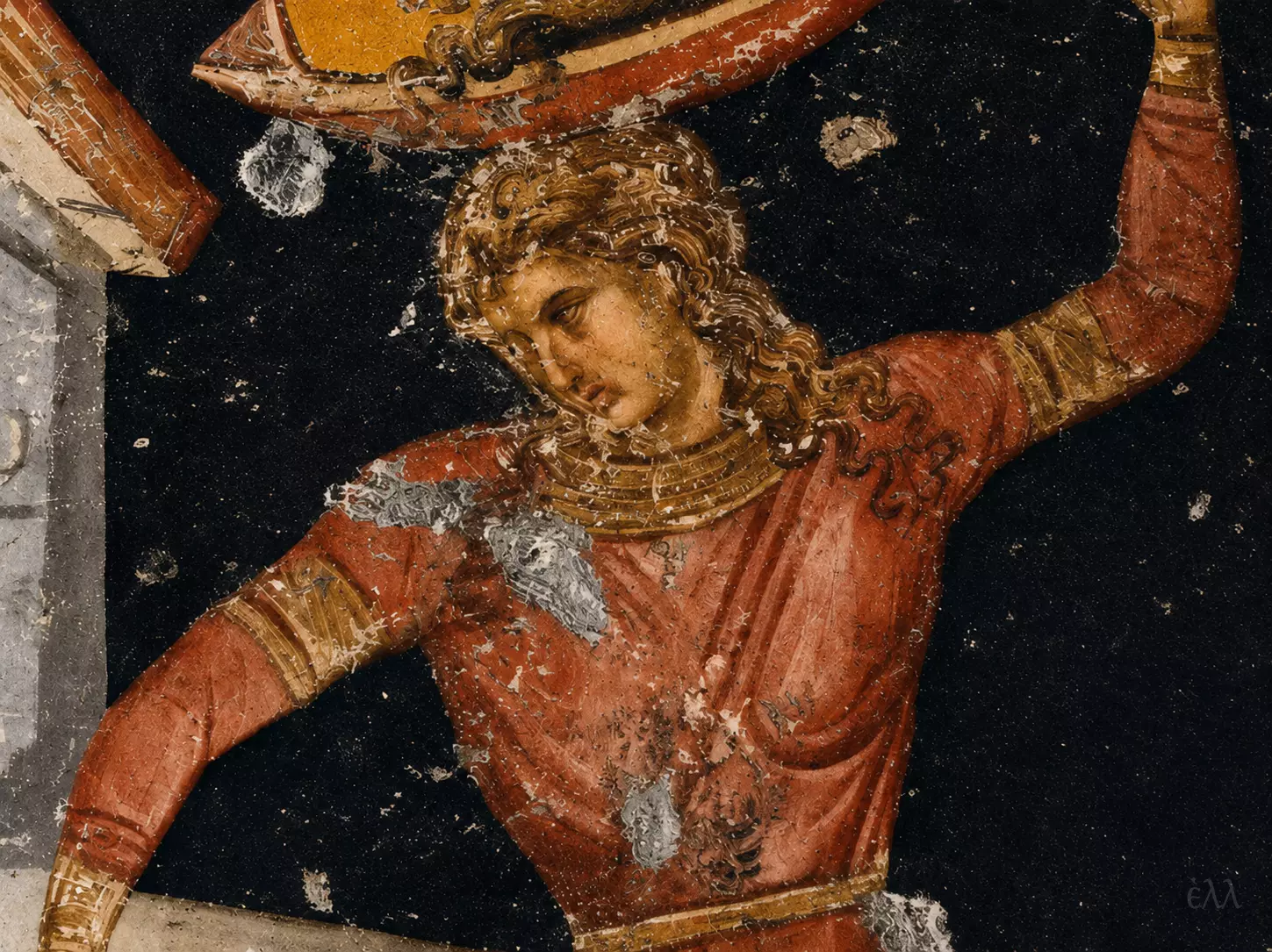
In the closer view, the relationship between dance and consequence becomes considerably more compressed. Above Salome’s inclined head appears the head of John the Baptist on a shallow platter, framed by a golden halo. The circular nimbus is one of the most stable geometrical forms in the image. Below it, Salome’s curls, tilted face and raised arm create a cluster of intersecting curves and diagonals, so that stillness and motion are brought into immediate contact.
The treatment is discreet. There is no insistence on physical violence. John’s face is rendered with closed eyes and a composed expression, while the halo preserves the sacred identification of the martyr within the narrative. Salome, by contrast, is defined through the instability of her pose. The juxtaposition is formal before it becomes interpretive: a circular sacred sign above, a turning living body below; gold and dark ground behind the head, red and flesh tones around the dancer.
Surface loss is especially visible in this area, with numerous small interruptions across the faces, garments and background. Yet the essential design survives. The head, platter and halo remain readable, as do the finer strands of Salome’s hair and the layered bands at her neck. What remains is enough to show the confidence of the painter’s linear organisation. The episode may have been conceived within a larger narrative cycle, but in this surviving passage the entire drama has been reduced to a few carefully balanced elements: a lifted arm, a bowed head, the circular halo, and the long red figure continuing its dance beneath it.
(The translation was edited by E. Alexandraki)