The Apostle Peter fresco at Panagia tou Arakos belongs to the extensive painted decoration completed in 1192 for the monastery church at Lagoudera, Cyprus. Its patron was Lord Leon, son of Authentes, while the identity of the painter remains uncertain. The frequently proposed attribution to Theodore Apseudes, who worked at the Enkleistra of Saint Neophytos in Paphos in 1183, is plausible but unconfirmed. What survives at Panagia tou Arakos is among the most complete ensembles of Middle Byzantine mural painting on the island, a work closely informed by the artistic culture of Constantinople.
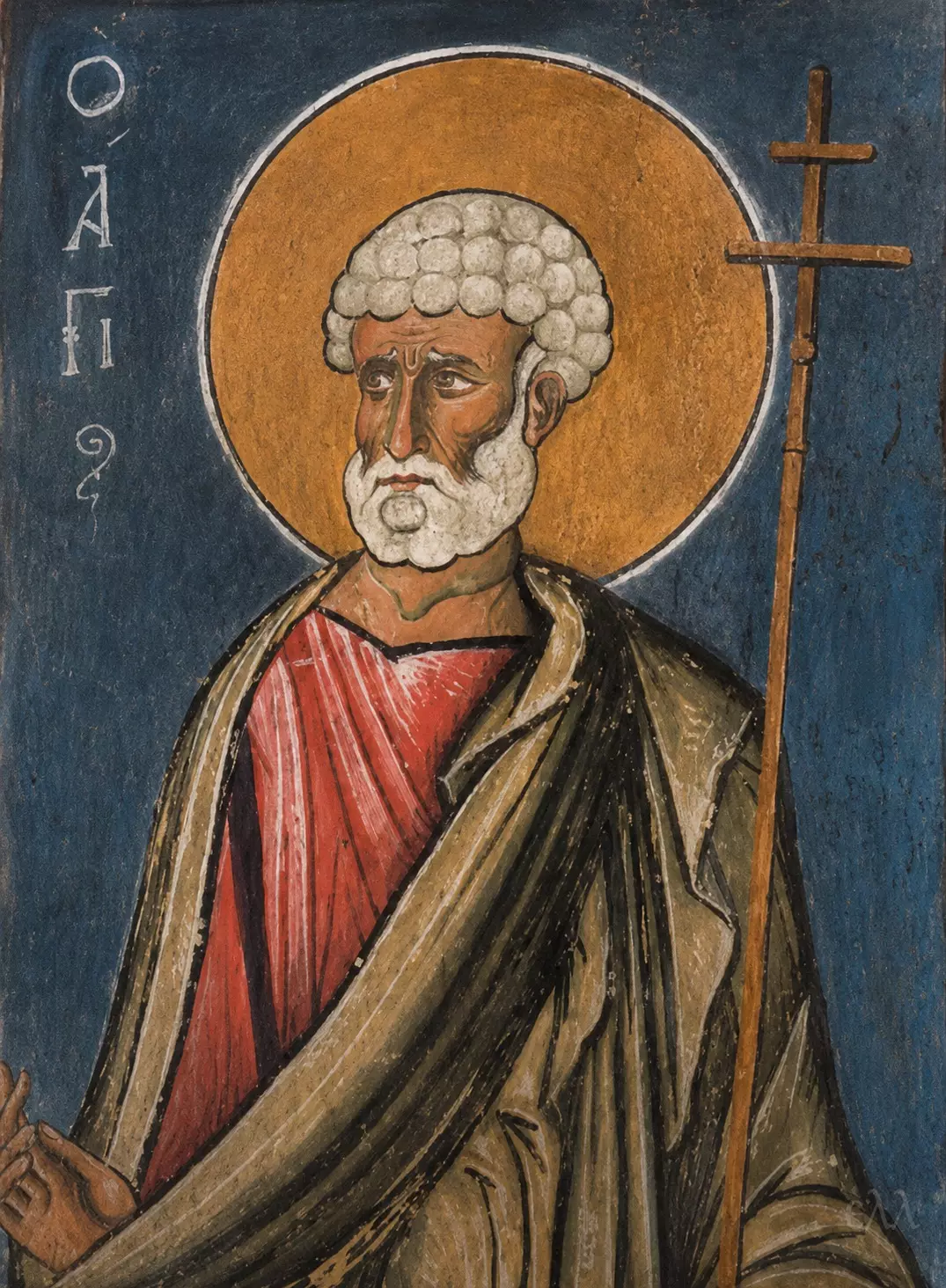
Peter appears as an elderly, nearly frontal figure whose face is turned only slightly to one side. White curls gather around his head in compact, rounded clusters; the beard, equally pale, is arranged in broader masses beneath the cheeks. His characteristic physiognomy would have made him immediately recognizable to a Byzantine viewer, even without the fragmentary identifying inscription beside the halo. A tall staff surmounted by a double-barred cross rises beside his left shoulder, introducing a severe vertical line into the composition. Below, part of his right hand remains visible in a restrained gesture.
The Apostle Peter Fresco at Panagia tou Arakos
The artist has concentrated unusual expressive force in Peter’s face. Deep furrows cross the forehead, descend between the brows and continue around the eyes, yet they do not produce a simple image of physical age. They construct an interior state. The apostle’s gaze, directed obliquely beyond the pictorial field, appears sombre and alert, while the tightly closed mouth introduces a note of reserve. There is no theatrical movement. Expression emerges through the pressure of line: the angular bridge of the nose, the dark contours beneath the eyes, the abrupt highlights on the brow and cheeks.
Such facial modelling belongs to the sophisticated language of late Komnenian painting. The human figure had acquired a heightened psychological intensity during the twelfth century, often expressed through elongated forms, agitated drapery and sharply articulated features. Peter’s head is comparatively compact, but the same sensibility remains evident in the restless passage from light to shadow. His face has weight and dignity, although its structure is governed by linear rhythms rather than naturalistic softness.
Color, Drapery, and Monumental Form
An ochre-gold nimbus, enclosed by a narrow white line and a darker outer contour, isolates the apostle’s head against the deep blue background field. The contrast is immediate. Pale hair, warm flesh tones and the luminous halo establish the visual center, while the surrounding blue lends depth without creating a natural setting. To the left of the head, the surviving letters of the Greek identifying inscription form a second vertical accent.
Peter wears a rose-red chiton beneath a heavy ochre-brown himation. Fine white strokes animate the chiton, whereas the mantle is constructed through broad passages of olive, brown, cream and black. Its folds sweep diagonally across the torso, gather around the shoulder and fall in long, broken bands. The body consequently appears substantial, even though its volume is never described anatomically. Drapery supplies the structure. Dark cavities alternate with pale highlights, turning the mantle into an arrangement of intersecting planes whose movement stops abruptly at the rigid cross-staff.
The restrained palette seen in this figure forms part of a considerably richer chromatic program. Official documentation describes the murals, commissioned in December 1192, as the island’s most complete surviving ensemble of Middle Byzantine monumental painting and notes that some scholars have associated their anonymous master with Theodore Apseudes.
Panagia tou Arakos and Komnenian Painting in Cyprus
The church’s painted cycle developed during a moment of political upheaval, shortly after the Crusader conquest of Cyprus. Yet the artistic language remains connected to Byzantine metropolitan traditions. Monumental figures, expressive faces, dynamic folds and intense color contrasts reveal a workshop thoroughly familiar with late twelfth-century developments, whether through direct Constantinopolitan training or through their circulation among accomplished Cypriot masters.
Panagia tou Arakos was included in the UNESCO World Heritage List in 1985 as one of the Painted Churches in the Troodos Region. UNESCO identifies its Komnenian wall paintings as works of exceptional artistic quality, closely associated with Constantinopolitan practice. Within that celebrated ensemble, the figure of Peter is especially concentrated: aged flesh, curling white hair, a muted garment, an unwavering cross. The result is both austere and intensely present.
(The translation was edited by P. Alexiou.)