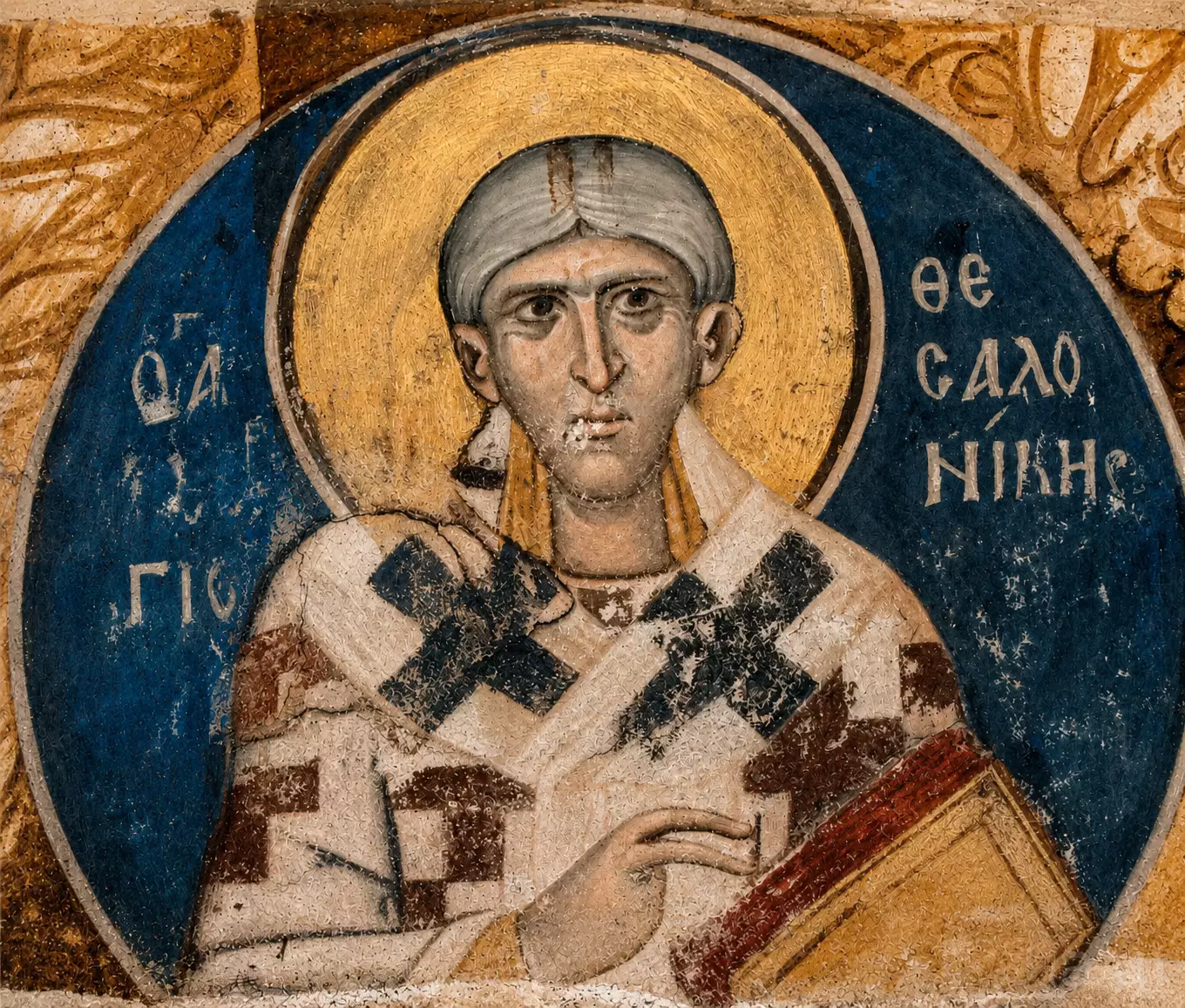
Within the dense iconographic program of the early fourteenth century on Mount Athos, the Saint George of Thessaloniki fresco occupies a position of quiet authority. Located on the north wall of the prothesis in the Katholikon of the Holy Great Monastery of Vatopedi, this mural dates to the major decorative campaign of 1312. Thessalonian painters, working in a stylistic idiom closely allied with the monumental achievements of Manuel Panselinos at the Protaton, executed the extensive cycle covering the church interior. The portrait preserves the likeness of an obscure eleventh-century hierarch, a figure rarely cited in standard hagiographical literature or synaxaria. Placed chronologically between two prominent metropolitans of the city, his inclusion here serves as a vital document for local ecclesiastical history. Oral tradition firmly links the bishop to a monastic cell belonging to Vatopedi itself. The artists anchored him securely within a spatial and theological framework dedicated to figures profoundly tied to the monastery’s own ascetic lineage.
Physiognomy and the Palaiologan Gaze
The visual presence of the saint commands immediate attention through its severe, unembellished individualism. Depicted as an elderly man, he presents a highly unusual physiognomy for an Eastern hierarch. The face, ascetic and sharply contoured, remains entirely beardless. His white hair, parted precisely down the middle, falls flatly against his head, hugging the skull before ending abruptly near the ears. This specific facial type ensures his immediate recognition among the multitude of heavily bearded patriarchs surrounding him.
The almond-shaped eyes, deeply set beneath arched eyebrows, lock onto the viewer with a penetrating, direct quality. The painter—masterfully controlling the transition from shadow to light—built the flesh tones over a dark proplasmos, using linear white highlights to define the taut skin across the cheekbones and the furrowed brow. A massive, burnished gold nimbus frames the head, separating the figure from the deep, lapis-toned blue ground. Significant surface abrasion and paint loss have afflicted the lower portions of the face and neck. The lime plaster substrate lies exposed across the chin and mouth.
Episcopal Vesture and Inscriptional Evidence
The garments articulate his ecclesiastical rank with geometric rigidity. He is vested in a polystavrion phelonion, the customary white mantle densely covered with dark crosses, indicating his high episcopal status. Over this, the broad band of the omophorion drapes across his shoulders, its large, block-like crosses visible despite the degraded condition of the pigment layer. The heavy, stark patterns of the vestments establish a flat, almost architectural base that contrasts with the volumetric modeling of the facial features.
The damaged state of the lower register makes it difficult to decipher the precise arrangement of his hands. A swelling in the drapery on the viewer’s left suggests the concealed right arm of the figure, raised perhaps in a gesture of blessing or supporting a heavily bound Gospel book. Flanking the luminous halo, the identifying titulus survives in fragmented white majuscule lettering. On the left side of the pictorial field, the abbreviated forms for “Saint George” and “Bishop” are partially legible. On the right, the word “ΘΕΣΑΛΟΝΙΚΗΣ” (of Thessaloniki) remains sharply defined against the dark background. The blue pigment of the background overlaps the incised guidelines of the halo slightly.
Contextualizing the Thessalonian Workshop
The artists responsible for the 1312 Vatopedi decoration brought the refined aesthetic of the empire’s second city to the monastic republic. Their work embraces a monumental naturalism, an approach that emphasizes corporeal weight alongside intense psychological interiority. Line, pigment, form. The basic elements coalesce into a portrait of formidable gravity. In this specific depiction, the painters prioritized a solemn, introspective characterization over decorative appeal. The composition balances a static hieratic frontality with the inner life radiating outward from the bishop’s eyes.
The brushwork, clearly visible in the surviving passages of the upper face, demonstrates fluid handling. Opaque layers of tempera interlock to create subtle chromatic shifts across the high forehead, while thin, calligraphic lines define the individual strands of the hair. The Saint George of Thessaloniki fresco thus functions simultaneously as a theological anchor within the prothesis—the chamber where the Eucharistic elements are prepared—and an accomplished example of late Byzantine portraiture. The stylistic affinities with neighboring Athonite monuments reinforce the existence of a mobile network of craftsmen operating across the region. A thin vertical fissure disrupts the plaster near the outer edge of the left shoulder, trailing down into the unpainted masonry.
(The translation was edited by P. Alexiou)