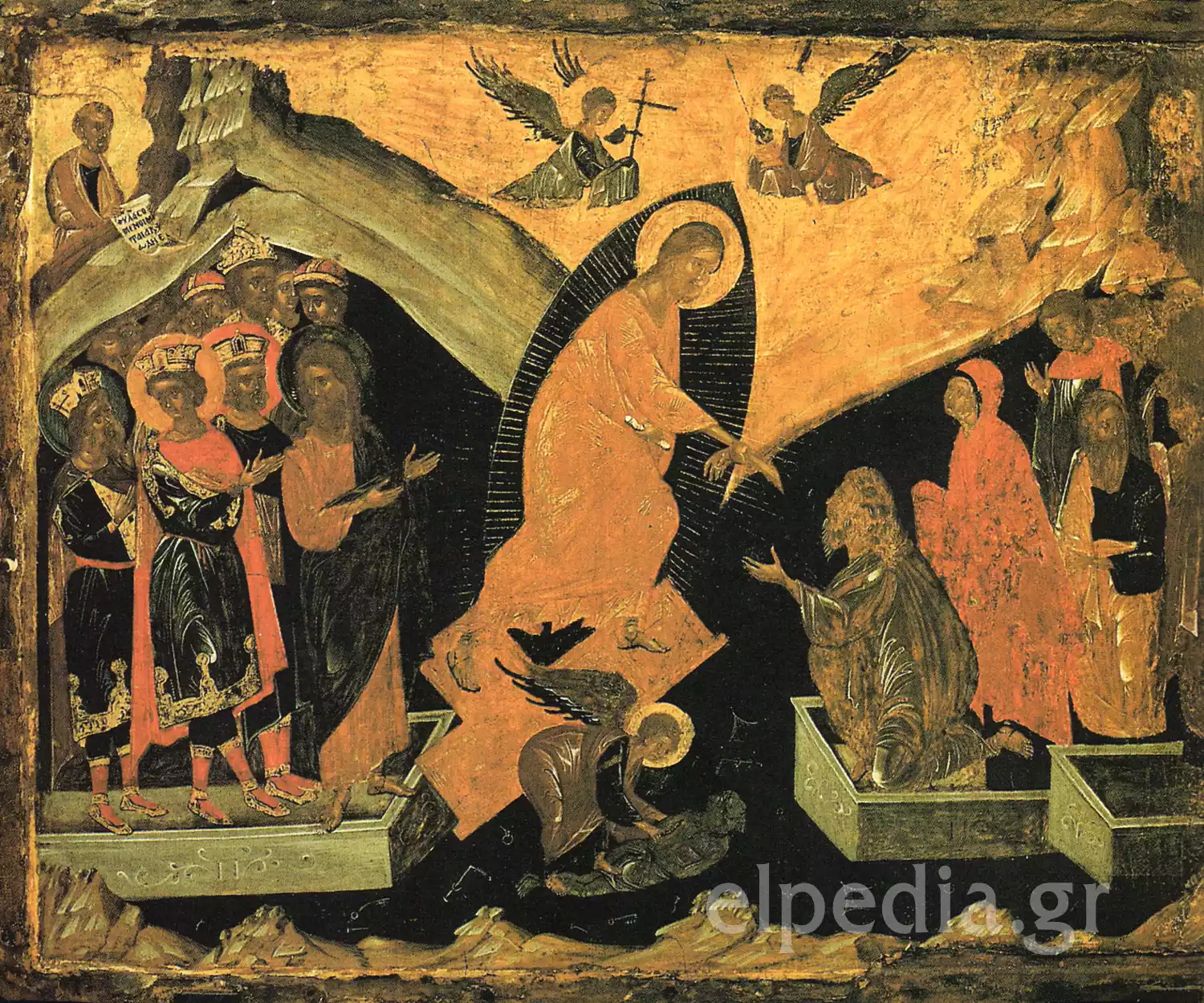
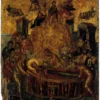
A portable panel in egg tempera, the work of an anonymous painter of the sixteenth century, is preserved among the collections of the Hellenic Institute of Byzantine and Post-Byzantine Studies in Venice. It stands as one of the densest in meaning among the specimens of post-Byzantine iconography that passed, together with their creators, through the Greek workshops of the city. At the centre of its composition, Christ is depicted at the moment he overthrows the dominion of death, breaking into the bowels of Hades to free the souls of those who had awaited redemption for generations. This representation, known in common parlance as the Resurrection, although its official iconographic name remains the Descent into Hades, ranks among the most dramatic compositions of Orthodox art, combining as it does theological depth with intense narrative movement. Painted probably by an artist issuing from the Cretan tradition, or at the very least deeply influenced by it, the icon bears the typical hallmarks of the workshops active within Venetian territory after the Fall of Constantinople, when a multitude of Greek icon-painters carried their techniques into the West in search of new patronage. The wooden support, covered with layers of gesso and gold leaf, receives a composition dense with figures, in which every detail, from the garments to the expressions, bears witness to the maker’s familiarity with an iconographic tradition centuries old.
The Composition of the Descent into Hades: An Analysis of the Central Scene
A golden ground, almost immaterial in its density, covers the entire depth of the representation and transforms the space into something beyond a geographical place. Within this light there opens a dark fissure, the mouth of Hades, out of which the figure of Christ emerges. Surrounding him is an almond-shaped mandorla, its interior almost black, pierced by dense white rays radiating outward — a convention which in Byzantine painting signifies the uncreated light, that which is not produced but has existed from all eternity. Above the mandorla, two angels with wings outspread hold the cross and the symbols of the Passion, balanced in a posture that resembles nothing natural at all, nor need it.
To the left of the composition, within a cavernous opening recalling a tomb rather more than a prison, stands the group of crowned kings of the Old Testament, their hands raised in an attitude of supplication. To the right, two open tombs of grey stone house Adam, kneeling, and behind him other figures awaiting their turn. Between them, low down, a dark personified figure, bound in chains upon scattered planks and ironwork, renders Hades himself as a vanquished power. The lower portion of the panel bears slight damage to the paint — traces of time which nevertheless take nothing away from the clarity of the narrative.
This is no mere illustration of a miracle. The composition functions as a theological argument painted, in which Christ’s movement towards the left, contrary to the customary direction of reading, underscores the violence of the liberation. Red and orange dominate in the garments, in contrast to the dark, almost black robes of the kings — a chromatic opposition which organises visually the twofold theme of death and life without requiring any inscription whatsoever.
The Righteous of the Old Testament: The Crowned Kings
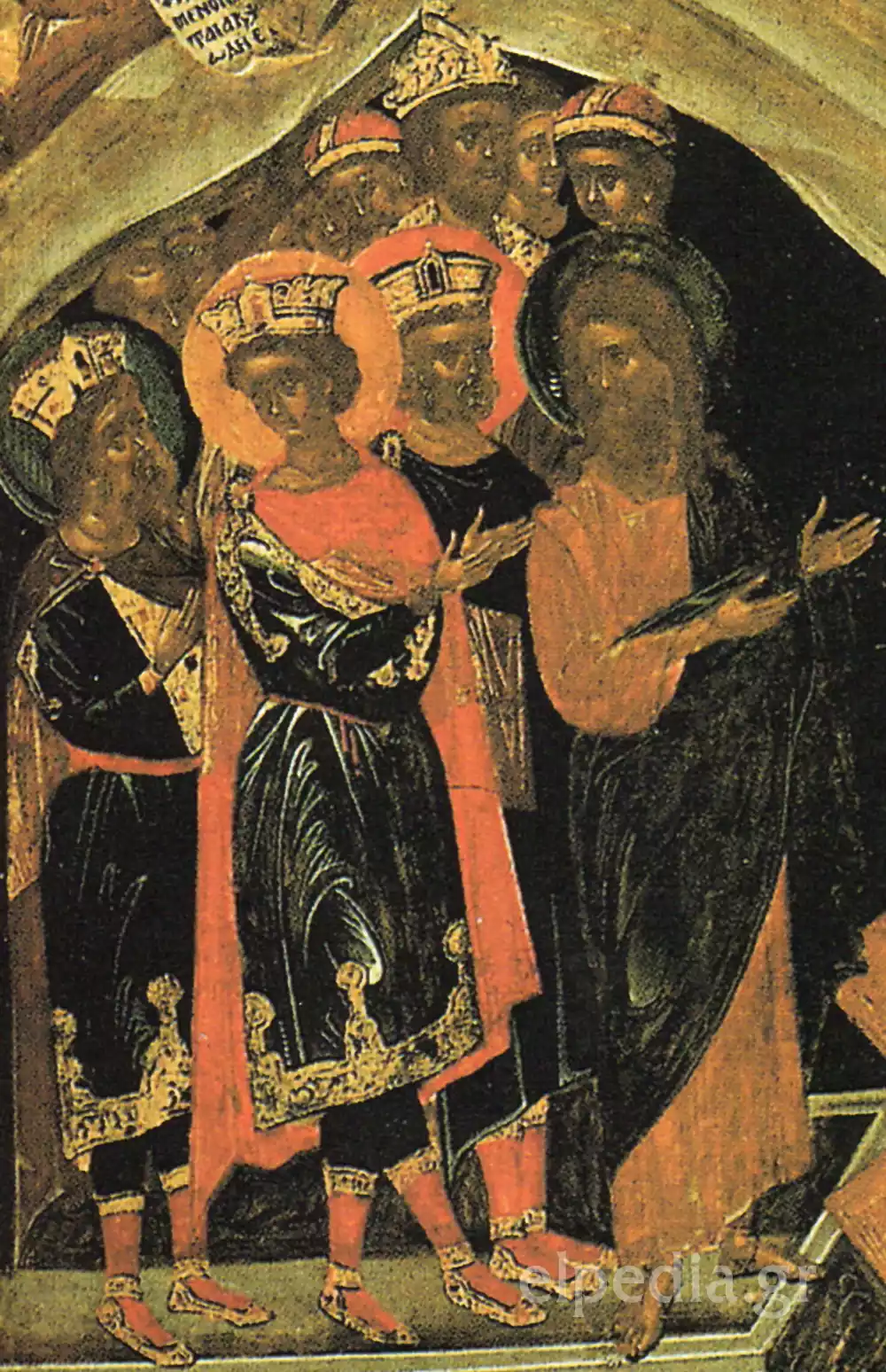
In the detail cropped from the left-hand side of the composition, the figures of the kings acquire a proximity which, in the icon as a whole, is lost within the crowd. Two dominant figures stand out clearly in the foreground, wearing rich crowns set with multicoloured inlays and pearls, while behind them other heads press close together, some with simple coverings, others with crowns of lesser splendour. The haloes overlap one another, creating a visual congestion which the painter does not appear to have sought to avoid — quite the contrary, he made use of it to signify the multitude of those who awaited salvation.
The garments carry deep green and black across the main body, with rich gilded ornamentation along the lower edge, where motifs recalling imperial fabrics, rather than simple priestly vestments, may be discerned. Over these falls a purple cloth, perhaps a chlamys, fastened at the shoulder, an element which reinforces the royal identity of the figures — probably David and Solomon, the two kings whom the hymnography of the Resurrection commemorates most frequently among the righteous. Their hands, open before them in an attitude of prayer, create a series of gestures repeated with slight variations, more like a score of movement than a chance pose. At the right-hand edge of the detail, part of the figure of Christ may be discerned, his halo very nearly cutting across the frame, a composition suggesting that the beholder’s gaze must move from the kings towards him, following the same direction that redemption itself follows.
Christ, Adam and Eve: The Detail of Redemption
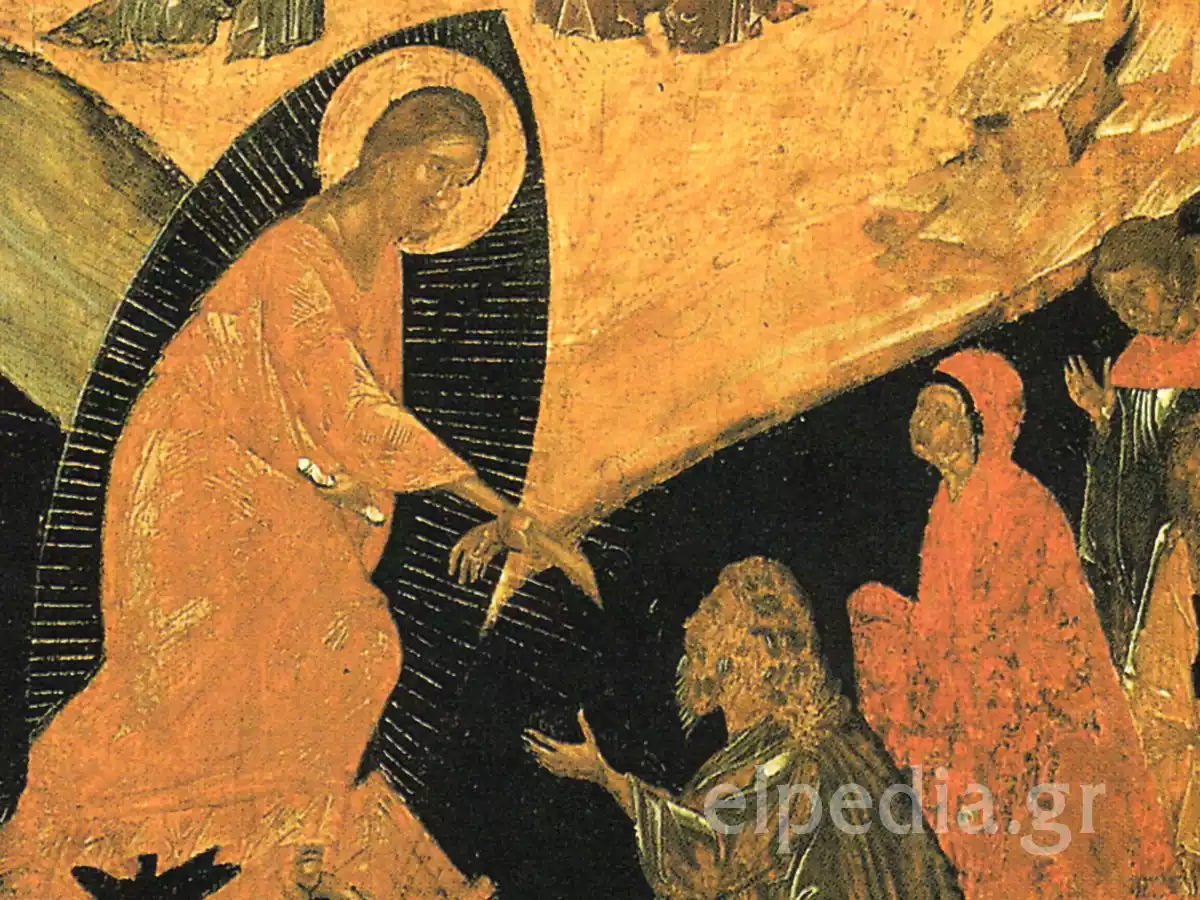
The second detail focuses on the exact opposite end of the composition, where the mandorla of Christ meets the tombs. His face, inclined slightly downward, bears a restrained expression, without any trace of triumph in the worldly sense of the term. The garment, deep orange with golden striations rendering the folds, is illuminated by fine, almost linear brushstrokes of gold — a technique known as assist, reserved in Byzantine painting exclusively for the garments of divine persons.
Christ’s hand extends towards a kneeling figure with curling hair and a beard, probably Adam, who returns the gesture with his own hands open, in a movement that is not yet a grasp but the preparation for the grasp, the instant immediately preceding contact. Behind him, a second figure in a red garment and head-covering, possibly Eve, observes the scene with hands half-open, in a posture retaining something of hesitation and something of hope. The two open tombs, rendered with geometric precision in the shape of a rectangular block, function as a scenic element emphasising the materiality of death, in full contrast to the immaterial light of the mandorla above them. The line of the rock, dark and almost coarse, closes the composition like a stage curtain only just drawn aside.
It is evident that the painter worked upon this section with particular care, perhaps because here is concentrated the theological centre of gravity of the entire representation: the very moment of redemption, not as an abstract concept but as a gesture between two hands.
This icon, as happened also with many comparable works that passed through the hands of Greek painters in Venice, did not serve a devotional purpose alone. It functioned as a vehicle of memory for a community living far from its homeland, keeping alive a visual language shaped over centuries in Byzantium and now adapted to new circumstances, between two worlds that never entirely ceased to communicate.
The study of such works as historical documents, beyond their religious function, uncovers the roads that art followed together with the people who carried it. Greek workshops operated in Venice for decades after the Fall of Constantinople, serving at once the diaspora and a Western market that had discovered its own interest in Byzantine aesthetics. Within this framework, the Descent into Hades constitutes no isolated phenomenon but a link in a long chain of production, in which each workshop retained its own characteristics within the shared iconographic model.
The details examined — the crowned kings and the instant of contact between Christ and Adam — compose together a narrative in which the individual and the collective coexist without friction. The work remains today accessible to the public through the collection of the Hellenic Institute, one of the very few institutional bridges still connecting present-day Venice with the long Greek presence upon its waters.
(This is a translation from the original Greek text, translated by K. Pappas.)

