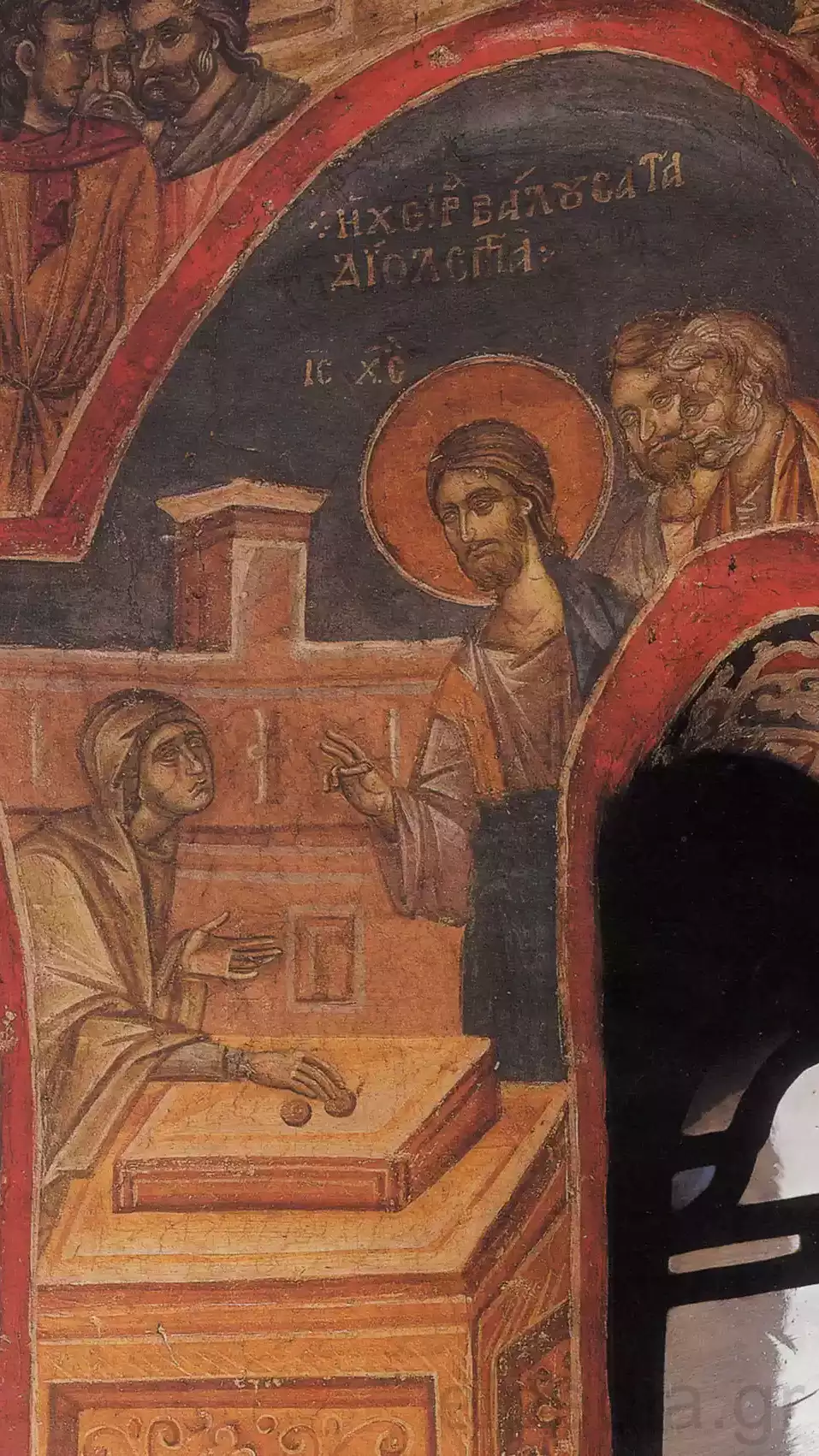
In the katholikon of Hilandar Monastery, on Mount Athos, there survives a fresco devoted to one of the most human episodes of the Gospels, known by the title Christ Praising the Widow’s Mites. It is dated to the second decade of the fourteenth century, when workshops of painters coming from Thessaloniki undertook the decoration of the church, without, however, the name of the craftsman who signed it with his brush having been preserved. Whoever stands before it today beholds two figures in direct dialogue: Christ with his hand raised in a gesture of approval, and a woman wrapped in a dark maphorion who lets two small coins fall into the treasury of the Temple of Jerusalem.
The narrative derives from the Gospels according to Mark and according to Luke, where Jesus observes rich men depositing abundant money into the treasury, while a widow offers the least that she possesses, two mites, coins of the smallest value even by the standards of her own time. Christ then points out to the disciples that she gave more than all the others, since she offered not out of her abundance but gave all that she had to live on. A rare subject, this, for monumental painting.
It focuses on a person without name and without social standing, in contrast to the usual preference of Byzantine iconography for emperors, hierarchs, and saints of recognisable identity. The fresco is integrated into the wider programme of the katholikon, alongside scenes from the Twelve Great Feasts and the Passion, an ensemble extensively documented in the monastery’s archival records. Despite the repainting it received in the early nineteenth century, at the hands of the monks Benjamin and Zacharias, natives of Galatista in Chalkidiki, the original composition remains legible as regards its design and its iconographic structure.
The Scene of the Widow’s Mites at the Treasury
The composition is organised around two points of tension, the treasury on the left and the figure of Christ on the right, while between them intervenes the space in which the gesture of the offering unfolds. The background is covered in a dark blue, almost inky colour, characteristic of Palaiologan fresco painting, which functions as a scenic backdrop capable of bringing out the luminous tones of the faces and the garments. Above the figures, a built structure with a small pediment suggests, in summary form, the architecture of the Temple, in accordance with the Byzantine convention of rendering space not realistically but as a symbolic frame of reference.
Christ wears a chiton in an ochre and pink hue, covered by a himation of dark grey-blue colour, while his halo, outlined with a white line and filled in a brownish-orange hue, sets him apart at once from the other figures. His hand is raised in a gesture of speech, with the two fingers extended, a sign both of speaking and of blessing at once, while above the scene an inscription in capital lettering can be discerned, referring to the phrase concerning the hand that cast the two mites, beside the customary monogram IC XC.
On the left, the widow bends over a wooden chest rendered in a linear, almost architectural manner, letting two small coins fall onto its surface. Her head is covered by a dark maphorion that closely frames the face, while behind Christ two further figures can be made out — the disciples — silent observers of an act that needs no further words to be understood.
The Disciples Watching the Gesture
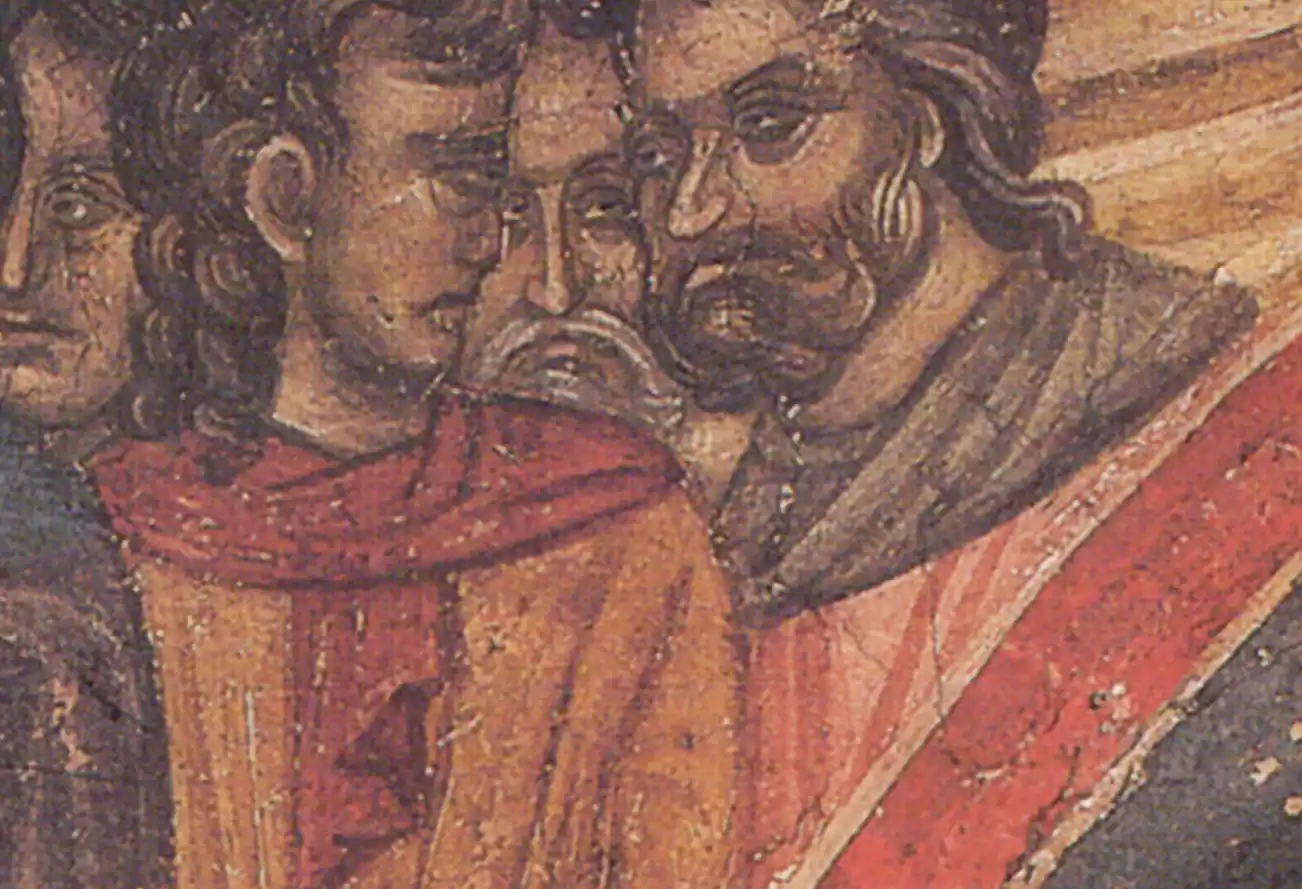
On the left side of the scene, the ravages of time have not impaired the delicacy with which the faces of the disciples were rendered, crowded one beside another in a narrow space. The painter differentiates each figure with care, giving one a thicker, curly beard, another a sparser and shorter one, while the hair ripples in a deep brown colour with lighter highlights at the tips of the locks.
The eyes, sunken beneath arched brows drawn with a dark line, look in different directions — one gaze turned straight towards the scene of the offering, the other lower, as though the mind of the figure had already grasped the meaning of the gesture before it had time to follow it to the end. The garment of the first figure, in a vivid orange-red hue, falls in folds accentuated by white lines of light, a technique that lends volume to the fabric without resorting to excessive detail.
This insistence on the individuality of each face, rather than the repetition of a generic disciple-type, is regarded by scholars as a hallmark of the Thessaloniki workshops, where, in the early fourteenth century, painters of Panhellenic renown were active, among them Manuel Panselinos and the Astrapas brothers — without this meaning that the present fresco is directly connected with any one of them.
The Face of the Widow
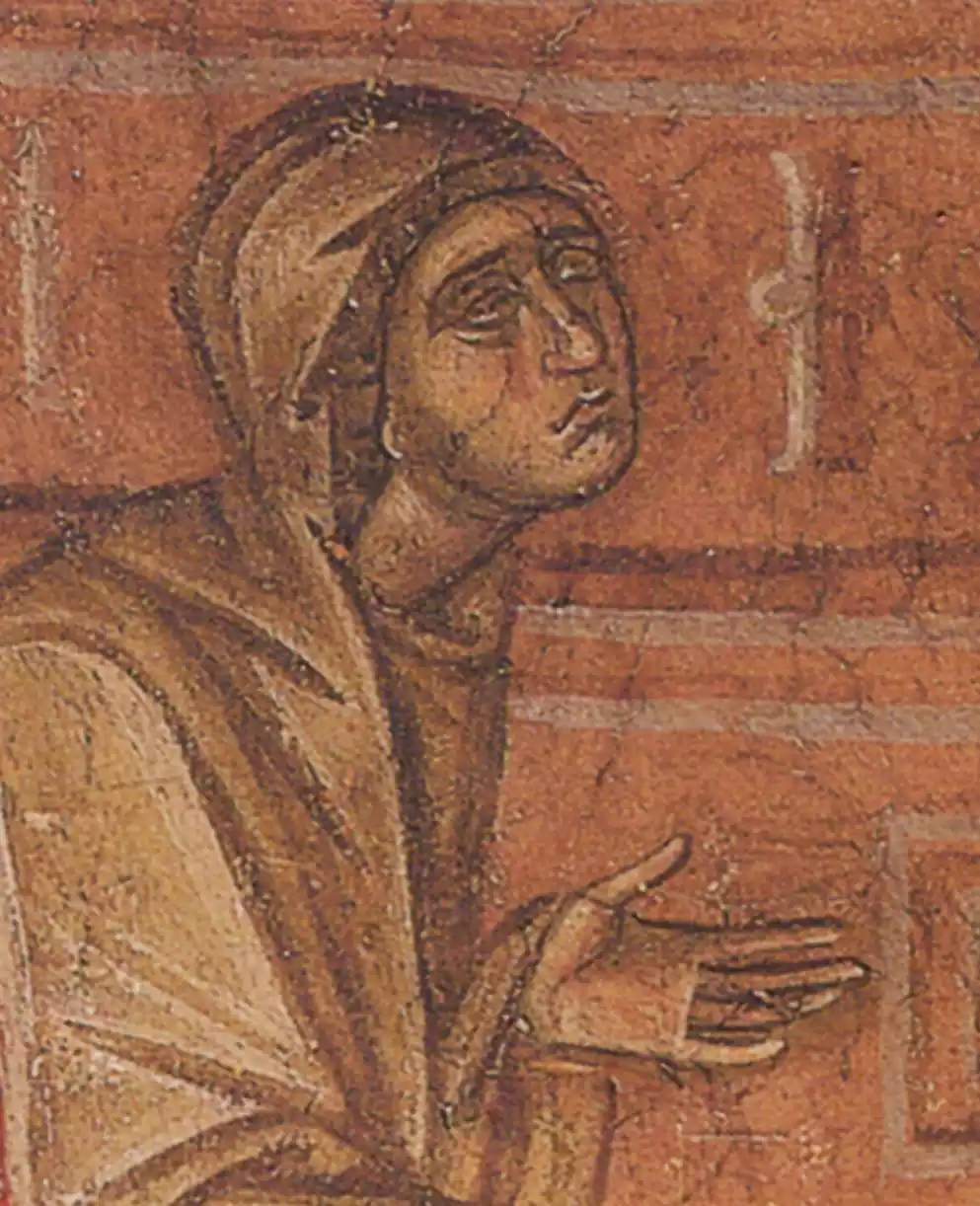
The face of the widow gathers within itself much of the emotional charge of the theme, as it is captured in this detail of the fresco. The head is covered by a plain, dark veil that leaves only the face uncovered, while the gaze turns upward, towards the direction in which Christ stands, with an intensity rarely encountered in figures of secondary importance within the Byzantine iconographic programme.
Her hand is raised, the fingers open in a gesture that one may read either as a continuation of the offering or as speech — as though she were explaining to herself, rather than to anyone else, why she gave all that she had. The lines around the eyes and the mouth, deep and dark, render her age and her hardship with a realism that departs from the idealised serenity of holy faces: a woman particular, poor, without a name, painted with the same care that the artist would have reserved for a saint.
The Gesture of the Offering
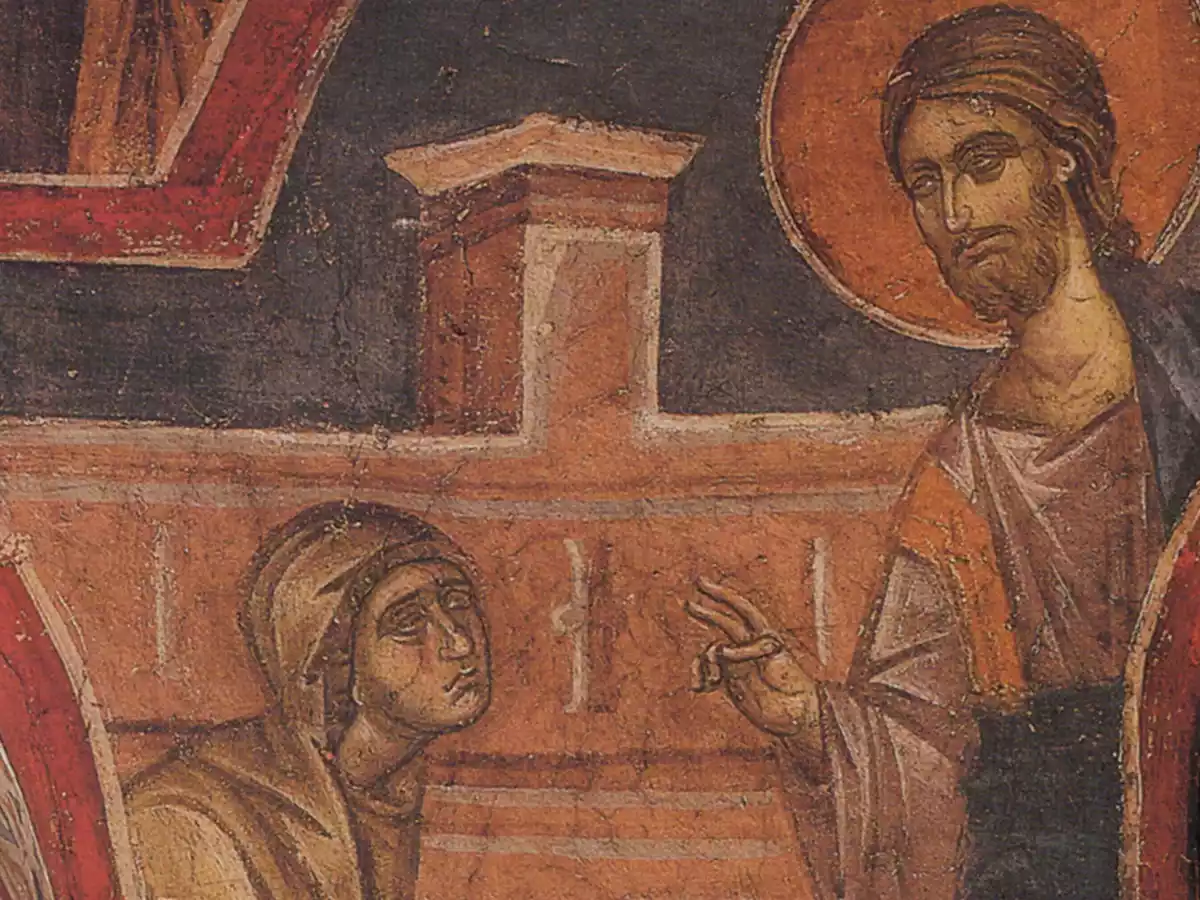
In this detail, the distance between the two hands — that of the widow who offers and that of Christ who blesses — contracts almost to nothing, a fact that conveys visually the meaning of the saying even before the inscription is read. The rim of the treasury, rendered with a linear precision recalling joinery, functions as a boundary and, at the same time, as a bridge between the two figures.
The halo of Christ, its red outline standing out sharply against the dark background, frames the scene from the right, while his hand, the fingers shaped in blessing, reaches out almost to touch the hand of the woman. Nothing here is superfluous. The architectural depiction, with the small pediment traced above the widow’s head, refers to a conventional rendering of a building, not to an actual structure, in accordance with the practice followed by the workshops of the period whenever they needed to suggest an interior space without interrupting the flow of the narrative.
The Figure of Christ
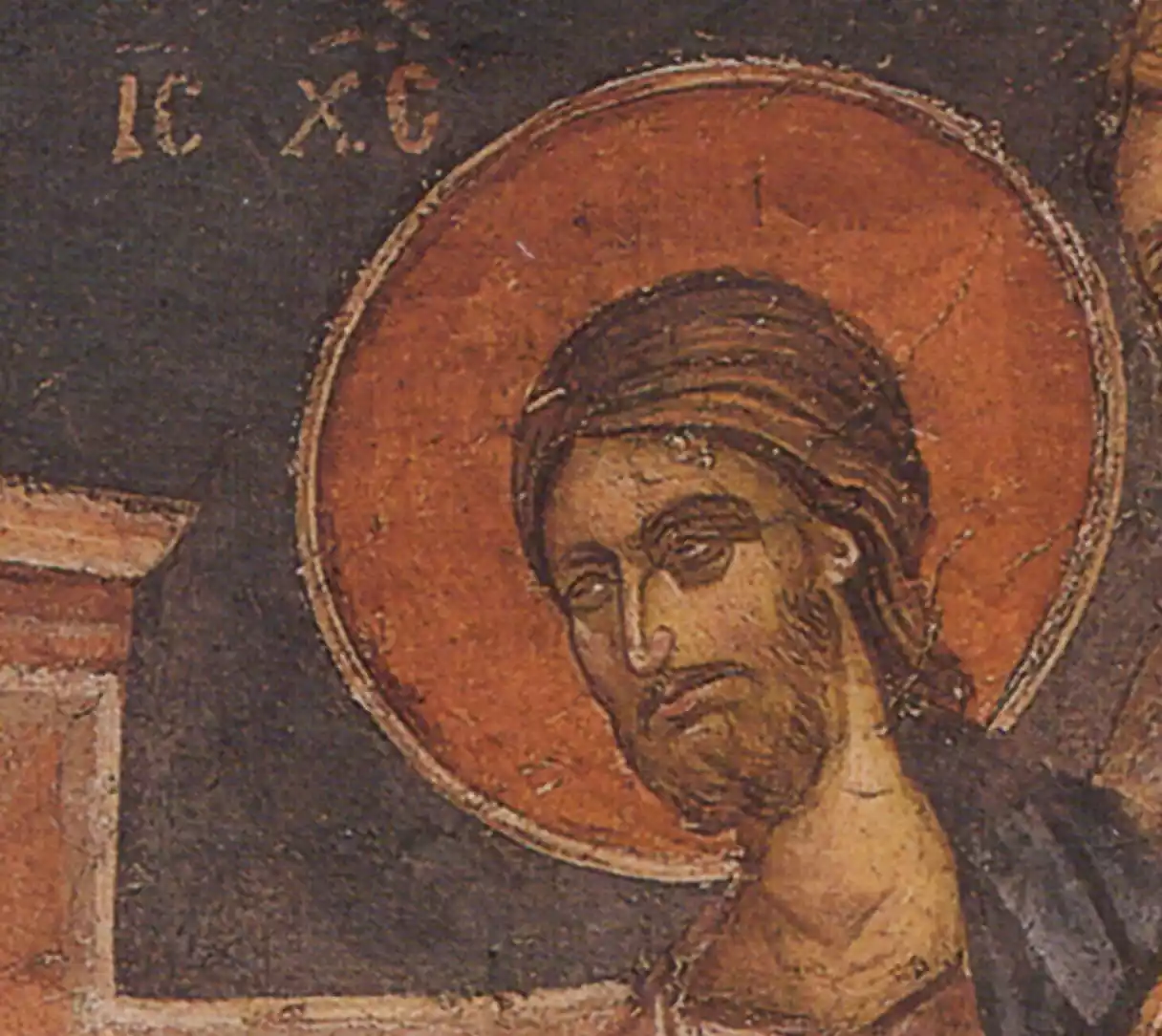
Isolated from the rest of the composition, the face of Christ reveals the technical skill of the painter in the rendering of the human countenance. The hair, parted in the middle, falls in wavy curls to the shoulders, while the beard, short and well-kept, frames a mouth closed, grave, without a trace of severity. The eyes, large and deeply shadowed, look downward and to the left, towards the widow, with an expression combining attentiveness and forbearance rather than judgement.
The halo, in a brownish-orange hue with a white outline, is flanked by the monogram IC XC, written in capital letters in ochre, against the deep blue background that dominates the entire composition. The transitions of the skin, from the dark brown depth to the lighter points of illumination on the forehead and the nose, are achieved through gradual, almost imperceptible gradations — a technique known as proplasmos — which lent to the faces the plasticity and the vitality sought by the painters of the Palaiologan period, as they moved away from the flatter and more austere rendering of earlier centuries.
The fresco of the widow’s mites constitutes a small yet characteristic sample of a wider pictorial ensemble that covered the katholikon of Hilandar in the early decades of the fourteenth century, a period during which the monastery functioned as a living point of contact between the Serbian dynasty of the Nemanjić and the artistic currents of Byzantine Thessaloniki. The choice of workshops from this great city for the decoration of a Serbian foundation on Mount Athos does not constitute an isolated occurrence; it reflects, rather, the dense networking of artists, patrons, and monastic communities that characterised the Orthodox world of the period, beyond national or political borders.
The repainting of 1803, the work of the monks Benjamin and Zacharias from Galatista in Chalkidiki, left its traces on the surface of the colour, without, however, destroying the structure of the original design — a fact that permits, today, the reading both of the composition and of the technique of its first phase. Every detail of the scene, from the faces of the disciples to the halo of Christ, is connected to a wider tradition of painting that had learned to convey theological meaning through minimal, economised movements.
The choice of this particular subject — a woman without name and without possessions, amid so many scenes devoted to emperors and saints — bears witness to a particular sensitivity in the iconographic programme of the katholikon, perhaps not unrelated to the monastic ideal of non-possession which Hilandar Monastery itself, as a cenobium, sought to embody in its daily life. The fresco remains, within the dim interior of the katholikon, one of the points at which the monumental art of the fourteenth century draws nearest to everyday human experience.
(Translated from the Greek text; translation by K. Pappas.)