
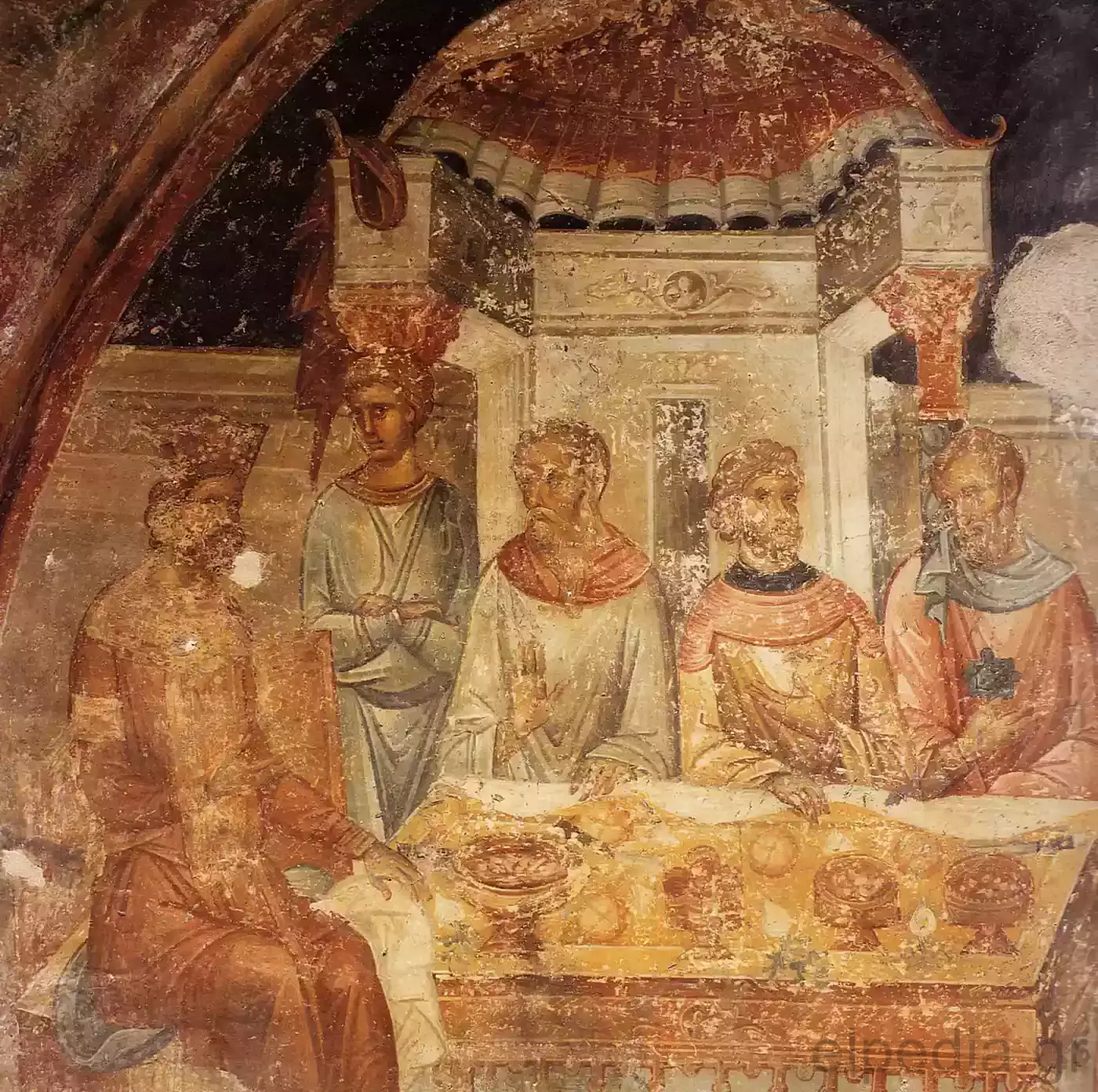
In the northern section of the portico of the Holy Apostles of Thessaloniki, within the small chapel dedicated to the Forerunner, there survives one of the most eloquent scenes of the cycle narrating the life of John the Baptist. The composition refers to the symposium given by Herod Antipas for his birthday, the feast at which Salome, daughter of Herodias, danced before the fellow-diners and demanded in return the head of the Forerunner upon a platter. It is dated to the period 1310 to 1320 and is attributed to the abbot Paul and his collaborators, who undertook the continuation of the church’s decoration when the patronage of the patriarch Niphon for the mosaics ceased abruptly, following his removal from the patriarchal throne in 1315. Beside, then, the sumptuous mosaics of the main church, with fewer financial means but by no means less art, the fresco undertook to complete the iconographic programme. The image does not capture the moment of the dance, as one might perhaps expect from the title of the scene, but the table itself, around which the guests are gathered, with a density of detail that recalls how systematically the painters of the period studied depictions of food in monumental painting. Worn in several places, with the plaster lost here and there down to the joint of the stone, the composition nonetheless retains sufficient clarity that we may reconstruct the staging of a courtly reception with an almost archival precision.
The Setting of Herod’s Symposium
A vaulted chamber with a roof of tiles in tones of terracotta and ochre frames the whole composition, supported upon slender colonnades with capitals still discernible, despite the damage, in the upper part of the image. This is not a realistic rendering of a palace; it is rather a convention, an architectural backdrop that indicates the interior, palatial space without describing it in detail, as Palaiologan painting was accustomed to do when it wished to “enclose” a scene within walls. In the upper left section a heavy red curtain has been drawn to the side and gathers in folds above the black, depthless field, a customary technique that shows the scene to be taking place in an enclosed space, behind fabric that has only just opened for the eyes of the viewer. The dark background, without landscape or sky, leaves the attention to be concentrated exclusively upon the figures and the table.
Five figures fill the space beneath the roof, all turned towards the centre of the composition, all part of the same silent conversation. At the left edge, partly cut off by the frame, sits Herod, with a tall, elaborate head-covering and a tunic of warm orange, his hand resting on the edge of the table and a white cloth thrown over his couch. Beside him a standing figure in a grey-green mantle holds something slender between joined hands, with lowered gaze, almost pensive, while in the centre a bearded man in a white tunic and orange-coloured mantle raises his hand in a gesture of speech, the fingers open as though speaking or commenting upon something just said. The last two, one in golden-yellow garb and a pink mantle and another in a rosy tunic, a grey-blue overgarment and a dark ornament fastening the fabric at the breast, close the composition on the right, bearded themselves, grave, without any movement betraying the tragedy that is about to follow.
Between them stretches the table, dressed in golden-yellow fabric that ends in a red decorative band with fringes falling along the front, a detail of luxury that would not have passed unnoticed by a fourteenth-century viewer. Upon it are discernible a shallow vessel with reddish contents, most probably roasted meat or fish, round loaves of bread, cups of differing height, a tall vessel at the centre that could be a candlestick or a container, and smaller round objects recalling fruit. No detail here is a chance addition; symposium scenes, such as this one of Herod, together with other similar banquets of Byzantine iconography, constitute among the richest sources for those who study food and tableware in monumental painting between the tenth and the fourteenth century, precisely because the painter was obliged to render the luxury of a courtly reception convincingly.
The foundational study by Andreas Xyngopoulos on the painted decoration of the church, published in 1953, remains a point of reference for anyone wishing to understand how the cycle of the Forerunner is articulated within the chapel, while research of the 1980s and 1990s brought to light further sections of frescoes that had been covered with plaster during the years of the building’s Ottoman use as a mosque. It is, perhaps, among the paradoxes of this monument that the technically poorer solution, the fresco, survived where the costly mosaics remained unfinished; necessity, not abundance, determined in the end which part of the church would reach us complete. In the scene of Herod’s symposium we do not see the violence of the beheading, nor the dance that provoked it, only the moment before, the men around a laden table, still unsuspecting of what the daughter of Herodias would demand.
(Translated from the Greek; translation by K. Pappas.)

