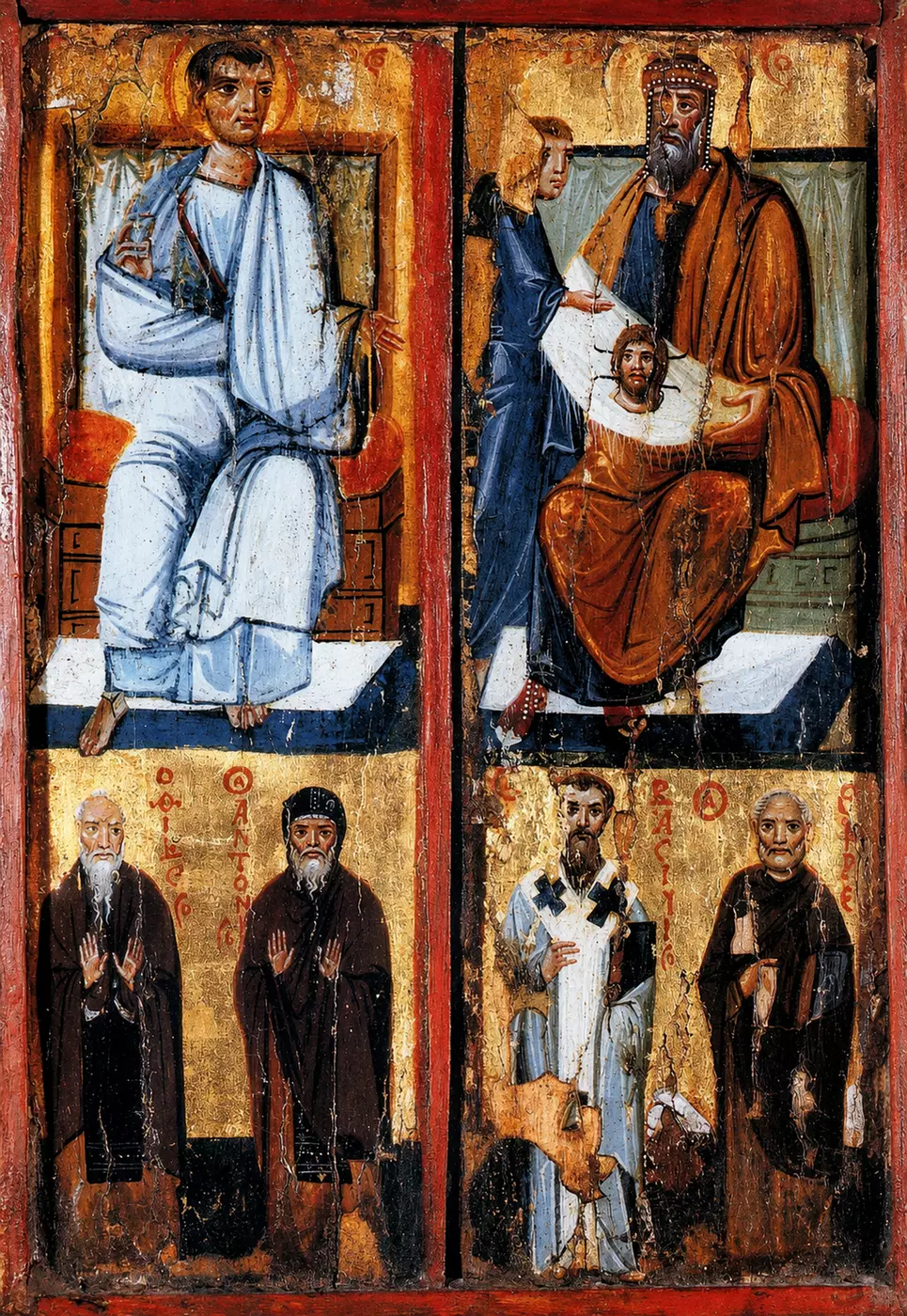
Two leaves of a triptych, with the central panel lost for centuries now, were painted in the middle of the tenth century and have been preserved ever since in the Monastery of Saint Catherine at Sinai. Each leaf, measuring close to 34.5 by 25.2 centimetres, is set today within a wooden frame that protects it from further decay. Upon each of the two wooden leaves, divided into two registers, are depicted, seated upon a throne, the apostle Thaddaeus and King Augarus of Edessa, the latter holding between his hands the cloth bearing the imprint of the face of Christ, the Holy Mandylion. In the lower registers stand four figures of the monastic life, Paul of Thebes, Anthony, Basil and Ephraim the Syrian, each upright and facing forward, his hands in the posture of supplication.
The narrative behind the composition is bound up with the transfer of the sacred cloth from Edessa to Constantinople in 944, an event that kindled a particular surge of devotion in Byzantium and inspired, in the years that followed, encomia dedicated to the miracle of the image not made by hands. Within the wider monastic complex of Sinai, where the katholikon holds pride of place but where numerous monastic chapels are also to be found, this particular work remains among the most representative examples of the classicising manner that flourished in the capital around the middle of the tenth century. Anonymous is the painter, as indeed were most icon-craftsmen of that era, yet the quality of the execution betrays a workshop connected with courtly circles.
The Icon of the Holy Mandylion: Analysis of a Byzantine Composition
The Enthroned Thaddaeus and the Architecture of the Throne
On the left-hand leaf, at the top, sits Thaddaeus. Youthful in age, with short brown hair and a face without a beard, he wears an open light-blue tunic and over it a broad, almost white mantle that wraps about his torso in wide folds, worked with fine, darker lines of shading, a manner of modelling that follows, in broad terms, the models of Hellenistic painting through the mediation of centuries of Christian tradition. His halo, gold and smooth, stands out clearly against the deep gold field of the background, so much so that the outline is scarcely discernible. The throne upon which he sits, with a red cushion on the seat and dark wooden sides, follows a typology familiar from depictions of the evangelists, a feature that reinforces the contemplative dimension of the figure.
Behind the young apostle rises a structure recalling a furnished façade, perhaps a cabinet or the door of a bookcase, with panels in orange-toned wood and a lattice of crossing lines, an element that appears often behind figures of scholars and evangelists in manuscripts of the same period, as though the painter wished to present him not only as an apostle but also as a bearer of written testimony. His feet, bare, rest upon a white footstool, while near the shoulder a small, dark-coloured object may be discerned between the fingers, perhaps a case or a clasp of the garment. It is not easy to identify this detail with certainty. The posture of the body, however, turned halfway towards the neighbouring leaf, testifies to the painter’s intention to connect the two scenes visually into a single narrative, although these are, strictly speaking, two separate panels.
Augarus, the Envoy and the Holy Mandylion
On the right-hand leaf the composition thickens noticeably. In the background, a standing figure in a light-blue garment extends a hand towards the throne. This is most probably the envoy who carried the sacred cloth to Edessa, according to the well-known narrative of the Narratio, the text that recounts how the ailing king first requested a painted image of Christ and received in the end the imprint itself, not made by hands.
In front of this figure, enthroned, King Augarus wears a jewelled crown set with pearls and a small cross at its summit, a beard grey and long, a deep light-blue tunic and over it a heavy cloak in a brownish-orange hue, with gold braid at the side, a colour combination that refers directly to imperial attire. With both hands, open before his chest, he holds stretched out a white cloth upon which is traced, at the centre, the face of Christ, elongated, with a dark beard, large eyes and a gaze directed straight towards the viewer. The cloth does not hang loosely. It is stretched taut like a banner, its edges falling into sharp, geometric folds that recall a hard material rather more than linen, a choice that reinforces the sense of the supernatural origin of the imprint. Behind the king, a green cloth hangs like a curtain, a customary convention of the period for indicating the interior space of the palace, in contrast to the open, constructed background behind Thaddaeus.
The identification of this figure with the historical Augarus remains, of course, conventional. The features of the face, with the meticulous rendering of the beard and the heavy diadem, have been connected by scholars, among them Kurt Weitzmann in an article devoted specifically to the subject, with the iconography of the Emperor Constantine VII Porphyrogenitus, who reigned in precisely the period of the transfer of the Mandylion to Constantinople and had a personal reason to advance his connection with the sacred relic, since its possession reinforced the prestige of his sole rule.
The Four Saints of the Lower Register
Beneath the two enthroned figures, in a narrower band, stand four monks. On the left-hand leaf, two elders with a long white beard and a dark beard respectively, both clothed in a deep brown monastic habit, raise their hands before their chests, the palms turned outward, a posture that in the iconographic tradition signifies supplication and entreaty. Inscriptions in red above their heads, worn but legible, identify them as Paul of Thebes and Anthony, the two fathers whom tradition regards as the founders of monasticism in the desert of Egypt.
On the right-hand leaf, correspondingly, a hierarch in a white polystavrion, dotted with black crosses, holds a closed Gospel book and forms a blessing, while beside him a second monk, in a darker garment, holds a rosette or a closed scroll in his hand. The inscriptions here refer to Basil and Ephraim the Syrian, that is to say two fathers of Cappadocia and of Syria respectively, a geographical spread that completes, together with the two Egyptian ascetics of the left-hand leaf, an almost pan-Orthodox mapping of the monasticism of the first centuries. The choice of these four ascetic figures, placed directly beneath the scene of the Mandylion, connects, with a clear programmatic intent, the veneration of the acheiropoietos icon with the ideal of the monastic life, a common thematic axis in many works commissioned specifically for a monastic setting such as that of Sinai. Nor, indeed, is it unrelated that the Monastery of Saint Catherine itself preserves, even today, the largest collection of early icons in the world, systematically catalogued by Weitzmann in his foundational work on the icons of Sinai from the sixth to the tenth century.
The Byzantine Art of Sinai and the Macedonian Renaissance
The style of both leaves fits comfortably within the so-called Macedonian Renaissance, that current of Byzantine art which developed under the dynasty of the Macedonian emperors, between 867 and 1056, and turned towards the models of Hellenistic and Roman painting, with volume in the faces, naturalism in the folds and gradations of colour that render light rather than flat linearity. Technically, the work appears to have been executed by the method of encaustic, an ancient technique inherited from late antiquity, in which the pigments were mixed with wax and applied hot upon the wooden surface, giving depth and density to the colour that is difficult to achieve by other means, especially in the rendering of the faces.
The ravages of time, visible in cracks that run across the surface and in places where the paint has flaked away around the faces of the saints, take nothing away from the power of the composition. It records, on the contrary, in its own way the very history of the object, its passage through ten centuries and more of safekeeping in one of the least accessible monasteries of the Christian East. The red border that surrounds both leaves today, a later addition of the kind customary for the protection of portable icons, does not belong to the original composition, yet has become an inseparable part of its appearance down the centuries.
The lost central leaf, upon which in all likelihood the Mandylion itself was depicted on a large scale, remains the most intractable question surrounding the triptych. No one knows with certainty whether it was lost through decay, through pillage, or through simple removal to another part of the monastery during one of the numerous renovations undergone by the katholikon, and this void functions today almost as a third, invisible leaf of the composition, compelling every modern viewer to complete mentally what the two surviving leaves only intimate. As a historical document, beyond its devotional dimension, the Sinai triptych remains among the rarest examples in which the political iconography of imperial power is interwoven so closely with a narrative of miracle.
(Translated from the original Greek text by K. Pappas)

