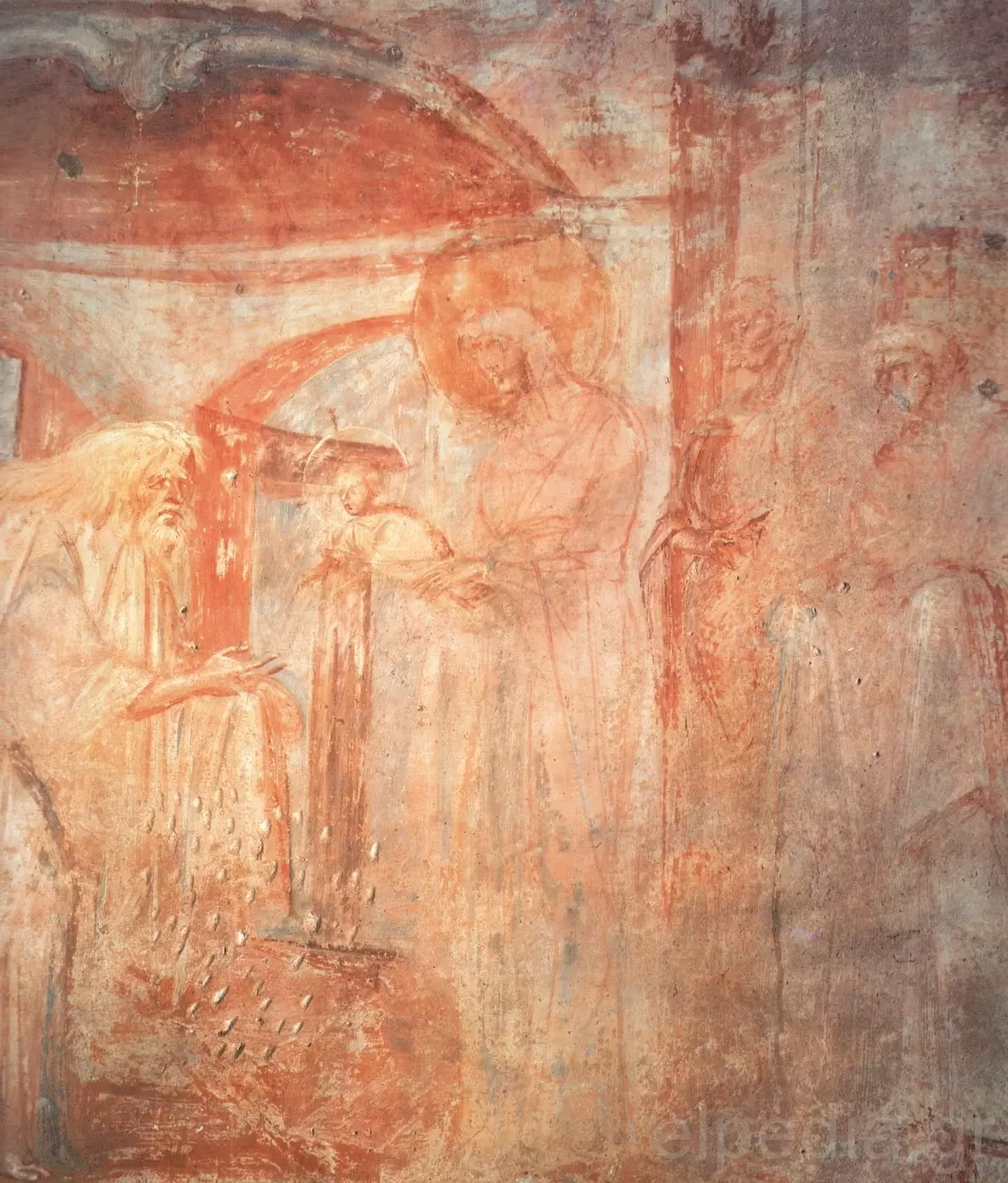
In the interior of the small church of Saint Mary outside the gates, in Castelseprio of Lombardy, there survives a fresco depicting the Presentation of Christ, a scene positioned in the middle zone of the apse and dated, according to the prevailing version of the research, around the 7th or 8th century, although the exact dating remains one of the most controversial issues of early Byzantine art in the West. The painter, whose name has not been preserved, followed the evangelical narrative of Luke, where the righteous Symeon, guided by the Spirit, recognises in the infant held by the Mother of God the awaited Messiah. The episode, known in Christian iconography as the Presentation, gathers into a single moment one of the most theologically dense scenes of the New Testament, that of the recognition of the divine within the human body of an infant. The region of Castelseprio, integrated today into the network of monuments of Lombardic Italy, guards within this small temple one of the rarest specimens of early medieval painting in Europe.
The frescoes were uncovered in 1944, beneath later layers of plaster, and since then have not ceased to occupy art historians, both as regards the identity of the artist and as regards their chronological placement, with proposals ranging from the 6th to the 10th century. The quality of the drawing and the freedom in the rendering of movement have led several scholars to recognise affinities with contemporary phases of the painting of Santa Maria Antiqua in Rome, a fact which strengthens the hypothesis of an early dating, near the 7th or 8th century.
The Scene of the Presentation in Castelseprio: An Early Byzantine Art in Decay
That which survives today of the composition does not retain its rich chromatic repertoire. The surface has lost almost in its entirety the plaster of the final highlights, and thus what we see approaches more closely the preparatory phase of the fresco, that reddish, almost monochrome underpainting upon which the Byzantine painters gradually built the volume and the light of the figures. There remain, however, clearly legible the basic elements of the narrative.
Symeon and the Moment of Recognition
On the left, the elder Symeon bends towards the child, with his long hair falling freely to his shoulders and both hands outstretched, ready to receive him. The posture of the body, deeply bent forward, conveys the bodily tension of the expectation more than a strictly frontal schema would permit. At his feet, the decayed surface allows small, dense spots to be discerned, traces in all probability of the decay of the mortar in the passage of the centuries.
The Mother of God and the Infant Christ
In the centre of the composition, a small figure with a halo, elevated almost in the air upon a base, stretches its hands towards Symeon. This is Christ, rendered in the conventional iconographic scale of the infant, smaller in size but not in weight of meaning. To his right, a taller figure, also haloed, with the head slightly inclining, holds the child gently before his handing over, in a gesture which the drawing renders with a remarkable fluidity of line for the standards of the era.
The Secondary Figures in the Background
Behind and to the right are faintly discerned more faces, heads mainly, covered in part by the decay of the surface, which research connects with the prophetess Anna, Joseph, and additional attendants of the scene. In the upper part of the composition, an arched element with a wavy, lace-like outline demarcates the sacred space of the reception, and within this a small cross is discerned, painted with austerity, almost as a reminder rather than as a dominant iconographic element. The more general style is placed within that current of early medieval painting which did not entirely abandon its classical origins.
The plasticity of the bodies, the freedom of the movement, the absence of a strictly hierarchical, frontal arrangement, all these bear witness to a painter familiarised with models that had not yet hardened into schematised formulas. We do not know his name. We know however that the hand which drew this scene worked with certainty, without the hesitation of a copying from a ready model. The Presentation of Castelseprio, even in this fragmentary state, remains a document of a crossroads of artistic influences, there where Rome, Byzantium, and the local Lombardic traditions conversed upon a wall of a small provincial church.
(Translated from the Greek text by K. Pappas)


