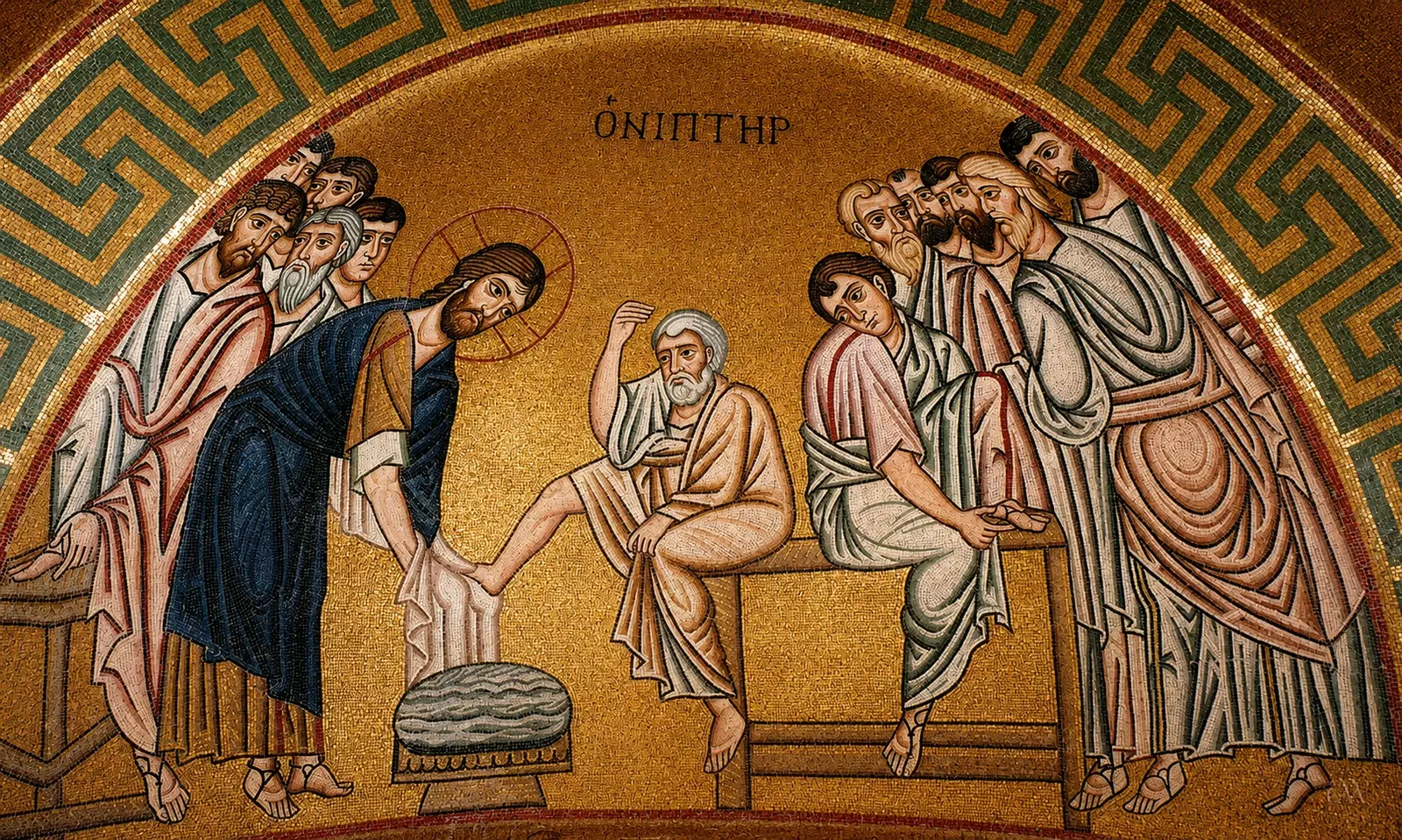
The silence in the narthex of the katholikon imposes its own rhythm, as the eye encounters the luminous surface on the tympanum of the northern wall. The Washing of the Feet depicts the supreme act of Christ’s humility, offering a visual translation of the Gospel word shortly before the Passion. Within a space of measured stability, the gold background, replacing the blue of the Early Christian sky, abolishes the notion of natural time and transfers the episode into the sphere of the eternal.
The monastic foundation of Boeotia preserves a pictorial art of spiritual austerity and refined chromatic sensitivity, characteristic of the artistic pursuits of the eleventh century. The tesserae shimmer in the light, not in order to impress, but to illuminate the doctrinal content of the Last Supper. This is a composition that excludes everything superfluous, serving an art that confesses the glory of the supersensible through the silence of the figures.
Hosios Loukas Mosaic: Middle Byzantine Art and the Depiction of Humility
Dominating the left side of the scene is the figure of Jesus. Bent forward, with the blue mantle cast behind him, he washes Peter’s feet, presenting the absolute model of ministry. The foremost apostle, seated at the centre, brings his right hand to his head, in a gesture that reveals embarrassment, perhaps also profound awe, before the condescension of his Master. The marble vessel containing the water, placed directly beneath the disciple’s feet, anchors the narrative in the material world. One of Peter’s feet is raised to receive the Lord’s touch, strengthening the sense of movement.
The rhythmic organisation of the space secures the autonomy of each figure while, at the same time, preserving the unbroken unity of the composition. The plastic rendering of the garments, with their dense and often severe folds, gives weight to the bodies, functioning in an anti-classical manner within the classicising calm of the whole. The colours follow the strict demands of monumental expression, filled with inner tension, while the white towel around Christ’s waist creates a visual division that focuses attention upon the very act of purification. The divine is enclosed within human offering, transforming the Creator into the servant of his creatures.
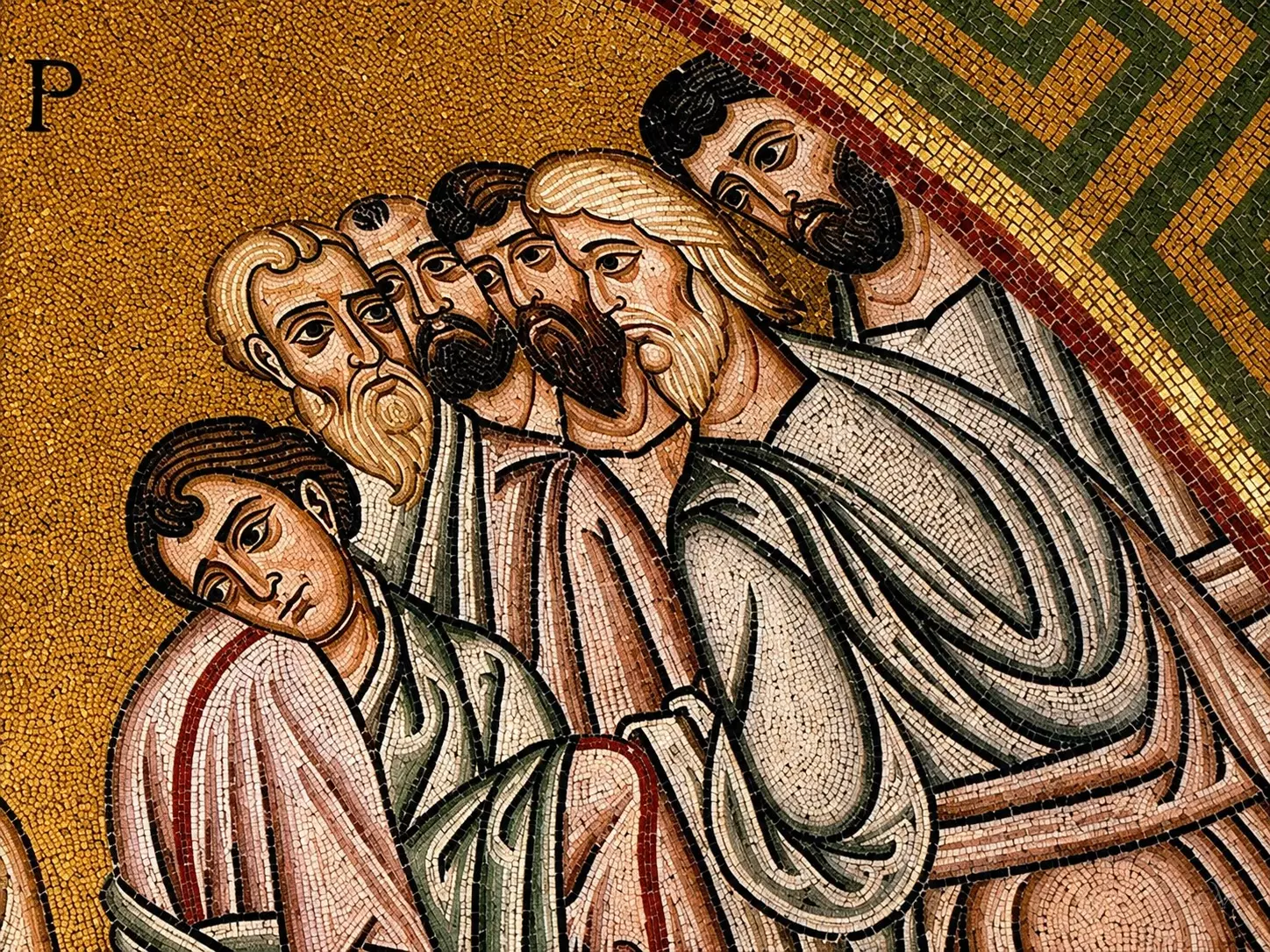
The Apostles in the Hosios Loukas Mosaic
On the right side, the remaining disciples are gathered together. Through the observation of this group, the artist’s careful psychological approach is revealed. The young John, beardless and slightly melancholic, stands at the front, his gaze directed downwards. His figure, clothed in white with greenish shadows, gives forth a rare inwardness. He acts as a connecting link between Peter’s dramatic tension and the contemplative calm of the others.
Behind him crowd the older disciples, stern faces with deep wrinkles, heavy beards, and wide-open eyes that follow the event with evident reverence. They perceive, perhaps, that this is not a simple ritual, but a mystagogy that establishes the ecclesial community. Frontality is avoided almost systematically. The heads turn with subtle inclinations, forming a silent yet exceptionally eloquent dialogue, capable of penetrating the viewer.
The garments alternate rhythmically in shades of green, brown, and grey, breaking the visual monotony of the gold ground. The technical perfection in the placement of the tesserae, with delicate chromatic gradations in the flesh tones, allows individual characteristics to emerge. The undifferentiated crowd is transformed into a group of distinct personalities, each possessing its own spiritual weight, bringing forth the plastic qualities of the painting beyond the surface.
The strict geometry of the composition is framed by the elaborate, multicoloured meander that follows the curve of the tympanum. The entire scene condenses the theological thought of the period, which requires the participation of the person and not merely the presence of the individual, wholly removed from every inclination towards worldly display. The artists of this masterpiece succeed in combining the abstract purity of the line with the spiritual search for form.
The event of the Washing of the Feet is not merely narrated as an occurrence of the past. It is reproduced perpetually as a mystical act, calling those who enter the church to embrace condescension as a way of life. This monumental record keeps alive the expression of a society that gave form to the invisible, mastering matter not in order to subjugate it, but to sanctify it.
(Translated from the Greek text by K. Pappas.)


