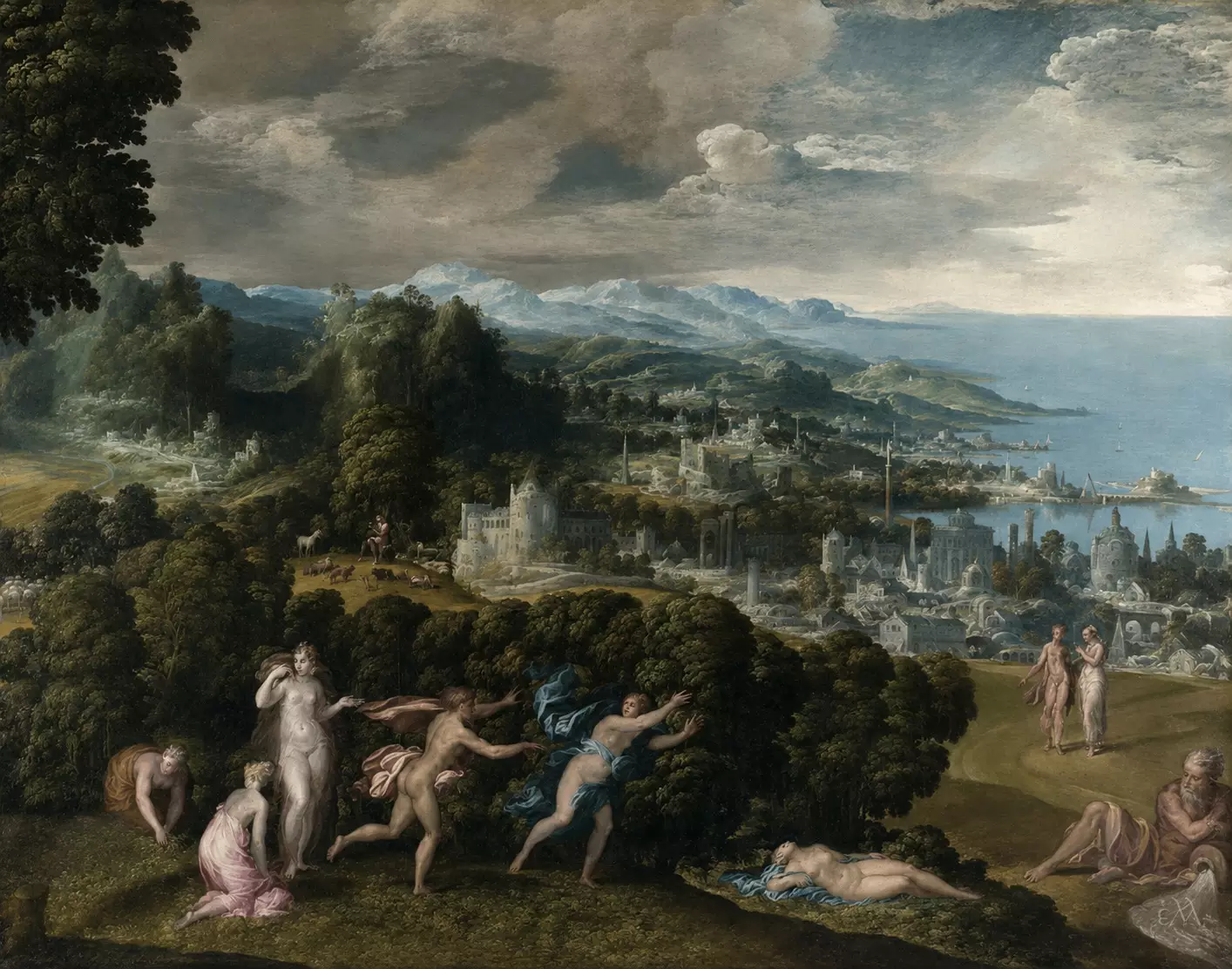
In the monumental oil on canvas that today adorns the National Gallery in London, Niccolò dell’Abate delivers the mythological narrative to the vastness of space, allowing the landscape to swallow the protagonists of the drama. Executed during the later period of the Italian artist’s career, between 1552 and 1571, the work represents the culmination of a profoundly Mannerist conception, in which the natural environment ceases to function as a merely accompanying setting.
The bodies in the foreground move, subjected to a choreography of flight; the eye immediately perceives the nakedness, the force of the pursuing Aristaeus, the fluttering fabrics, the figures of the nymphs reacting to the threat.
Enormous geological masses, steep dark rocks, an entire city concealed in the distance, the sea fading and disappearing upon the horizon compose the cosmic indifference of creation. A creation that stands silent, motionless before the transient. On the right, already fallen to the ground, the female figure has surrendered. The poisonous snake has struck; for her, time has stopped.
Further away, high upon a verdant hillock, Orpheus, absorbed entirely in his own melody, unknowingly charms the animals, wholly unaware of the silence that is about to overwhelm his life. The immense distance between his art, which tames nature, and the fatal event in the forest strengthens the sense of the inevitable.
The Death of Eurydice: The Art of Panoramic Illusion
The colours follow a strict course, from the earthy, heavy ochres of the foreground towards the cool, atmospheric tones of a depth that continually recedes. Here precisely, the painter from Modena, having organically absorbed the Flemish influences of panoramic landscape painting during his long residence at the French court of Fontainebleau, constructs successive levels of distance. Distances that appear boundless, almost inaccessible.
A woman runs, casting convulsive glances behind her; her garments, blue and dazzling white, twist around her. They twist, trapping the air, imposing a frantic rhythm upon her attempt to escape. Beside her, other figures are connected with the pursuer in a complex chain of gestures, while the bodies, slightly elongated according to the demands of the movement, retain a strangeness; they appear light, almost immaterial, despite the intensity of the pursuit. Aristaeus, impetuous, his cloak swelling threateningly, bursts into the frame, bringing physical turmoil with him.
The Death of Eurydice and the Indifference of Nature
The tragedy is quickly fragmented, dissolved within the landscape. The unexpected death beneath the shadow of the trees causes no substantial disturbance in the rest of the luminous creation. The meticulous depiction of the leaves, the elaborate buildings outlined with architectural precision along the shores of the water, the ships waiting at anchor, the distant mountain range melting into the clouds: all continue their eternal, frozen operation. Nature, as it is conceived here, stands sovereign, panoramic, absolute.
Avoiding easy emotional intensity, the artist transfers the real weight to the viewer’s cold, visual exploration. The gaze travels instinctively from the agitated bodies of the foreground to the tranquil pastures, from there to the fortified castles and finally ends, perhaps exhausted, in the distant, pale light of the horizon. It is an organic passage from the noise of tragedy to absolute spatial stillness, a vertical division reflecting the gulf between the pulse of life and the emptiness that naturally follows, without moralising, without any promise of artificial redemption.
(Translated from the Greek text by K. Pappas.)


