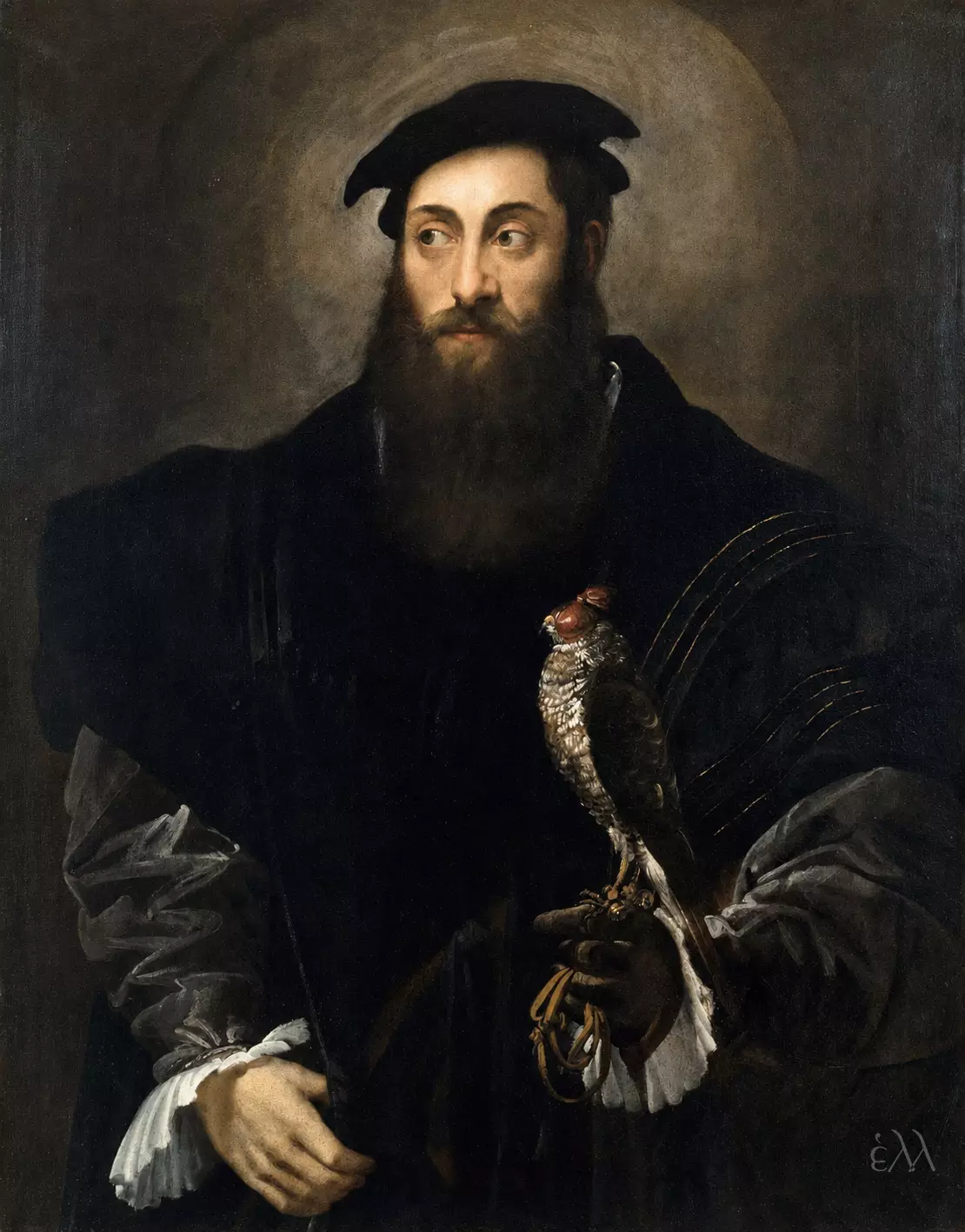
A man with a thick, dark beard holds in his gloved hand a falcon with a red leather hood, his gaze turned sideways, avoiding all direct contact with whosoever stands before him. This figure is depicted in the “Portrait of a Gentleman with a Falcon,” a work by Niccolò dell’Abbate, an Italian painter born in Modena in 1509 and deceased in Fontainebleau in 1571. Closely associated with Mannerism and the so-called School of Fontainebleau, he laboured at the court of Henry II of France beside Primaticcio.
Dating to approximately 1548–1550, the composition was executed in oil on canvas measuring one hundred and forty by one hundred and seventeen centimetres, and is presently housed in the Art Gallery of New South Wales, in Sydney. It portrays a North Italian aristocrat whose voluminous body occupies almost the entire surface of the canvas, in accordance with the customary practice of Italian portraiture during the 1540s.
Falconry, manifested through the bird upon his hand, constituted a privilege and a pastime beloved unto the noblemen of northern Italy, an indication of social standing equally with a personal trait of character. Dell’Abbate remained in history principally for his frescoes at Fontainebleau; nevertheless, the portraits of his youth reveal an artist already capable of capturing the distance between the social ostentation and the inward restraint of a person.
The art of Mannerism in the portrait of a gentleman with a falcon
The black garment of the lord, heavy and densely woven, most probably velvet, absorbs the greater part of the light of the composition, leaving the face and the hands to emerge almost solitary amidst the darkness. Around the head spreads a faint, greyish luminescence, circular like a halo—an atmospheric device of illumination that reinforces the presence of the face without denoting sanctity, a technique customary in the portrait painting of the sixteenth century for the elevation of socially significant personages.
Upon his left hand, covered by a dark leather falconer’s glove, rests motionless a falcon with a red leather hood upon its head, its feathers speckled in brown and white hues, its legs bound with slender straps that hang loosely. The bird looks nowhere. It remains blind behind the hood, an instrument of the chase in a posture of anticipation, an image of dominion over a thing living and wild.
Details of wealth and status in the portrait of a gentleman with a falcon
Behind the shoulder, golden, curving lines are discerned, perhaps a remnant of embroidery or pleated decorative silk, an element that betrays the financial ease of the sitter without imposing itself upon the composition. His right hand, lower down, clasps something oblong, likely the hilt of a sword or a staff, a common accessory of aristocratic appearance in the sixteenth century. The cuffs at the wrists, white and pleated, stand in contrast with the dark garment and draw the gaze downwards.
The gaze and the expression of the lord in detail
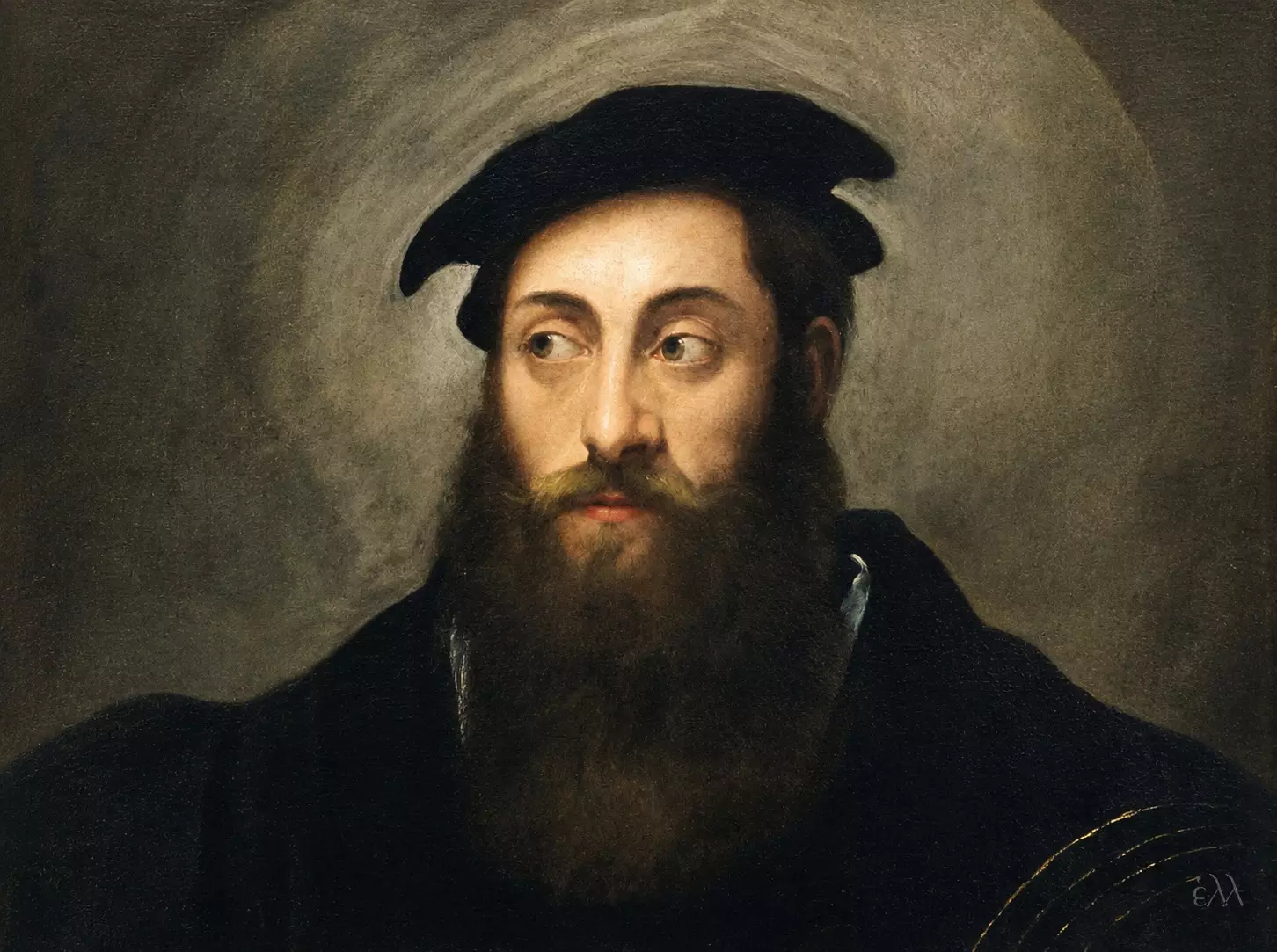
The detail of the face unveils elements which, in the distant viewing of the full composition, easily escape notice. The eyes, deeply sunken beneath the eyebrows, look sideways, avoiding all direct connection with the beholder, a posture frequently associated with the pride of the North Italian aristocracy of the sixteenth century. The moustache is groomed and short. The beard spreads thick down to the chest, without concealing the tension of the jaw.
The dark cap, with its characteristic broad brim, rests low upon the forehead and partially shadows the eyes, heightening the sense of distance. Behind him, the light of the background returns more intensely in this section, a trace that the painter left incomplete.
Dell’Abbate departed Italy around 1552 to join the workshop of Fontainebleau, where he collaborated with Primaticcio in the decoration of the royal apartments of Henry II. His greatest legacy is located not in portraits but in landscape, a genre he cultivated in a pioneering manner, prefiguring the pastoral compositions of Poussin and Claude Lorrain decades later. The Sydney portrait, lacking signature and lacking certain dating, passed through the collection of Alessandro Contini-Bonacossi in Florence, was exhibited in London in 1971, and ultimately arrived in Australia in 1991, by way of the collection of William Bowmore.
(Translated from the Greek text by K. Pappas)


