
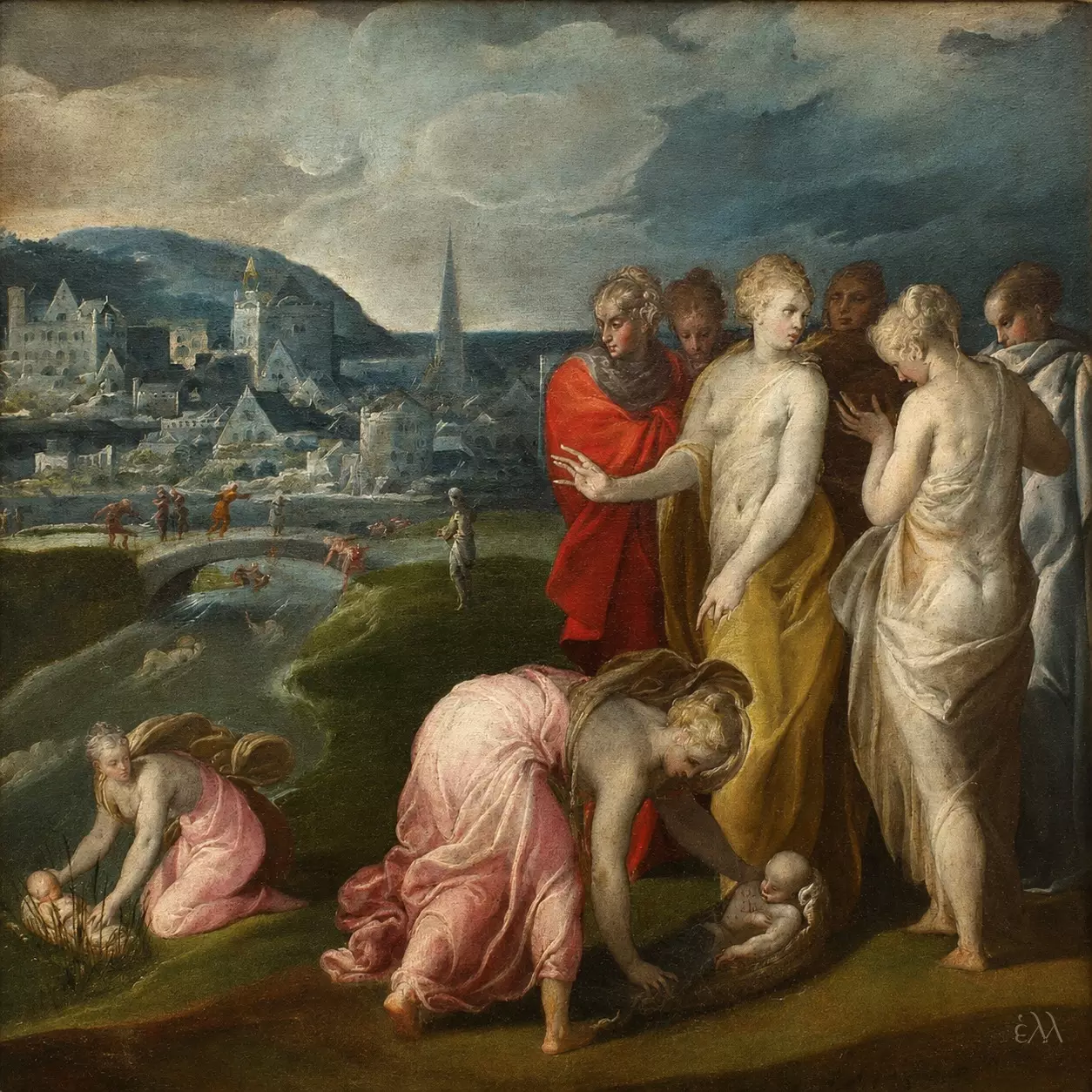
Fluid landscapes, breathing beneath heavy, leaden skies, define the hallmark of Niccolò dell’Abbate. Executed around 1560, the painting “Moses Rescued from the Nile”, an oil on canvas belonging to the Louvre Museum, intends in no wise to represent ancient Egypt. The painter from Modena, who largely determined the aesthetic of the French court, transports the biblical episode unto the banks of a familiar, strictly European river.
What magnetizes the gaze, paradoxically, is not the infant. It is the choreography of the women. Elongated figures reflect the aristocratic slenderness of the School of Fontainebleau; ethereal silhouettes, wrapped in translucent fabrics, lean into the reeds with a dancing, effortless grace, ignoring historical accuracy before the imperative of aesthetics.
Mannerist art and visual subversions
Shifting the attention to the right of the composition, the daughter of Pharaoh with her attendants emerge as ancient nymphs, the bodies whereof are outlined through fine, almost aqueous folds. Gentle movements of the hands lead the gaze low, exactly where a woman in an iridescent pink garment hath already rested the woven basket upon the water. The drapery betrays a peculiar theatricality, wrapped elaborately around their limbs.
Deeper in the background, however, the great subversion comes to pass. A misty, blue-green landscape unfolds. Turrets of sixteenth-century French châteaux rise, while upon a stone bridge hunters and wayfarers cross the river, entirely indifferent unto the sacred event of the foreground. A paradoxical tension emerges from this asymmetry between the miracle and secular daily life. Niccolò dell’Abbate doth not merely narrate, composing a dreamlike world, where the fluidity of the brushstroke dissolves the boundaries between the myth and his contemporary reality.
(Translated from the Greek text by K. Pappas.)


