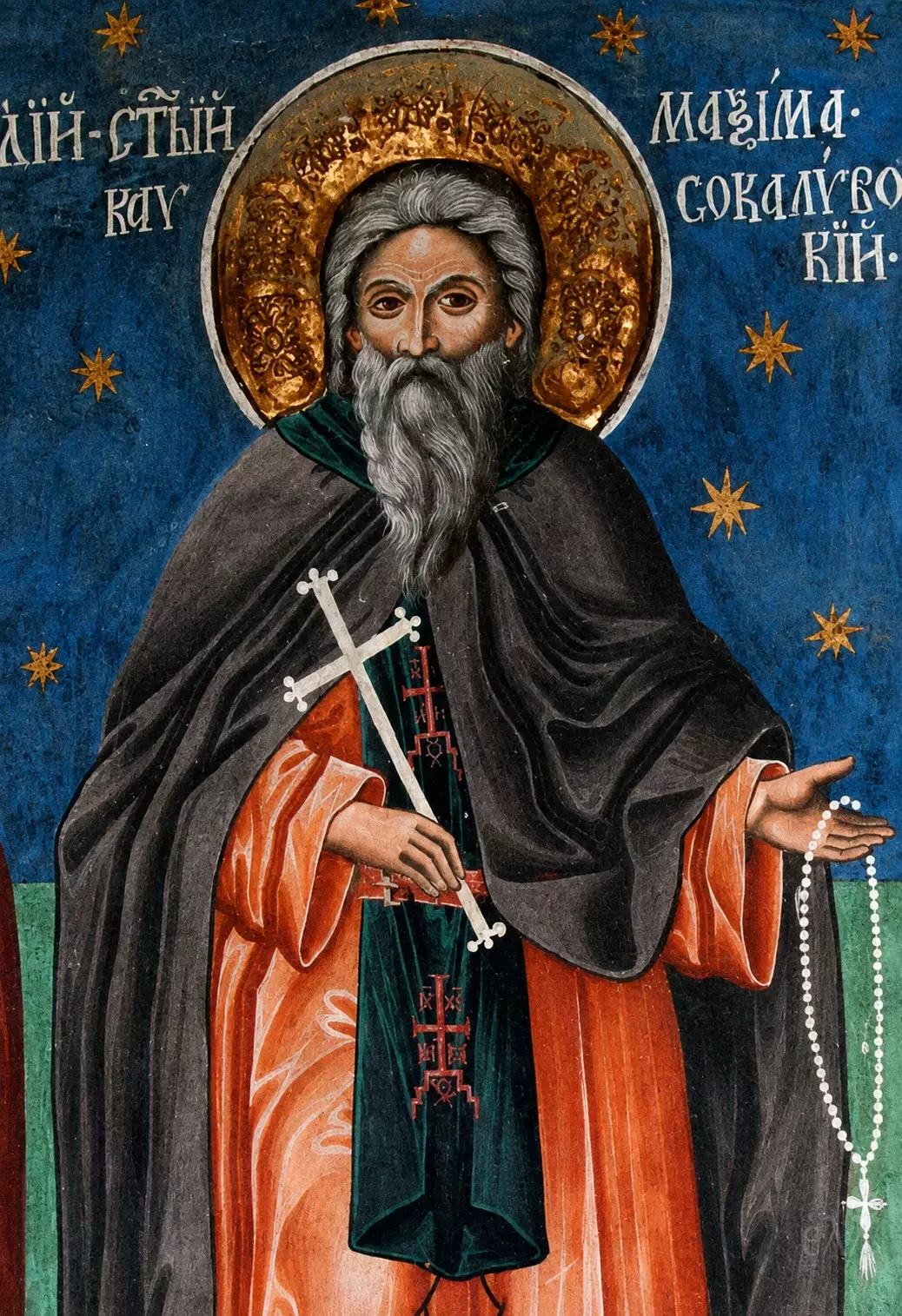
The figure of Saint Maximos the Kavsokalyvites—the ascetic to whom the skete of the same name owes its designation—is rendered in an 1820 fresco on the interior wall of the narthex of the Kyriakon, situated at the southeastern extremity of the Athonite peninsula. The saint is depicted frontally as an aged ascetic, bearing a long, whitish-grey beard and unkempt hair, wrapped within a dark monastic mantle that parts at the shoulders. Beneath it emerges the green analavos bearing the red crosses of the Great Schema, signaling the highest degree of the monastic life. A reddish-orange tunic is visible beneath, a hue that in the relative painting tradition of the period often functions as a counterpoint to the gravity of the outer garment. A white cross is held in his right hand, while his left palm is extended toward the viewer—a gesture that, in post-byzantine iconography, alludes to virginity and the austere life of the desert. A prayer rope hangs from his wrist. The deep blue background, strewn with golden stars, and the golden, relief-worked halo comprise the typical scenic vocabulary of narthexes within the sketes of Athos, where the heavenly character of the space is signaled by the starry firmament surrounding the figure. Adjacent to the head, a two-column inscription identifies the saint, bearing traces of Slavic stylistic influence—an element customary in Athonite workshops of the era, as the movement of monks and donors between Greek-speaking and Slavic-speaking monasticism left indelible marks upon the formation of texts.
Saint Maximos lived during the 14th century and reposed around 1365, renowned for his custom of abandoning each hut he constructed by setting it ablaze before it could become his possession, thereby ensuring he would never amass property. From this practice he derived his sobriquet, which subsequently gave its name to the monastic settlement itself, organized in the early 18th century by Saint Akakios the Younger the Kavsokalyvites, with the central church officially recognized in 1745. The wall painting thus functions as a deliberate visual reminder of the place’s identity to all who traverse it prior to entering the main space of worship.
Iconographic Elements and the Ascetic Tradition of Saint Maximos Kavsokalyvites
The painter seeks a sense of plasticity, imparting depth to the golden background through the relief treatment of the halo adorned with scrolling floral ornaments—a technique standard in Athonite art of the early 19th century. The visage of the elder, with its sunken eyes and pronounced linear incisions carved around them, adheres to the established type of the hermit inherited from earlier Byzantine prototypes, while nonetheless retaining an individual character in its execution. The beard, dense at the upper portion and thinning into delicate wisps toward the base, evokes a sense of motion, as though stirred by an unseen wind—a characteristic frequently encountered in representations of the Holy Mountain’s ascetics.
Naturally, the cross operates as an immediate signifier of the elder’s station and spiritual authority, whereas the prayer rope, though a discreet element, points toward the unceasing prayer that characterized the hesychast life. Maximos, much like other great hesychasts, is linked to the tradition of noetic prayer cultivated on Athos during that epoch. His visual rendering within the narthex constitutes simultaneously a mnemonic and didactic reminder, addressed to the monks who pass daily through this space on their way to the liturgical services.
The chromatic tension generated between the dark mantle and the orange underlayer of the tunic draws the gaze toward the center of the composition. The green of the analavos, embellished with embroidered red crosses, introduces a third chromatic pole that balances the representation without overburdening it. This constitutes a solution common among the workshops of Macedonia and Epirus that operated on Mount Athos during the late 18th and 19th centuries—bearers of a tradition that keeps the core of older art alive within a continuous dialogue with time.


