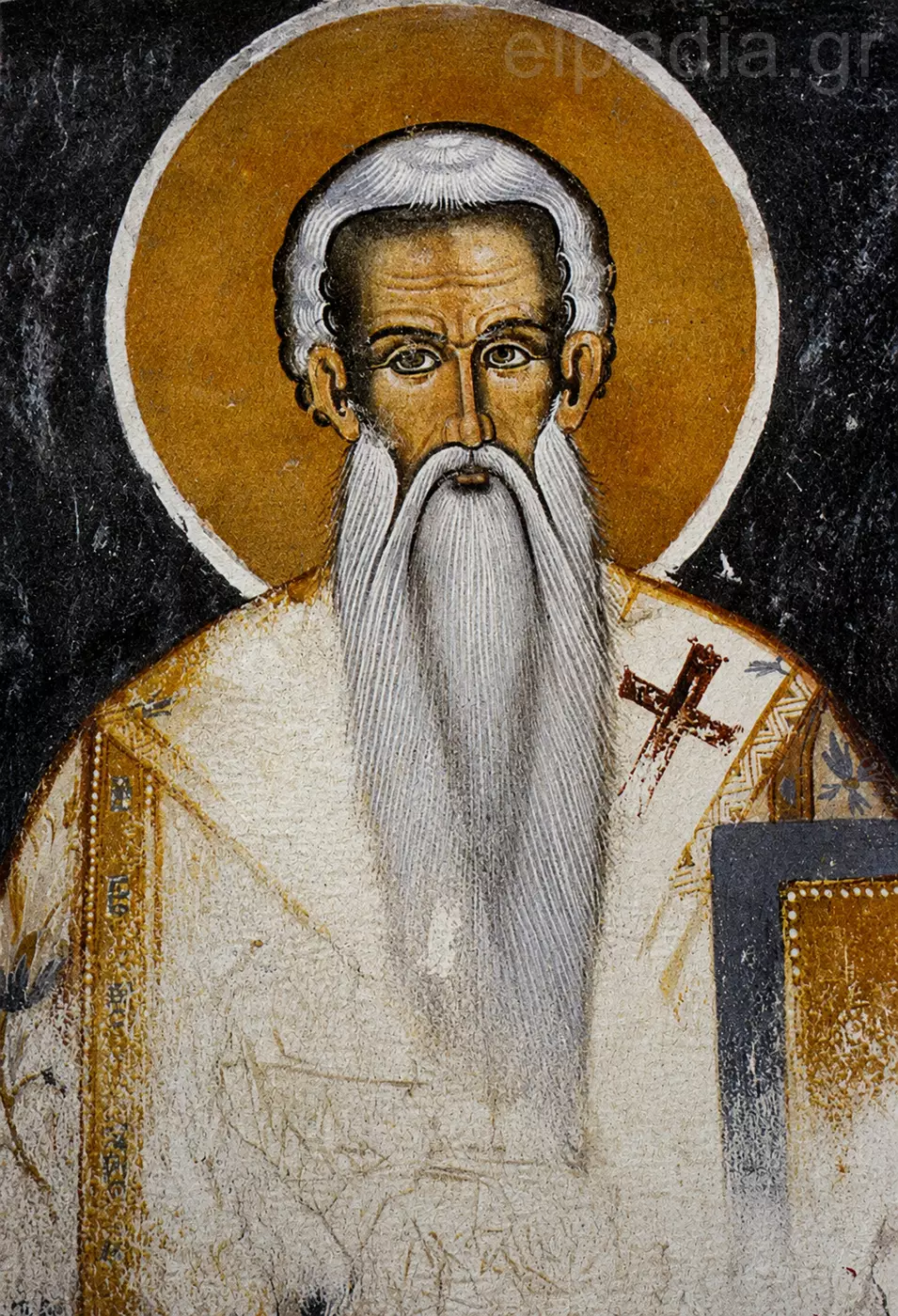
In the exonarthex of the katholikon of the Holy Monastery of Philotheou, there where in 1765 the brother painters from Korçë worked, was crafted the figure of a hierarch whom history places between Kastoria, Constantinople, and Trebizond. This is Saint Theodosios, metropolitan of Trebizond, who died in 1391 following a life full of movements, captivity, and ecclesiastical ministry in three different corners of the Byzantine empire. The fresco renders him in a frontal pose, with his gaze fixed straight at the viewer—a convention which in Byzantine and post-Byzantine hagiography always signifies sanctity and not mere portraiture.
The painter did not hasten with the face. The wrinkled forehead, the hollowed cheeks, the greyish tone of the flesh bearing witness to old age and not to youthful vigour; all these compose a man who managed to know, before arriving in Trebizond, Constantinople as a young cleric and Bithynia as a slave. Precisely this biographical roughness, which one might call unusual even for the life of a saint, the hagiographical tradition seems to have attempted to render in its own language. A language rooted in a long history, for the monastery was built in 1746 on the site of an older church that had collapsed, and a few years later, the text of the old Byzantine documents of the monastery confirms how early this brotherhood had been linked with powerful donations and protections.
The Figure of Saint Theodosios of Trebizond in the Byzantine Hagiographical Tradition
The golden-yellow halo, with the white perimeter line that delimits it from the dark, almost pitch-black background, leaves no doubt as to the sanctity of the person. Upon this dark background—which the ravages of time have hardened even further—the face of the hierarch emerges with an intensity almost sculptural. The white hair, combed in wavy tufts around an inner layer of a darker hue, covers the head like a cowl. And the eyebrows, raised slightly above eyes that look out with a serene austerity, convey precisely that balance between humble disposition and high deed, which the manuscript office of the saint in the monastery describes.
The beard descends almost to the waist, divided into two thick streams that allow to be seen, between them, a small section of the neck. Not accidental is the extent of this beard. It refers directly to the very description preserved in a manuscript of the monastery of Philotheou, where the saint is characterised as having his beard reaching unto the girdle, most sweet in speech, and highly educated in the ordering of the ecclesiastical canons. He wears a white omophorion, the episcopal vestment that denotes his metropolitan capacity, with a cross in dark, almost rusted red delineated at the level of the chest. In the left hand, covered beneath the edge of the cloth, he holds a closed book with a dark blue cover and a golden, pearl-adorned perimeter decoration, while along the edge of the vestment an inscription is discerned which identifies the figure—without, however, the surface wear permitting a full reading of every letter.
It is worth noting that the biography of this man is not simply ecclesiastical. Born around 1300 near Kastoria, brother of the venerable Dionysios who later founded his well-known monastery on Mount Athos, Theodosios passed first through Constantinople, where he was ordained deacon and priest, then to Mount Athos and the monastery of Philotheou, where he was elected abbot against his will. There followed his captivity by Turkish pirates and his sale as a slave in Bithynia; a trial rare in the life of a hierarch. He was liberated, returned to Constantinople, and was appointed by the patriarch Kallistos I as abbot in the monastery of Saint George of Mangana. And around 1368, when the emperor sought the most virtuous man for the metropolitan throne of Trebizond, he was ordained metropolitan. Metropolitan he remained, assisting at the same time his brother in the foundation of his own monastery in 1375.
His memory is honoured on the 11th of January, while on the 24th of the same month he is celebrated together with the rest of the saints of the monastery of Philotheou with a common office. A second date of memory is also mentioned, the 20th of August, an element which shows how different local traditions attempted to keep alive the memory of a man whose life flowed between three continents of spiritual authority. What the texts had already preserved in words, the art of post-Byzantine hagiography did nothing else but to stabilise visually, recording his figure upon the wall of the exonarthex.
(Translated from the Greek text by K. Pappas.)

