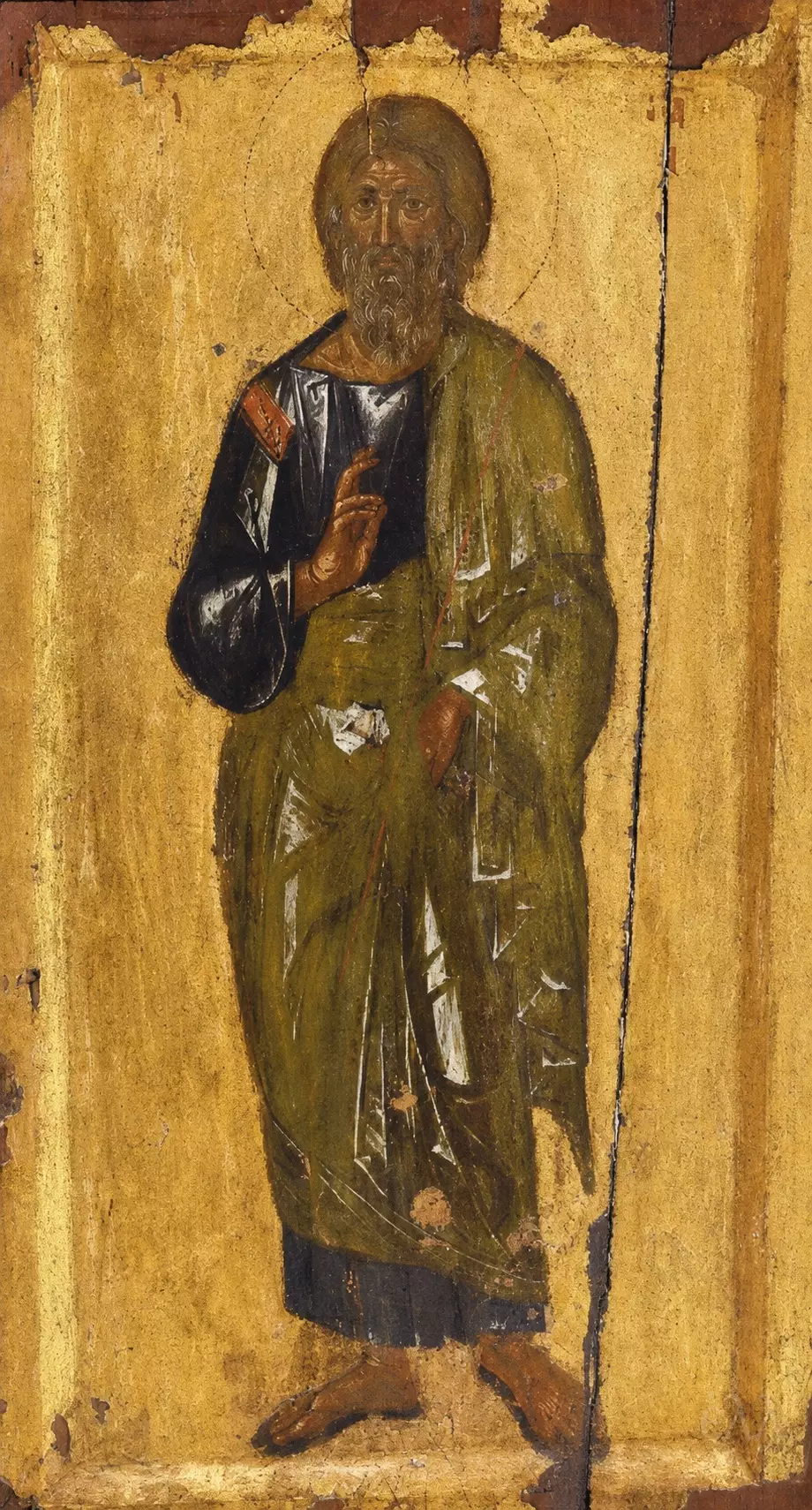
A tall, ascetic figure, with a gaze fixed beyond the beholder, stands at the center of this Byzantine icon preserved in the Holy Monastery of Vatopedi on Mount Athos. This is the Apostle Andrew, the brother of Peter and the first disciple to follow Christ, hence his designation in Orthodox tradition as the First-Called. The technique is the familiar egg tempera on a wooden panel, set against a gold ground that now bears the marks of time, with cracks and flaking traversing the surface yet without disturbing the clarity of the composition. A double-incised halo circumscribes the head, a standard practice to emphasize sanctity without superfluous ornamentation. About the figure, in the upper corners, traces of an inscription remain, too worn to allow for a secure reading. Taken as a whole, the icon belongs to that category of works preserved for centuries by the Athonite tradition—copies and originals alike—within workshops where art functioned simultaneously as theology and as technique. The apostle is rendered according to his established iconographic type: elderly, with thick gray hair and a long beard, features that distinguish him from the younger apostles in Byzantine production. What follows examines the individual components of this composition, from the garment to the gesture.
The Byzantine Art of the Icon of the Apostle Andrew
The face, deeply furrowed with wrinkles upon the forehead and about the eyes, betrays the aging of a man whom tradition holds to have undertaken distant journeys of preaching. The hair, sparse at the crown, falls in short curls at the sides, while the beard, dense and interspersed with white strands, descends to the chest. Over the body, the painter has laid two strata of fabric: beneath lies the dark chiton, almost black in its shadows, and above it the olive-green himation, its folds articulated with delicate, luminous lines reminiscent of chrysography though distinct from it. Upon the right hand, raised to the level of the chest, the palm is opened toward the beholder—a gesture that in Byzantine iconography does not merely signify speech or blessing, but frequently alludes to virginity and an ascetic life, attributes ascribed by tradition to Andrew already from his earliest days beside the Forerunner. In the left hand, he holds a scroll, indicative of his didactic labor, while a slender reddish staff traverses the body diagonally, an element that in Athonite painting often accompanies apostolic figures as a symbol of their itinerant mission. The feet, bare, tread upon a narrow strip of ground beneath the gold ground; no perspective supports them, as is characteristic of all medieval painting prior to the advent of Renaissance perspective. The overall posture, frontal and rigid, eschews all naturalistic movement, which constitutes not a failing of the painter but the deliberate choice of an art oriented toward the spiritual rather than the corporeal. The olive-green hue of the himation, with its golden gradations across the folds, reflects techniques that predominated in Athonite workshops, where the coloring of vestments followed strict rules of symbolism. Despite the damages to the lower portion of the wood and the vertical fractures crisscrossing the surface, the icon retains intact the power of its original conception—a presence that teaches not through words, but through its very being.


