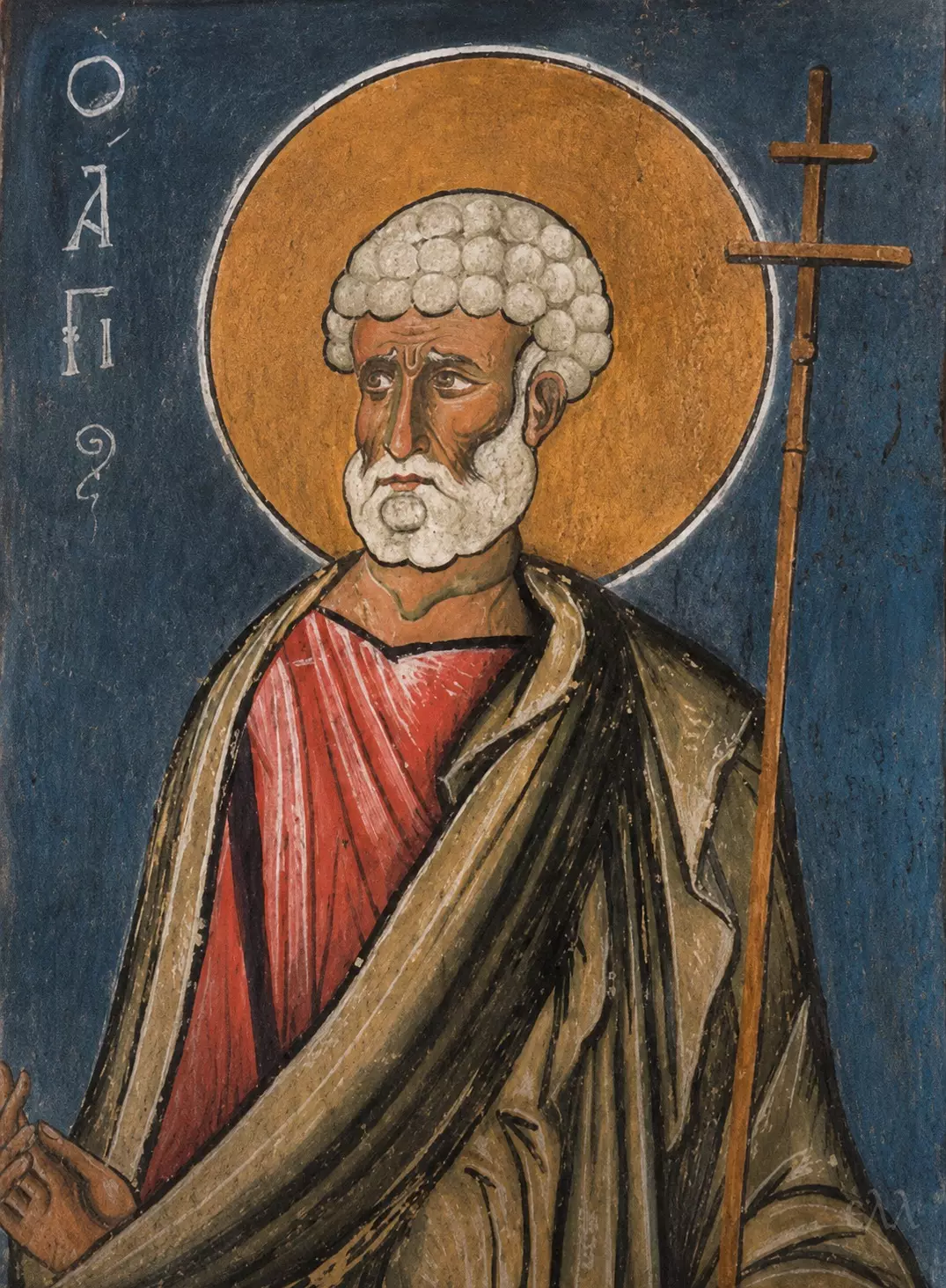
An old man with white curly hair and a beard looks the viewer straight in the eyes, his face furrowed with deep wrinkles, his expression somber yet serene. This is the Apostle Peter as rendered by the unknown, though often identified with Theodoros Apseudes, painter who in 1192 undertook the decoration of the katholikon of the Monastery of Panagia Araka, in Lagoudera, Cyprus, at the expense of the archon Leon the Authentikos. The figure belongs to one of the most complete cycles of Middle Byzantine painting preserved on the island, an example of mature Comnenian art with direct dependence on Constantinopolitan models. The apostle bears a golden halo outlined in white, a rose-colored chiton beneath a deep ochre himation falling in heavy, broad folds, while in his right hand he holds a tall cross-topped staff, a symbol of his apostolic journey. In the background spreads a bluish, almost smoky color, characteristic of the monument’s palette. To the left of the head, part of the inscription can be discerned, the beginning of the customary designation “Ο ΑΓΙ[ΟΣ],” as was the practice for identifying holy figures in Byzantine iconography. The church, together with nine other painted churches of the Troodos range, has been included since 1985 on the UNESCO World Heritage List.
The rendering of Peter in the Byzantine art of Panagia Araka
It is not the severe, almost immaterial sacrality of earlier Middle Byzantine models that dominates here. In Peter’s face, the painter was occupied with something more human, closer to the experience of age and labor. The wrinkles on the forehead, the deep hollows around the eyes, the thick beard with its curly locks descending symmetrically to the shoulders—all these compose a head type already fixed in early Christian times for the chief apostle, here however rendered with particular plasticity. The gaze does not seek the viewer in an aloof manner; it meets him, almost scrutinizes him. Around the neck a fine line of shading is visible, giving volume to the nape, while the chiton, painted in a vivid pink, is set against the earthy ochre of the himation in a way that emphasizes the corporeality of the figure beneath the fabric.
The staff he holds, tall, slender, ending in a cross, is not a mere iconographic accessory. It functions as a marker of apostolic status, of the wandering and preaching that accompanied the lives of the disciples after the Resurrection. In this Cypriot fresco, as in other monuments of the period, the inclusion of such figures in full-length or nearly full-length representations around the main church reflects a broader program, in which each apostle occupies a position inseparable from the liturgical order of the space. The bluish background, without architectural or landscape elements, allows the figure to emerge with force, almost as an autonomous image.
The inscription preserved fragmentarily above the shoulder follows the usual practice of writing the title “saint” before the proper name, a practice that in Cypriot monumental painting of the late 12th century still retains its learned, abbreviated form. Scholars who have studied the ensemble of frescoes at Panagia Araka identify in works such as this one one of the most persuasive testimonies to late Comnenian painting, where interest in the human character of the represented figures coexists, without contradiction, with their hierarchical dignity. The Apostle Peter, aged, grave, with his gaze fixed, remains one of the most characteristic examples of that pictorial sensibility that flourished in Cyprus at the end of the 12th century.


