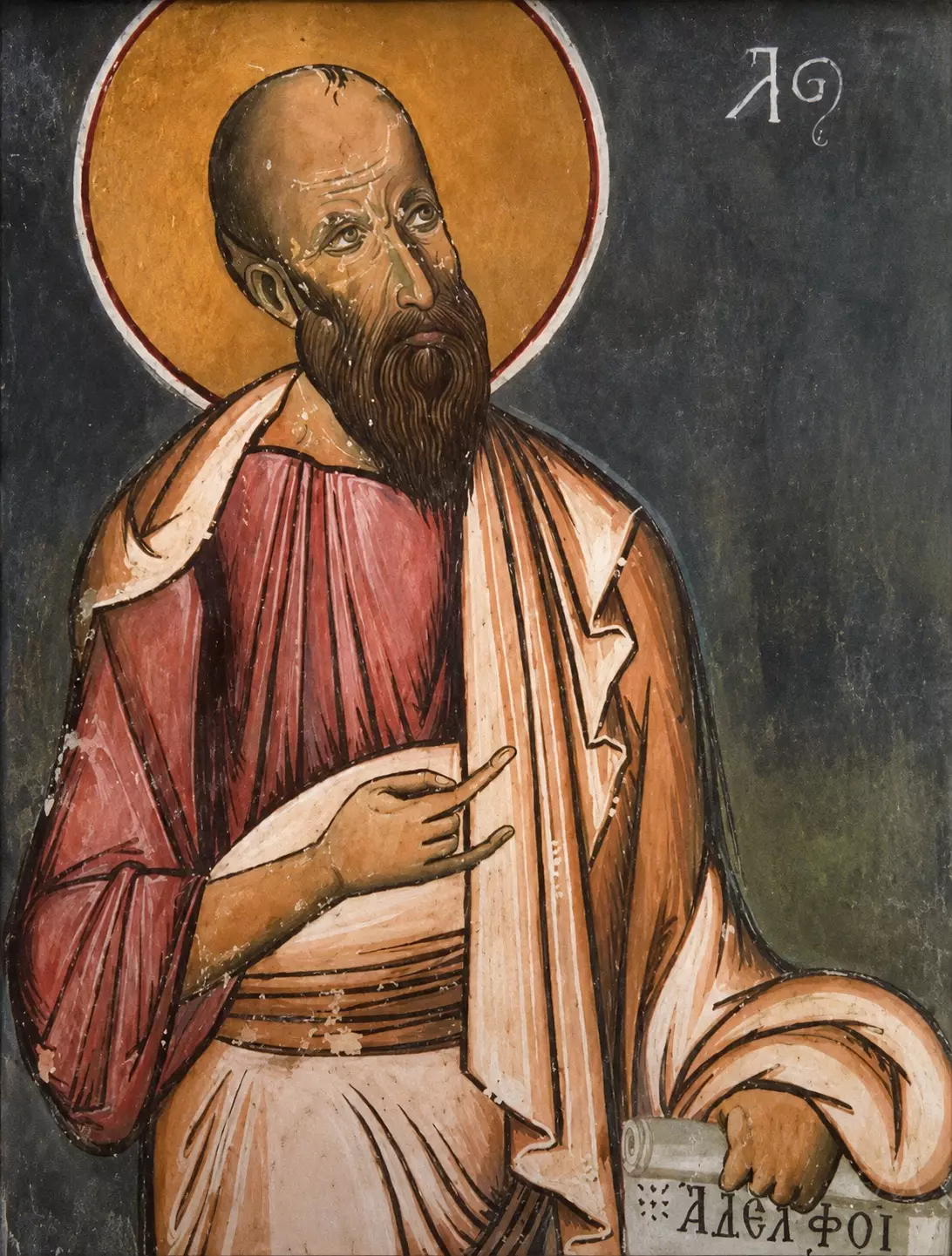
The Apostle Paul is depicted bald, with a long dark beard and a face deeply furrowed, in a fresco in the katholikon of Panagia tou Araka, in the mountain village of Lagoudera in Cyprus. The work belongs to the great decorative program which, according to the dedicatory inscription above the north entrance of the church, was financed in December 1192 by Leo the Authentes. Research attributes the ensemble, though not with absolute certainty, to the painter Theodoros Apseudis, the same artist who had already painted, a decade earlier, the Enkleistra of Saint Neophytos in Paphos.
In the apostle’s face, age is not rendered as wear but as spiritual maturity. The gaze, directed slightly upward, is accompanied by raised eyebrows that lend the expression something between ecstasy and thought. The right hand, half-open, forms a gesture of speech, while the left holds a rolled codex with the inscription “BROTHERS” visible, a word that directly recalls the way many of his letters begin. The pink-toned tunic is partly covered by a white himation, rich in folds that fall over the left shoulder and wrap around the arm with almost linear precision.
These frescoes rank among the most fully preserved cycles of Middle Byzantine painting in Cyprus and reflect the artistic currents of the imperial capital.
Byzantine art behind the fresco of the Apostle Paul
The style belongs to what scholarship calls the late Comnenian manner, a phase of Byzantine art in which the figure acquires heightened expressiveness without losing its geometric discipline. The garments are not merely a covering for the body; they function almost as an independent design, with the folds arranged in parallel lines abruptly lit, creating the impression of movement across an otherwise still surface. The halo, a deep ocher with a darker outline, separates the head from the gray-green background without cutting it off entirely from it, since the shadow at the lower part of the face continues visually into the light of the circle.
The choice of gesture is not accidental. In the iconographic tradition of the apostles, the open palm with two fingers in a speaking pose signifies teaching, the transmission of the word to those who listen but are not represented. Paul holds no keys and bears none of the traits of the elderly, rounded beard that conventionally identifies Peter; his own, pointed and long, together with the high, bare forehead, is a fixed feature of his iconography in almost every monument of the period.
At the upper right, part of an inscription is visible, largely illegible, which probably gave the saint’s name, as was customary in similar figures. This writing, together with the inscription on the codex, created for the believer of the time a familiar, almost oral relationship with the apostle’s person, who stands here not as a distant symbol but as a teacher in the midst of speech.
Within the ensemble of frescoes at Panagia tou Araka, Paul’s figure does not stand out for its size or placement. It stands out for the intensity it manages to compress into a few lines of color, the legacy of an art that, by the end of the twelfth century, had already learned to speak of the soul through the face.


