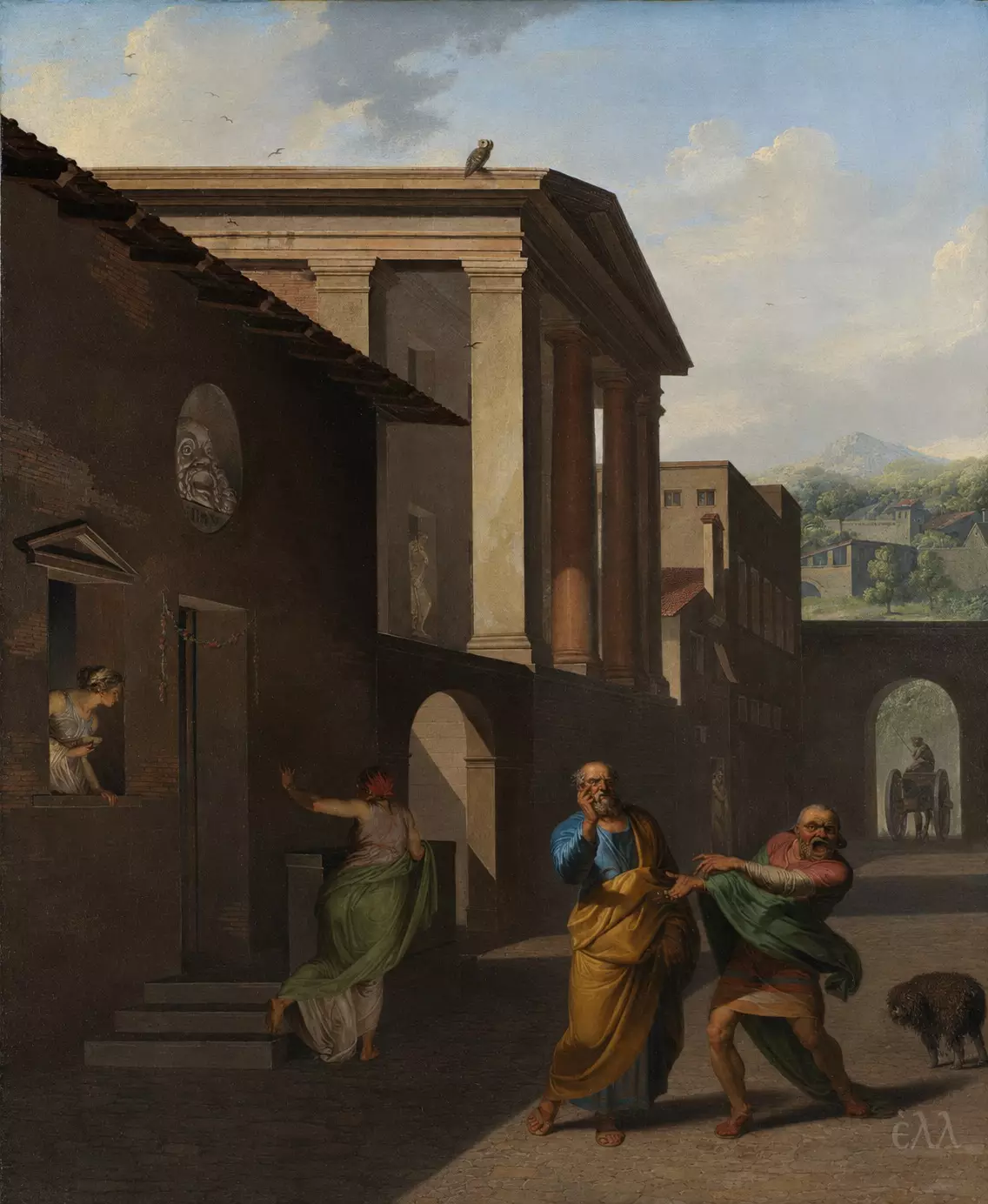
In 1801, the Danish painter Nicolai Abildgaard completed in Copenhagen a painting based on a scene from Terence’s Roman comedy, “Andria, or the Girl from Andros.” An oil on canvas measuring 158 by 129 centimeters, the work is now housed in the Statens Museum for Kunst in Copenhagen. The artist, born in 1743 in the same city and deceased in 1809 at Frederiksdal, was at that time in a particularly productive period of his painting career, having linked his life with his second wife, Juliane Marie.
The painting is the first of four large canvases that Abildgaard designed as a wedding gift, intended to adorn the couple’s apartment at the Royal Danish Academy of Fine Arts in Charlottenborg. Each depicts a different moment from the comedy’s plot, in which the old Simon suspects that the pregnancy of his son’s beloved is an arranged fraud meant to force him into marriage. The scene chosen here captures the midwife as she leaves the young mother’s house, while Simon, before the slave Davos, voices his disbelief at the entire matter of the birth.
The Midwife Bids Farewell to the Girl from Andros: the scene on a Roman street
A narrow street, made up of stone buildings with tiled roofs and an imposing temple with Ionic columns in the background, organizes the entire composition in perspectival depth. At the far right, an arch opens onto a second, brighter square, where a man drives a cart drawn by a horse. On the roof cornice, a dove stands motionless, a small detail that gives the scene a breath of everyday life amid the tension in the foreground.
In front, at the threshold of the house, a female figure in a green cloak hastens away, one hand raised in a gesture of farewell; this is the midwife, who has just left the room where the birth took place. From above, in an open window, a woman watches what is happening in the street without taking part in it. At the center, two men dominate visually. The older one, bearded and wearing a rich yellow himation over a blue chiton, brings his hand close to his face in a posture of deep, almost embarrassed thought. Davos, to his right, restrains him by the garment with force, his mouth open in the middle of a cry or protest that we do not manage to hear. Between them runs all the tension of the comedy, without the need for a single word.
Color, light, and technique in Abildgaard’s art
The light falls obliquely from the right, leaving most of the façade on the left in deep shadow, where an oval relief with a satyr-like figure and the inscription “PAN” engraved below can be discerned, a trace of playful learned culture. The palette moves through earthy tones, ochres, golds, deep green, while the sky opens into blue and illuminated clouds, a technique borrowed from 17th-century Dutch street painting, which the Danish artist knew well. The dog on the right, with its dense grayish coat, adds a note of narrative immediacy, almost indifferent to the quarrel among the people.
The architectural precision of the columns and pediment betrays Abildgaard’s knowledge of ancient Rome, drawn in part from his years of study in Italy. Yet this is not an archaeological document; it is a theatrical set, arranged with almost stage-directorial exactitude around two figures struggling, one with his suspicions, the other with the need to overthrow them. In the broader course of Northern Neoclassical art, this painting stands as one of Abildgaard’s most personal works, born of a love relationship that, after an unhappy first marriage, gave him new subjects to explore: family, birth, and trust among people who share the same roof without always sharing the same truth.


