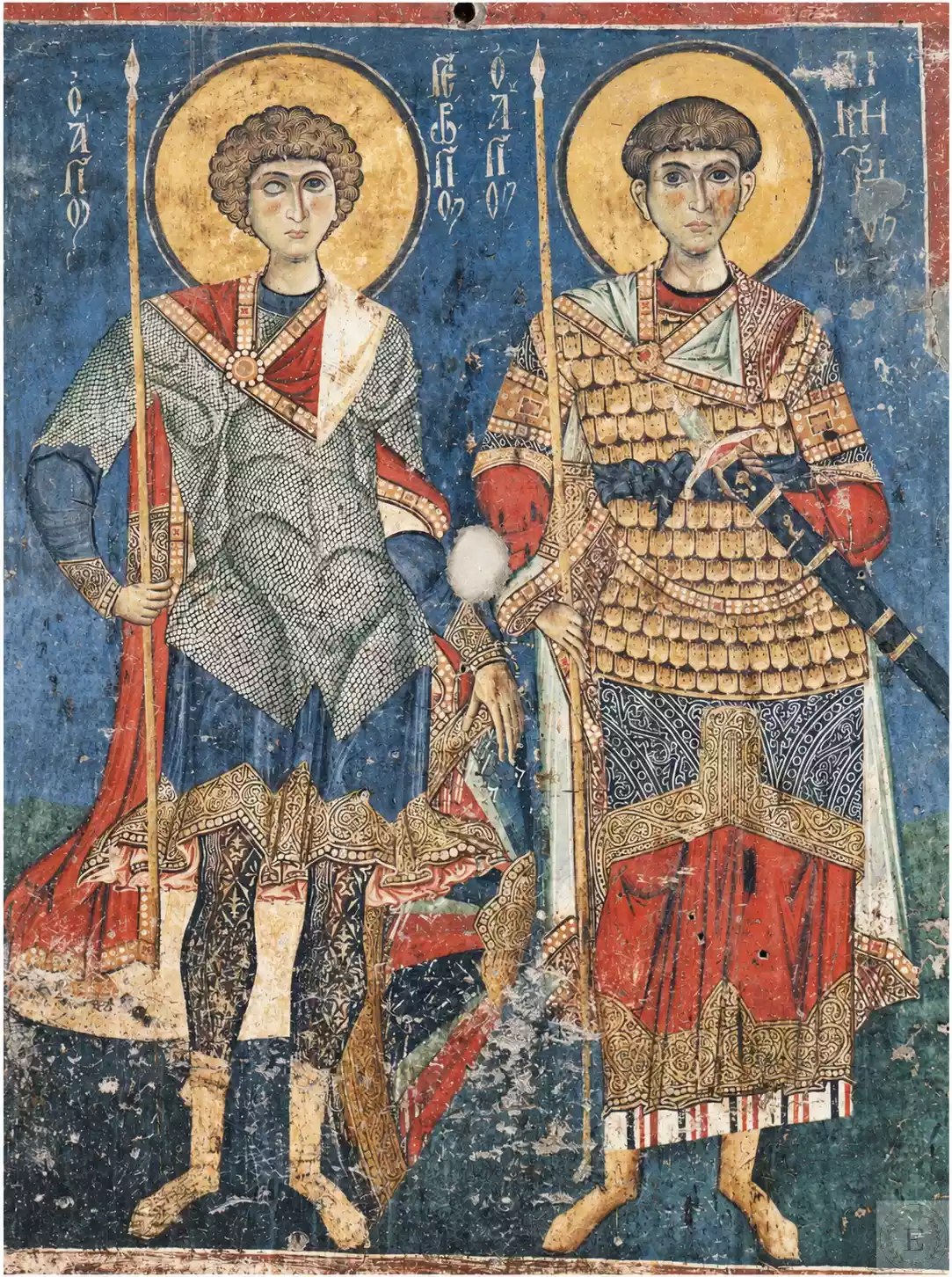
 Saints George and Demetrios, wall painting, c. 1180. Kastoria, Church of the Hagioi Anargyroi, nave, beside the sanctuary.
Two spears rise in parallel, dividing the scene into vertical strips and holding apart two figures who otherwise stand almost shoulder to shoulder. In the nave of the Hagioi Anargyroi at Kastoria, below the Entombment and in a privileged position beside the sanctuary, the anonymous painter of the church’s second layer of wall paintings depicted Saints George and Demetrios around 1180, the most familiar pair in the company of military saints. Young and beardless, standing frontally, the two saints share the same posture and the same gravity. What sets them apart lies in their dress: two suits of armour that differ in almost every particular.
The Lemniotes’ church and the donor’s saint
The small basilica of the Hagioi Anargyroi had been painted once before, a good while earlier. In the narthex, where the twelfth-century paintings have fallen away, older images can be made out; G. Millet placed them at the beginning of the eleventh century and A. Orlandos in its middle decades, as Charalambos Bakirtzis’s article on one of the church’s inscriptions sums up. The second layer, to which the two military saints belong, is connected with a local family, the Lemniotes. Its date is given sometimes broadly as around 1180 and sometimes, with reference to the monograph on Kastoria by S. Pelekanidis and M. Chatzidakis, as around 1170–1180; the two proposals are not far apart, though the exact year remains unknown.
Eight inscriptions in the church, all from the same layer, are according to Eugenia Drakopoulou’s study dedications by the family. In the narthex, beneath the angels of the Ascension, an epigram of sixteen iambic dodecasyllables presents Theodore Lemniotes dedicating the church to the physician saints, the Holy Anargyroi, and asking them to heal his ailing flesh. In the north aisle he appears himself, with his wife Anna Radene and their son John, accompanied by inscriptions that were rewritten later. In the south aisle a monk, Theophilos Lemniotes, also declares himself a donor. His identification with Theodore, which had been proposed, Drakopoulou regards as unfounded, pointing out that the two figures do not resemble each other.
The north aisle, according to a further verse inscription above the door into the narthex, is dedicated to Saint George, whose miracles its decoration recounts. Here the donor addresses the saint in the first person. He has had him as his protector, he says, since he was in swaddling clothes, and now, having first “written” him in his heart, he paints him in colours on the walls. The inscription is badly damaged in its central section; Drakopoulou’s reading differs appreciably from that of Orlandos, while Chatzidakis had confined himself to lines 1–4 and 14–16. Two lines, with the editor’s restorations in square brackets:
τανῦν δὲ καὶ [χρώμασιν ὑλ]ικωτέ[ροις]
[τῶ]ν θαυμάτων σου ζωγραφῶ τὰς εἰκόνας
English translation
Lines 3–4 of the epigram in the north aisle: “But now, with more material colours as well, I paint the images of your miracles.”
Against this background, George’s presence beside the sanctuary carries added weight. He is the saint of the donor’s personal devotion, co-titular saint of the church with an aisle of his own, and here, in the nave, he stands next to Demetrios. Saint Demetrios, for his part, is not alone in the programme: he is honoured in the church together with the Venerable David and the Venerable Theodora, two further saints of Thessalonica. On a reasonable reading, then, the choice of this pair ties the piety of a private patron to the cults of the great city of the region.
Frontality and an almost imperceptible turn
The composition is built on juxtaposition. The bodies stand frontally, each turned slightly towards the other, so slightly that the movement might go unnoticed were it not confirmed by the shoulders and the slant of the garments. Each holds his spear upright in his right hand (on the left side of the figure, as the viewer sees it), its leaf-shaped head reaching high into the blue ground above the haloes.
The inscriptions take up the vertical. Written in columns, letter beneath letter and with ligatures, they flank each head: the epithet “ὁ ἅγιος” to the left of the figure, the name to the right. From this symmetrical arrangement a small felicity arises at the centre of the scene, where George’s name and Demetrios’s epithet meet between the two haloes, two columns of letters running parallel to the spears.
The background is divided horizontally. Dark blue spreads across the upper part; lower down, at roughly knee height, a dark green band marks the ground. A red border frames the scene above and below. The haloes, ochre-yellow discs with dark outlines, are considerably worn, as is the lower zone, where the plaster has lost much of its paint layer.
Scales, plates and fabrics
For George the painter devised a close-fitting cuirass of small, dense scales in a greyish green, its curving rows describing chest and abdomen as if drawing the torso beneath. Across it run two ornamented straps studded with white dots like pearls, meeting at a round brooch on the chest. The red chlamys with its white lining falls behind his back and opens out low, on the side of the spear, in a broad and almost theatrical curve. Beneath the cuirass a blue tunic is visible, together with a wide decorated belt in a golden tone, bearing scrolling plant forms and ending in a rose-red tip. The shins are clad in darkly drawn leggings, with lighter wrappings further down.
His left hand, in a dark blue sleeve, comes down with fingers outstretched to touch the rim of the shield, which stands upright on the ground between the two saints. Only part of its ornamented border and multicoloured surface can be seen; the rest is lost behind the chlamys and in the damage to the lower zone. A little higher, at the level of the forearm, a white patch marks a spot where the paint has gone.
Demetrios looks heavier, and he is. His cuirass is made up of large, rounded plates in ochre, set in horizontal rows from shoulders to hips, with shoulder pieces decorated with meanders and with red sleeves. A dark blue sash is knotted at the waist. With his left hand, at belt level, he holds the scabbard of his sword, which slants down towards the viewer’s right. His light-coloured chlamys, fastened with a brooch, falls over the shoulders and behind the body. Further down, a dark blue skirt with white ornament and the long red tunic, with golden decorated bands and a striped hem in red, white and a dark tone, all but hide the body underneath. Small dark holes can also be seen in the red fabric.
The contrast seems deliberate: one cuirass that lets the body show through and one that encloses it, with equally rich ornament in each case, so that the symmetry of the pose is brought to life by the variety of the surfaces. Whether the painter was copying real military equipment of his own day or repeating forms handed down by tradition is a question that Piotr Grotowski’s study raises in general terms for the iconography of the military saints between 843 and 1261, comparing the images with Byzantine military manuals. The Kastoria wall painting provides material for such a comparison, although the image alone cannot decide the matter.
The face of Saint Demetrios up close
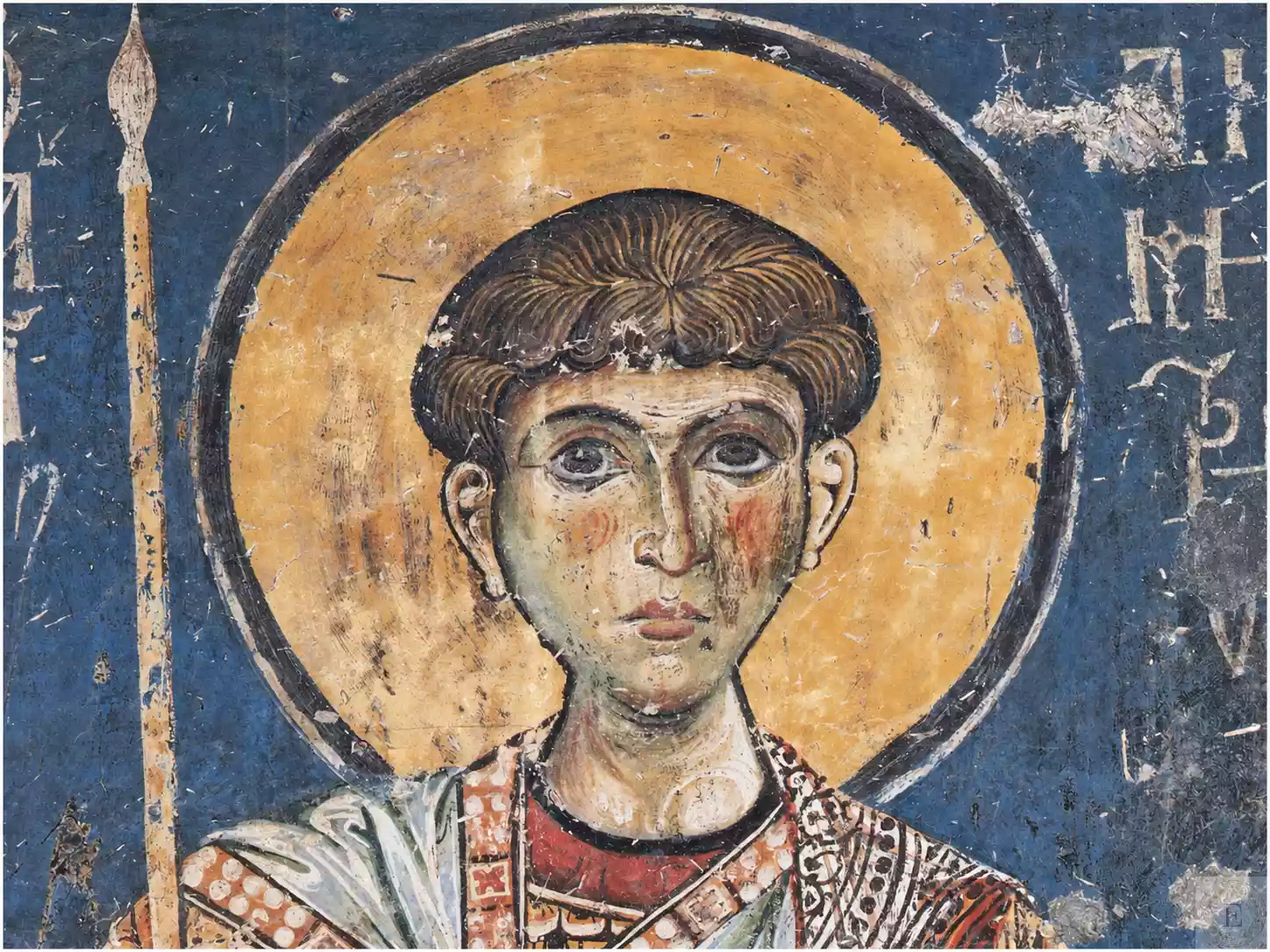 Saint Demetrios, detail of the wall painting of Saints George and Demetrios, c. 1180. Kastoria, Hagioi Anargyroi.
In the detail, the first thing to catch the eye is the hair. Brown and short, the strands radiate from a point on the crown and descend in fine dark lines, ending over the forehead in a row of small curls. George’s hair, by contrast, breaks into dense spiral locks that enclose the head like a sphere: two calligraphic solutions for the same youthful type, almost a distinguishing mark for each saint.
The modelling rests on a greenish proplasmos, that is, the darker first layer of the flesh, which stays visible in the shadows of the neck, on the jaw and around the mouth. Over it the lighter ochre tones are laid. On the cheeks, red circular spots with small curved strokes; on the bridge of the nose, below the eyes and on the neck, white linear highlights, which on the neck form curves. The arched eyebrows run on into the long, straight line of the nose. The eyes are large, with dark irises, and the gaze is turned directly towards the viewer. A dark contour closes the oval of the face and the ears. The small mouth with its red lips gives no movement to the expression, which is grave, if anything restrained.
The surface bears scratches and small losses through flaking, denser on the halo and on the right side of the forehead as the viewer sees it. At the upper right, the beginning of the name has disappeared in an area of damage, while the remaining letters continue “Δημήτριος” vertically. At the base of the neck, the red collar of the tunic and the band of the chlamys with its white dots, the same as those on George’s straps, bring back into the detail the ornament that seems to dominate the full view.


