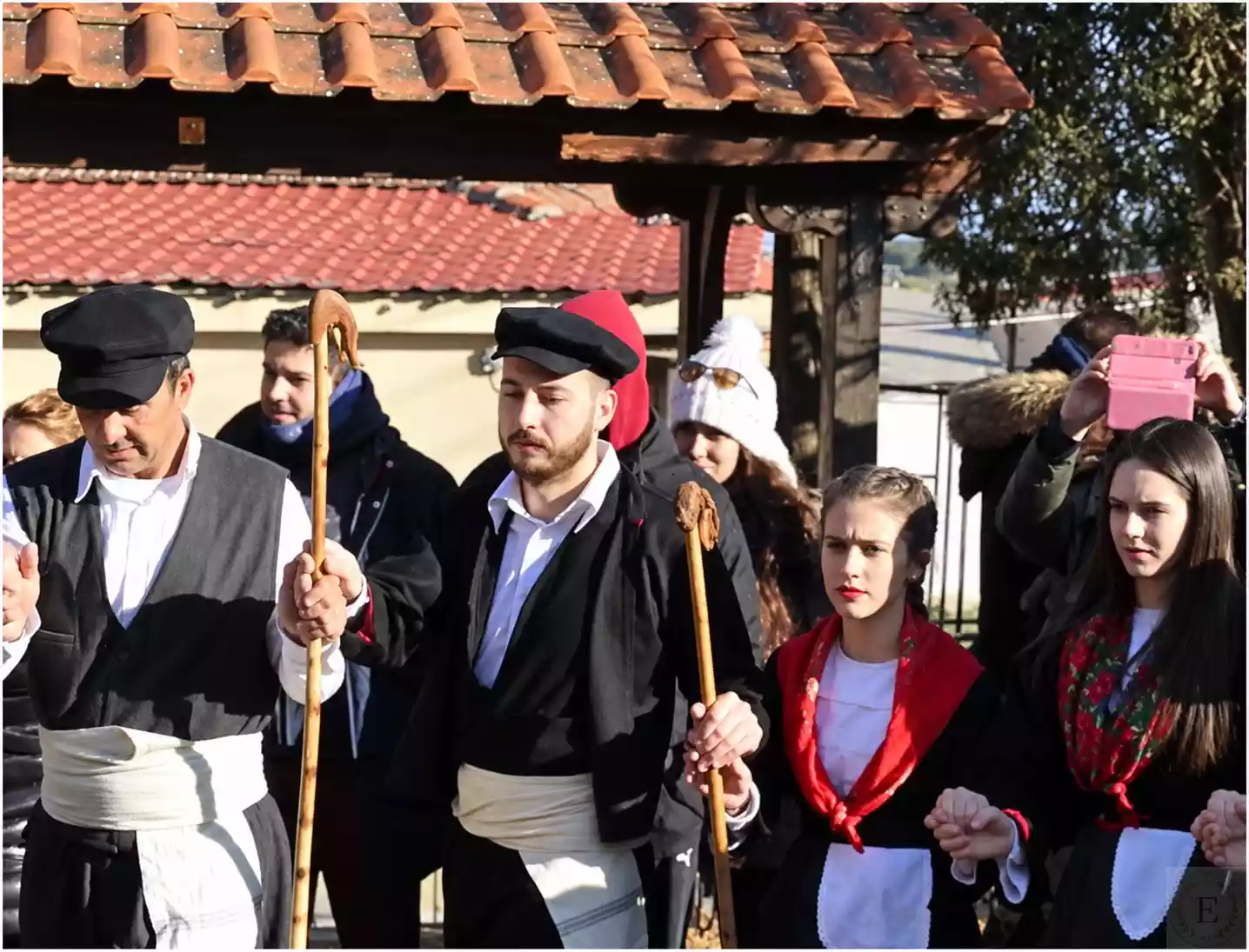
 An outdoor traditional dance. This shot shows festive costumes, without the animal masks and bells of the Babougera.
In Kali Vrysi, near Drama, the animal-masked revellers known as Babougera take to the streets from 6 to 8 January, heavy bells strapped around their waists, drawing villagers and visitors alike into teasing and dancing. They appear once the waters have been blessed on the feast of Theophany (Epiphany) and roam for two further days, prolonging the customary celebrations of the Twelve Days. Here the wish for a prosperous year finds a noisy, physical expression, in a place where farming and stock-rearing have left a deep imprint on everyday life.
The Dionysian affinity of the custom
Goat-like masks and fertility symbolism underpin the familiar association of the Babougera with the worship of Dionysus. Local interpretation gives particular weight to the ancient sanctuary uncovered near Kali Vrysi, which is linked with the god. The label “Dionysian survival”, however, calls for caution when it is offered as a historical finding: to establish the unbroken continuity of a specific ritual since antiquity, one needs successive testimonies, not merely resemblances between symbols or the presence of an ancient cult in the area.
Folklorists place the Babougera among the so-called evetiria, that is, ritual acts intended to secure a good year and a fruitful harvest. It is within this framework that the vigorous movement and the temporary disruption of daily routine acquire their meaning. The masqueraders’ pranks are accepted “for good luck”, as the record of the custom puts it.
How the animal mask is made
The goat’s appearance is achieved by combining cloth and sheepskin. The folklore record hosted on the website of the Democritus University of Thrace describes a mask of white handwoven wool, onto which pieces of fleece are fixed to form the eyebrows and a long beard. The horns are shaped from the same woven cloth and tipped with fleece. Red braid outlines the eyes and nostrils, while a small round mirror is sewn onto the forehead. In place of a mouth, two rows of beans form the teeth.
Dimitris Sidos also describes the preparation of the skins in his interview for the Istorima archive: they are salted, dried in the sun and then cut to the required size. In the same account he explains that the mask has a fabric base to which the skins are added. His testimony fills out the description of how the costume is made, showing how much work goes into it before it is ready.
Beneath the black outer coat, extra clothing is bundled to form a hump. Once the masquerader puts on the mask, the natural outline of the body has already changed; the head looks larger, the back juts out, and the weight of the bells is added at the waist.
The weight of the bells and the art of movement
The large shepherd’s bells of the costume come straight from pastoral life. Choosing them takes care, since what matters is also how they sound together. The folklore record mentions the search for suitable bells, even involving journeys or hiring them from herders, so that their combination produces the desired effect.
In the oral testimony of Dimitris Sidos, the total weight is said to range from twenty to forty kilograms. The estimate refers to the sets described by this particular participant; sizes are adjusted to the strength of whoever is to wear them. He lays special emphasis on tying them correctly, because the ropes transfer the load to the waist and shoulders and cause strain when running.
This relationship between body and weight helps to explain why the step matters so much. As the torso shifts, the bells are set in motion; running makes the strokes come thicker and faster, while turns alter the way the whole ensemble sounds. The sound is produced on the very person carrying it and follows the limits of his endurance. Even a brief pass along the street requires familiarity with the costume.
Gaida, dacharés and rhythmic noise
The musical tradition of Kali Vrysi is distinguished by the gaida, the local bagpipe, and the dacharés, a round frame drum with a stretched skin, also known as the dairés. Their presence in the wedding procession is recorded in folklore testimonies, while the guide published by the Institute of Cultural and Educational Technology stresses the deafening din of the bells and the mocking banter of the masqueraders in the narrow lanes.
From a musical point of view, two ways of organising sound can be distinguished. The instruments sustain the dance sequence, whereas the strokes of the bells depend on the movements of the wearer. This is an analytical distinction that helps us follow what happens during the festivities: the shared step of the dance coexists with the sudden dashes and turns of the Babougera towards the onlookers.
The explanation that the bells “wake up nature” belongs to the symbolic world of the custom. In the relevant interpretations, the intensity of the sound is linked with driving away evil and with the hope of fertility. The word “magic” is used in this same folkloric sense: as the effect the ritual act seeks to have on the world surrounding the community.
The mock wedding and the abduction of the bride
On 8 January the festivities reach their climax with a staged wedding. The detailed record hosted by the Democritus University of Thrace describes the shaving of the groom and the dressing of the bride, before the wedding procession makes its way to the square. In older descriptions, the ceremony is conducted by a man playing the priest, who offers the couple facetious words of advice. The brief presentation by the Institute of Cultural and Educational Technology likewise underlines the exuberant, satirical spirit of the event.
The form of the performance has undergone adaptations. In his 2022 interview for Istorima, Dimitris Sidos explains that the satirical priest has been replaced by Dionysus, a more recent change intended to avoid friction with the Church. In his account, the procession collects the bride and carries her dowry to the square.
The bride is played by a man. As the record by Aikaterinidis describes, the Babougera suddenly seize her and immediately let her go. This particular testimony documents an abduction and a release; no episode of the bride’s death and resurrection appears in its description. The broader association of the custom with the rebirth of nature should therefore be kept distinct from the individual acts performed in the wedding enactment.
The wedding game makes room for wishes for the continuation of life, together with a lampooning of customs the spectators know from real weddings. The abduction is slotted into this familiar sequence, between the visits and the feasting that follows.
The costume passes to the younger generation
Children, too, dress up as Babougera, as the folklore record points out. Their participation gives the transmission of the custom a practical dimension: they see how the costume is prepared and grow used to the disguise, wearing bells suited to their strength.
When preparations begin for the following year, the fastenings must be checked once more and the masks looked after. That is where part of the younger participants’ apprenticeship continues, alongside those who already know how the weight is to be secured on the body.


