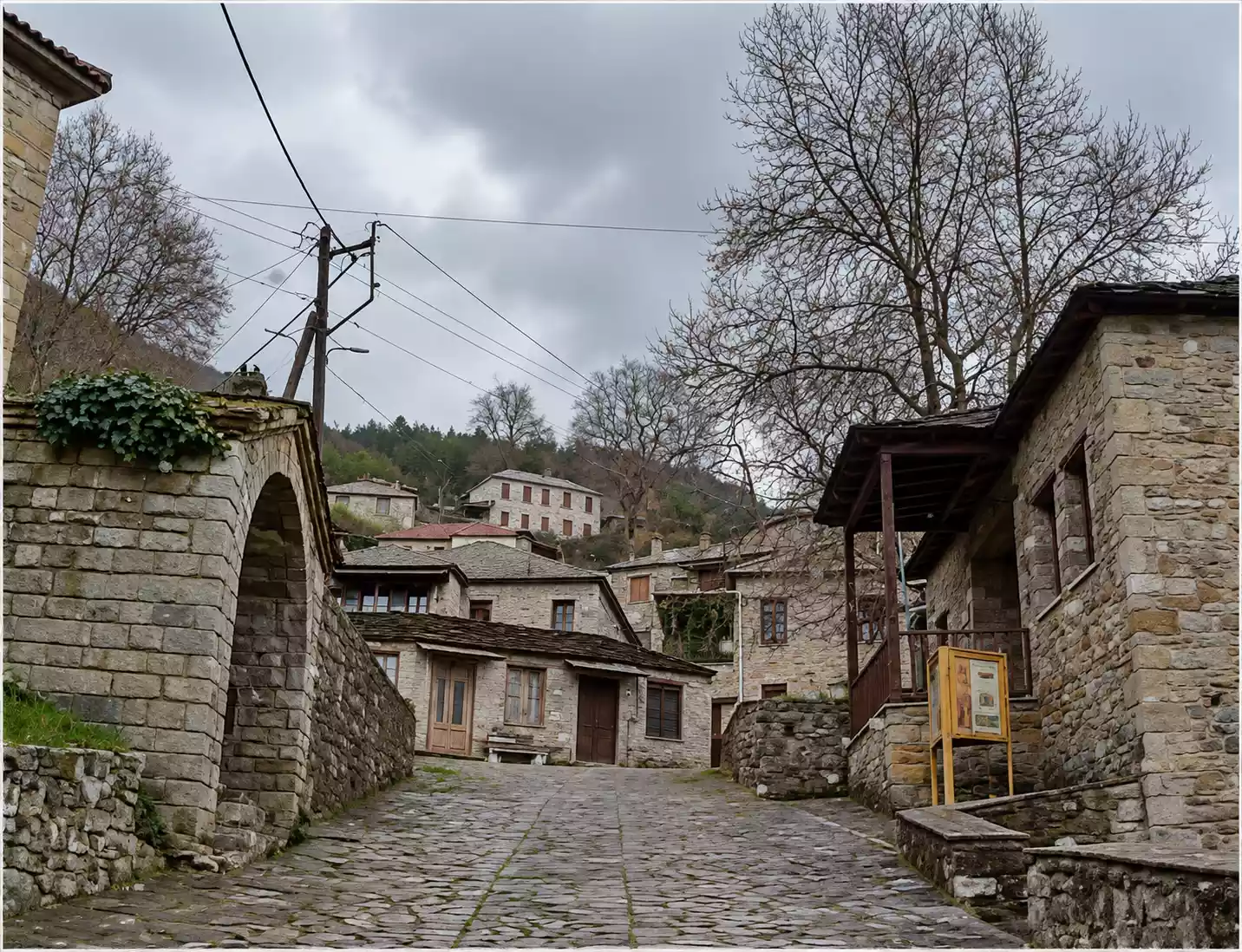
 A stone-paved communal space between the stone buildings of a mountain village.
In the Mastorochoria of Konitsa, on the slopes of Mount Grammos and across the wider Sarantaporos area, building was for generations the trade that shaped working life. From these mountain settlements set out crews who took on construction far from home, carrying their technical knowledge with them and returning with what they had learned elsewhere. Pyrsogianni and Vourbiani rank among the oldest centres of this tradition, while Gorgopotamos became known above all for woodcarving. Plikati belongs to the same highland world, though its communal history is its own.
The name itself calls for a word of clarification. As a historical and cultural term, “Mastorochoria” – literally “the master builders’ villages” – has a broader currency than the name of the former Municipality of Mastorochoria. All four villages did belong to that municipality, whose seat was Pyrsogianni, until it was abolished and its settlements absorbed into the Municipality of Konitsa under the 2010 administrative reform.
Work beyond the village bounds
Rugged terrain and limited scope for extensive farming helped to turn the population towards the building trades. That specialisation was reinforced by apprenticeship to older craftsmen, within the crews and through ties of kinship. The university documentation on the master builders of Epirus describes how knowledge passed on at the building site itself, where the younger man gradually learned to recognise the properties of materials and what a given structure demanded.
The work gangs, the well-known bouloukia, were led by a protomastoras, the master builder who sought out commissions and negotiated the terms. A crew brought together craftsmen of different skills alongside apprentices, with unequal shares of responsibility and pay. Departure usually came after Carnival and the return towards winter, although this seasonal pattern did not hold for every case of migrant labour.
Among themselves the builders used koudaritika, a secret professional argot that kept the crew’s conversations from outsiders. Its use belonged to a working world in which access to the craft and to commissions bore directly on a family’s survival.
Pyrsogianni: the building tradition and its records
In Pyrsogianni the builder’s craft came to occupy a central place in the village economy, alongside small-scale farming and stockbreeding. The professional journeys of its inhabitants explain why the history of a fairly small settlement is bound up with buildings in so many other regions. The village was a point of departure for work, but also the place to which the craftsmen returned, keeping up family obligations and ties.
Among its notable buildings are the churches of Saint Nicholas and Saint George. The latter is of interest both for its construction and for its interior decoration, where woodcarving meets painting. Church buildings allow one to follow this collaboration between trades, which is often lost from view when an entire work is credited loosely to “the builders”.
Of particular importance is the material assembled for the Museum of Epirote Master Builders. Tools and contracts, photographs of completed works, records of the routes the crews travelled: all of these open up lines of study beyond the observation of surviving buildings. A contract, for instance, can shed light on the economics of a construction project, which the finished façade leaves out of sight.
Vourbiani and the place of education
Together with Pyrsogianni, Vourbiani is cited as one of the largest master builders’ villages in the area. Its history, however, is also marked by educational activity. The old Scholarcheion, a Greek secondary school of the period, was an important institution for the wider district, linking the community to formal schooling and to careers that reached beyond construction. The relevant record of the National Technical University of Athens notes that a scholarcheion was already operating in the nineteenth century.
This side of the village’s past allows a fuller reading of it. Professional specialisation went hand in hand with the effort to give children other opportunities, and maintaining a school presupposed a commitment that went beyond the needs of any single household.
The church monuments of Vourbiani include the Church of the Panagia, with a fine templon and icons by painters from Chionades. Their presence reveals the artistic links between neighbouring communities, where different specialisms could meet in a single building.
Gorgopotamos, the old Tournovo of the woodcarvers
Gorgopotamos near Konitsa, formerly known as Tournovo, was an important centre of woodcarving. The Tournovite craftsmen undertook ecclesiastical commissions as well as work in private houses, specialising above all in church furnishings. Templa and episcopal thrones called for a command of design, careful preparation of the timber and long, patient handwork.
In Aikaterini Polymerou-Kamilaki’s study of the Tournovite woodcarvers, extracts from which appear in the educational volume Λαογραφία – Παραδοσιακός πολιτισμός (“Folklore – Traditional Culture”), the family emerges as the principal setting in which the craft was handed down. Apprentices began with ancillary tasks and progressed to drawing under the supervision of the master.
The carvers drew their decorative motifs from the natural world and from biblical narratives. A design could be transferred onto the wood by means of pricked paper and powder, so that the lines were marked out before carving began. No less decisive was the choice of material. Walnut was widely used, while younger craftsmen such as Vasileios Skalistis also worked in robolo, the Bosnian pine.
Plikati and the ties of a mountain community
On the slopes of Grammos, Plikati links the history of the Mastorochoria to the mountain environment and to the movements of its people. Its position close to the Greek–Albanian border lends particular interest to the study of the community, since local bonds took shape under shifting historical conditions.
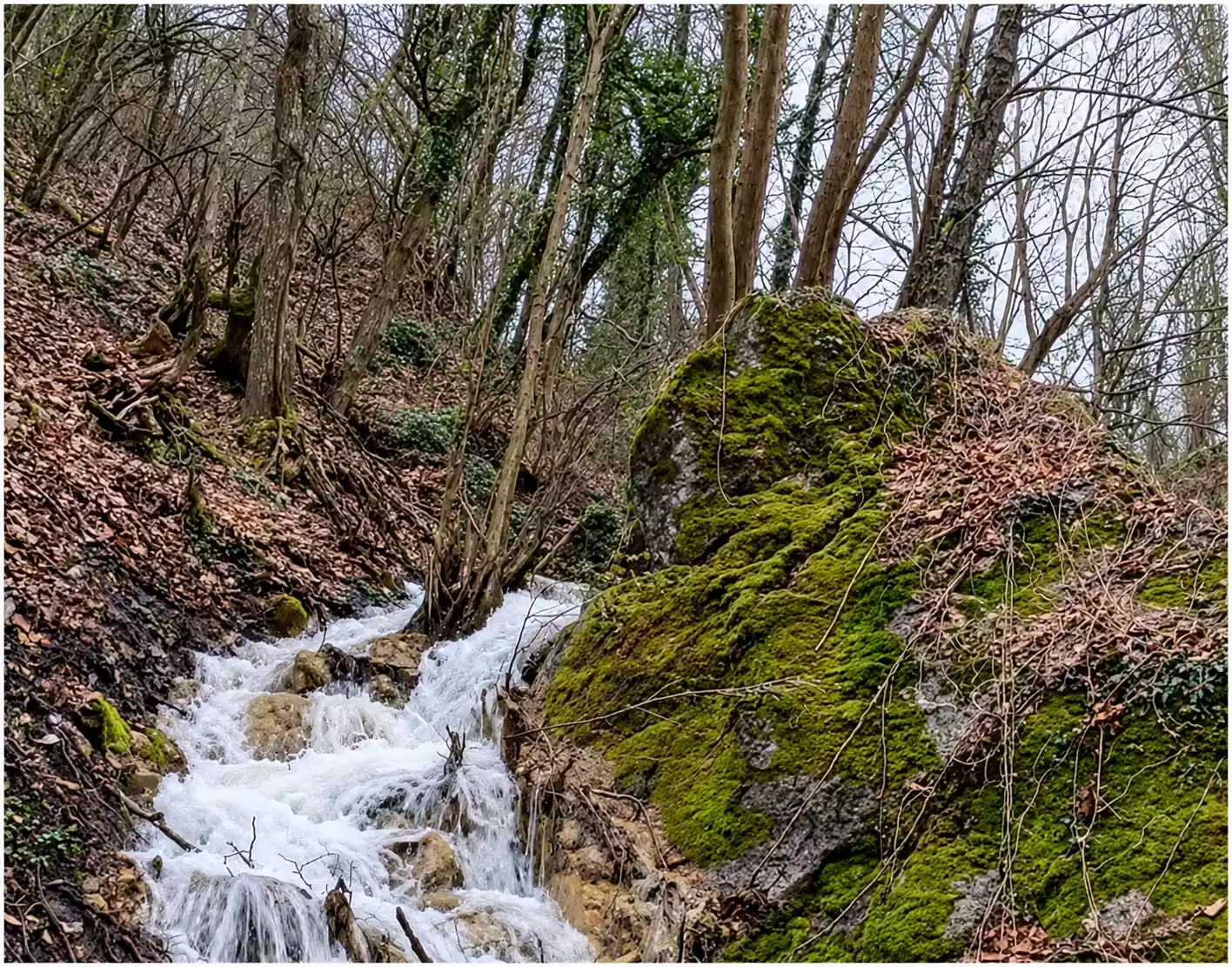 Small cascades of water in a wooded streambed, among moss and fallen leaves.
The archival ethnography of Chrysanthi Vasakou, at the University of Ioannina, examines Plikati through family memory and the organisation of the community. Marriage ties with neighbouring villages, Gorgopotamos and Vourbiani among them, were connected with labour migration and economic exchange. Kinship thus opened channels of communication between the villages, despite the distances and the difficult ground.
The household while the builders were away
Absences lasting many months shaped the daily life of those who stayed behind. Women bore much of the burden of running the household and the farm work, and families had to manage for long stretches without the men who were working far away. Ismini Tsoumpari’s architectural study of the Mastorochoria examines precisely this relationship between work, social organisation and lived space.
Seen from this angle, ordinary houses become as interesting as the more imposing public buildings. The layout of their rooms answered to the needs of the family, to the storage of provisions and to the seasonal rhythms of life. Studying them requires measured surveys and the testimony of those who lived in them, particularly where the uses of rooms have since changed.


