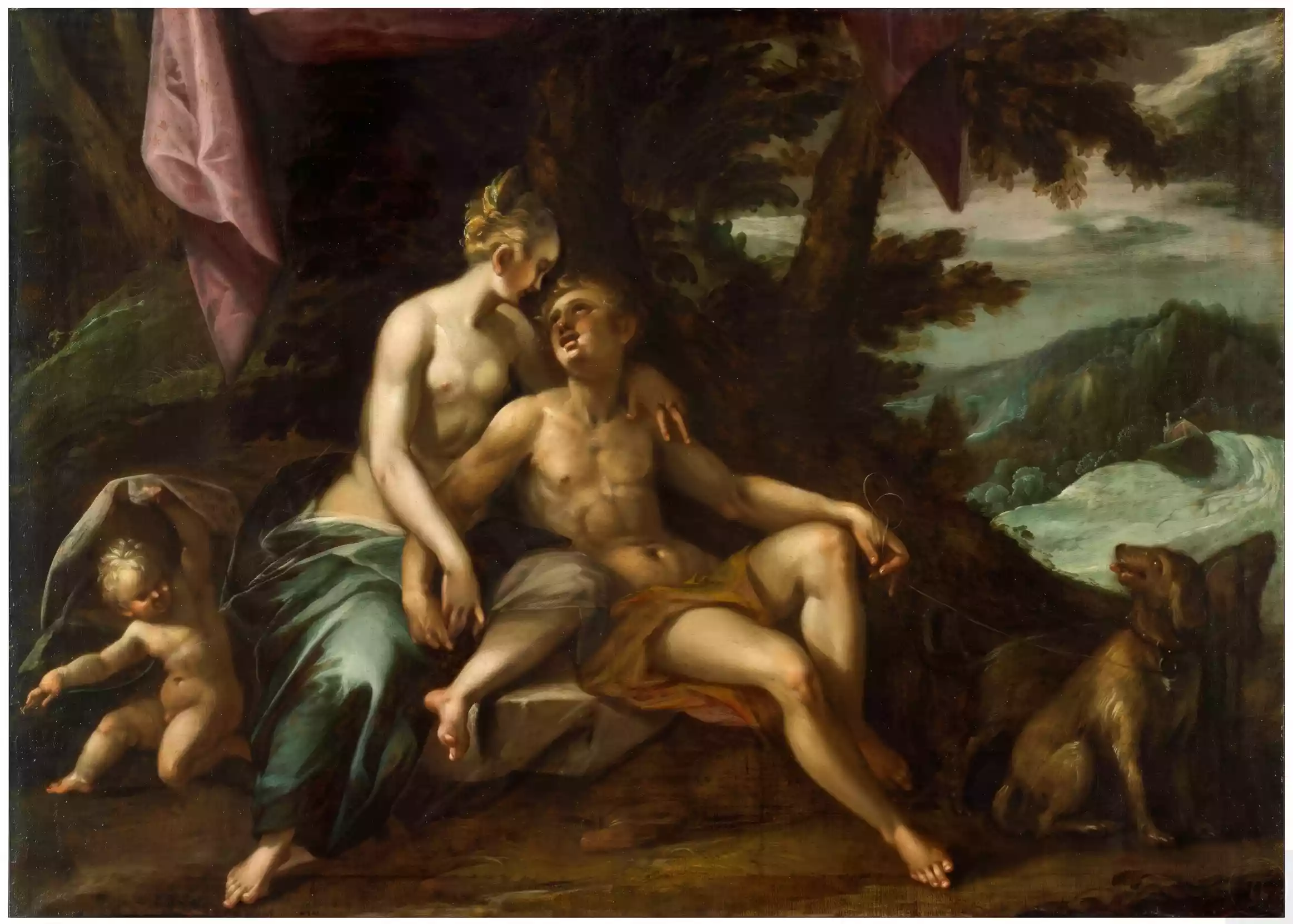
 Digital reproduction of Venus and Adonis, attributed to Hans von Aachen, c. 1574–1588. The original is oil on canvas, 68.2 × 95.2 cm, Harvard Art Museums / Busch-Reisinger Museum, Cambridge, Massachusetts.
In the shade of a great tree, Venus leans towards Adonis, who lifts his face to meet her gaze. Her arm passes behind his shoulders, while on the right a seated hunting dog turns its head towards the couple. Venus and Adonis, a painting attributed to the German artist Hans von Aachen and dated to roughly 1574–1588, is executed in oil on canvas and measures 68.2 × 95.2 cm. It belongs to the Busch-Reisinger Museum of the Harvard Art Museums in Cambridge, Massachusetts, under accession number BR77.1
What holds the scene together, above all, is the exchange of looks. Around this encounter the divergent movements of the bodies and the opening onto the landscape are arranged, with the small figure of Cupid at lower left, beside the draperies.
Venus and Adonis within the composition
Seated higher up, Venus sets her luminous torso against the dark foliage. The inclination of her head flows on into the shoulder and into the arm that encircles the youth. He sits obliquely, knees turned to the right, yet twists his face back towards the goddess. The opposition between the lower part of his body and the direction of his gaze lends movement to a scene of prolonged repose.
Lower down, in front of the draperies covering the legs of Venus, the hands of the two figures draw close and overlap. This contact echoes, on a smaller scale, the closeness of their faces.
The blue-green cloth gathers about the goddess’s hips and falls in dense folds to the ground. A pale grey drapery spreads between the figures, while a warm, ochre-red fabric covers part of Adonis’s pelvis and thigh. In the accompanying image, the sole of Venus’s foot comes close to the lower left of the composition. The young man’s outstretched leg runs the opposite way, towards the right, in front of the dog.
Beside them Cupid kneels, raising the edge of a cloth above his head with one hand; the other reaches out to the left. The gesture forms a small, relatively self-contained episode on the margin of the main group, where the dark fabric frames the brightly lit body of the child.
Light on the bodies and the opening of the landscape
The lightest tones are concentrated on Venus’s shoulder and breast. Her luminous flesh stands out against the browns and deep greens of the surroundings, whereas on Adonis the chiaroscuro brings out more strongly the articulation of the chest. Beneath the arm and around the abdomen the shadows deepen wherever the body turns or meets the draperies.
This difference in lighting allows the figures to be read separately, even though the embrace and the overlaps bind them closely together.
Behind the couple, the broad trunk of the tree and the dense foliage close off the depth. To the right, however, space opens out in cooler tones. Mountain masses succeed one another, with a bright expanse of water lower down and open sky above the slopes. The transition from the lovers’ shaded retreat to the distant landscape is abrupt, occurring almost directly behind Adonis’s shoulder.
A rose-pink curtain hangs from the branches, most clearly visible at upper left. Its folds lend the open-air setting something of the intimacy of an interior. The fabric also runs along the upper edge, although much of it is swallowed by the shadows of the foliage.
The attribution to Hans von Aachen
The authorship of the painting has been a matter of scholarly disagreement. The Louvre catalogue, in its entry on a drawing of Venus holding Adonis back as he sets out for the hunt, records differing views on the Harvard composition. Joachim Jacoby rejected its attribution to Hans von Aachen, whereas Eliška Fučíková regarded it as an autograph work by the painter and argued that the Louvre drawing was preparatory in character. The same entry notes that Thomas DaCosta Kaufmann concurred with her view. The relevant bibliography is gathered in the entry on the Louvre site des collections.
In formal terms, the elongated proportions and intricate arrangement of the limbs allow the scene to be described in the language of Mannerism. Venus bends forward, while Adonis turns towards her, keeping his legs pointed in a different direction. The ease of the embrace coexists with a pose that demands careful handling of the overlaps, particularly lower down, between the knees and the draperies.
At the far right, the dog holds its muzzle raised, its collar clearly visible. Its presence alludes to Adonis’s role as a hunter. It remains, nonetheless, close to the couple, within the same dark zone of the foreground, with the open landscape directly behind it.


