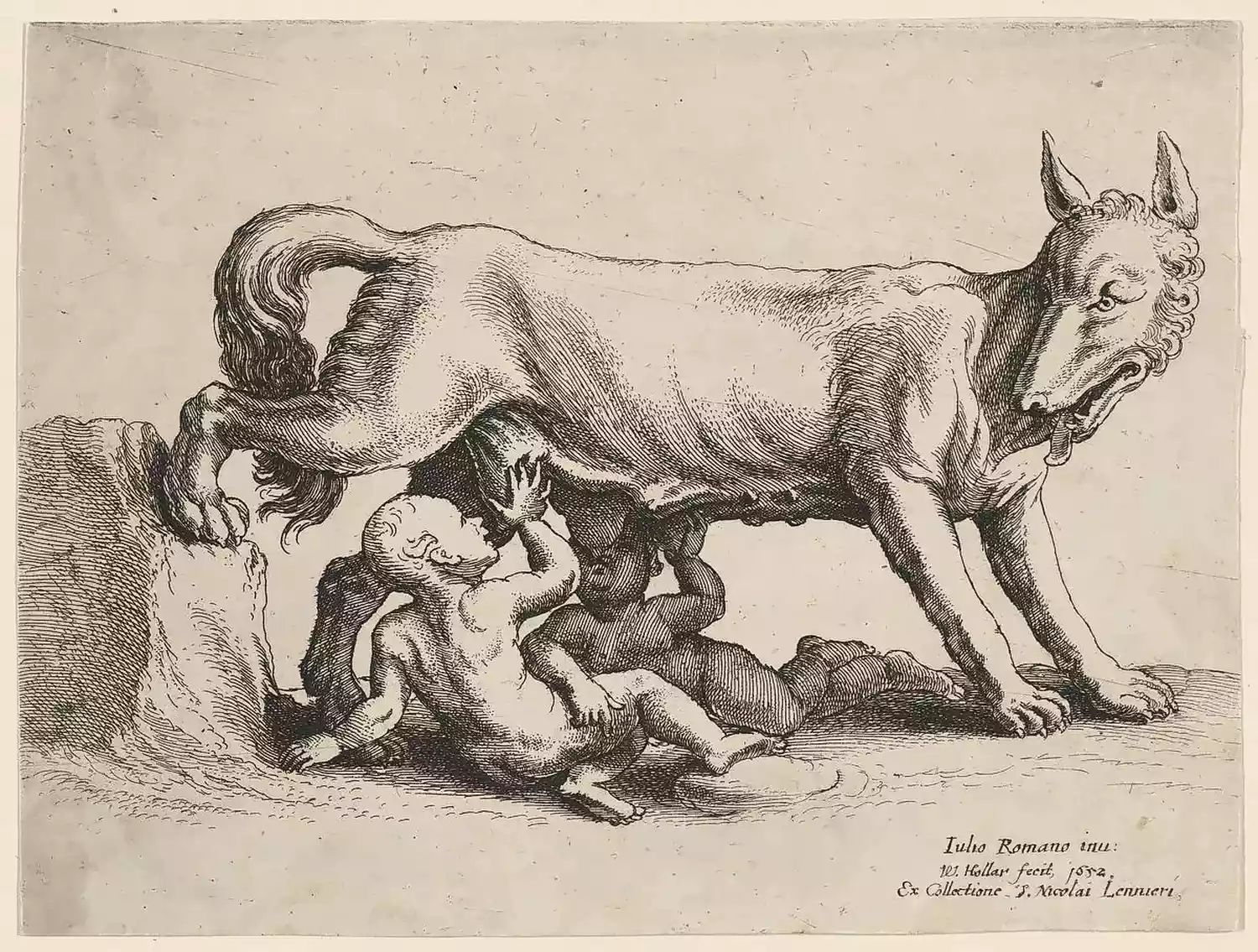
 Romulus and Remus with the she-wolf. Wenceslaus Hollar, etching, 1652, after a design by Giulio Romano for a stucco medallion in the Palazzo Te, Mantua. The Metropolitan Museum of Art, New York, acc. no. 17.50.18-119.
At the beginning of the story the Romans told about their city lay the death of a brother. Romulus, the eponymous founder of Rome, is left to rule alone when his twin brother, Remus, is killed in the quarrel over the new city – in some versions by Romulus’s own hand. Before this came the exposure of the infants on the Tiber and their rescue by a she-wolf, episodes that became an integral part of Roman tradition and later resurfaced in European art. For the ancient authors, however, neither the circumstances of the killing nor the responsibility of the survivor could be taken for granted, and the differences between their accounts bear substantially on how the myth is read.
The sources for Romulus and Remus
The canonical date of Rome’s foundation, 21 April 753 BC, combines two distinct elements: a feast day on which the Romans celebrated the birthday of their city, and a chronology that prevailed through the calculations of ancient scholars and is associated above all with Marcus Terentius Varro. The Parilia, a pastoral festival that Plutarch regarded as older than the foundation itself, fell on 21 April. The year, by contrast, remained a matter of dispute: Quintus Fabius Pictor, for instance, placed the beginning of Rome in 748/747 BC, according to the Olympiad reckoning that Dionysius of Halicarnassus attributes to him.
Fabius Pictor, the first known Roman historian, was writing at the end of the 3rd century BC, in Greek, and more than five centuries after the supposed age of the founders. Plutarch reports that he followed Diocles of Peparethus on many points, while early in the following century Ennius gave the Roman tradition poetic shape in the Annales. Fragments of that poem survive, among them the scene of augury that Cicero quotes in On Divination. The extended narratives at our disposal are later: Livy and Dionysius were writing under Augustus, Ovid treats the myth in the Fasti, and Plutarch composed his Life of Romulus at the beginning of the 2nd century AD.
Scholars have proposed different explanations of how this tradition took shape. T. P. Wiseman linked the development of the twins’ story, and the figure of Remus in particular, to the political changes between 367 and 295 BC, seeing in the second brother an allusion to the plebeian element of the Roman community. The proposal has been contested, just as the dating of certain early pieces of visual evidence has been debated. A firmer point of reference within the written tradition is Livy’s report that in 296 BC the Ogulnii brothers, then aediles, set up figures of the infants beneath the teats of a she-wolf near the ficus Ruminalis.
On the Palatine, meanwhile, excavation has brought to light remains of Iron Age settlement. Andrea Carandini has further interpreted finds on the northern slope as part of an 8th-century BC fortification, connecting them with the foundation tradition. The archaeological debate concerns the date and function of these structures; their attribution to Romulus himself remains an interpretative hypothesis and offers no proof of the persons or episodes of the myth.
From Alba Longa to the she-wolf’s cave
The dynastic conflict begins at Alba Longa, in the Alban Hills south-east of Rome. Amulius deposes his elder brother, Numitor, and forces Numitor’s daughter, Rhea Silvia, to become a priestess of Vesta, the Roman goddess corresponding to the Greek Hestia. Her enforced virginity serves the usurper’s security, since it precludes the birth of descendants who might lay claim to the throne. When she gives birth to twins, she names Mars, the Roman counterpart of Ares, as their father; Livy, having stated that she had been raped, treats the divine paternity with reserve and offers more than one explanation for her claim.
Amulius orders the infants to be thrown into the river. Because the Tiber has burst its banks, however, and its main channel cannot be reached, the servants leave the vessel in which they are carrying them in the floodwater, and the receding waters later deposit it on dry land. The rescue is associated with the Ruminalis fig tree and, in the wider Roman tradition, with the cave of the Lupercal at the foot of the Palatine. A she-wolf approaches and suckles the twins until the shepherd Faustulus finds them and hands them over to his wife, Acca Larentia, to bring up.
In Plutarch a woodpecker also appears and helps to feed them, a bird likewise associated with Ares. Livy records a different explanation of the she-wolf: according to some, this was the name the shepherds gave Larentia because she prostituted herself, since the Latin word lupa was also used of a prostitute. The coexistence of these versions shows that already in antiquity the story could be read with varying degrees of acceptance of the marvellous.
Once grown, Romulus and Remus discover their origins, overthrow Amulius and restore Numitor to the throne. Their decision to found a city of their own brings them back to the district where they had been abandoned, this time with followers of their own and with each of them in a position to claim the leadership.
The augury: six vultures, twelve vultures
The dispute concerns the site of the settlement and which of the two is to give his name to the new city. Since being twins gives neither a clear claim to seniority, the brothers turn to augury, looking to the birds for divine approval. In Roman ritual practice observation took place within a marked-out frame, the templum, a term that could denote both the defined space and the corresponding sector of the sky.
According to Livy’s text, Romulus chooses the Palatine and Remus the Aventine. Remus is the first to see six vultures, but once the sign has been announced, twelve appear to Romulus. Each band of followers hails its own leader as king, appealing to a different criterion: priority in time or the greater number of birds. Recourse to the gods thus leaves the question of power unresolved, because the two sides disagree over how the answer is to be interpreted.
The variants extend even to where the observers stood. In the fragment of Ennius preserved by Cicero, Romulus is on the lofty Aventine, while Plutarch knows a version in which he falsely announced that he had seen twelve vultures and saw them in reality only later, when Remus had already come up to him. Here the suspicion of deceit is added to the quarrel over the signs.
The leap over the walls: versions of the death of Remus
Livy gives two accounts of the death of Remus. In the first, the altercation that follows the augury turns into a brawl in which one of the brothers is killed, though the killer is not named. In the second, which the historian describes as the more widely current, Remus jumps over the new walls in mockery and the enraged Romulus kills him, adding: ‘sic deinde, quicumque alius transiliet moenia mea’ – ‘So shall it be from now on for anyone else who leaps over my walls.’
In the Life of Romulus, Plutarch depicts Remus jeering at the work and obstructing it, until he leaps across the trench being dug along the line of the future wall. Some say it is Romulus himself who strikes him down, others his companion Celer; in the same fight, the biographer adds, Faustulus and his brother Plistinus, who had shared in bringing up the boys, are also killed.
Ovid, too, names Celer as the killer, in the fourth book of the Fasti, where Remus contemptuously vaults the low wall and is struck a fatal blow with a spade. Here, however, Romulus has previously given orders that anyone who crosses the wall or the trench is to be put to death; the narrative thus takes the actual blow out of his hands while preserving his connection with the lethal prohibition. At the funeral he finally allows the grief he had held back in public to show. The scene takes on political weight in its Augustan setting, when the image of the founder could be associated with Rome’s new ruler; Suetonius reports, moreover, that it had been proposed that Octavian be named ‘Romulus’, as a second founder of the city. The association assists interpretation, but does not in itself prove the poet’s intent.
Furrow, wall and pomerium
In modern retellings of the myth the leap is often linked to the sacred furrow, the sulcus primigenius, which the founder ploughed around the city. Plutarch describes the ceremony, attributing the instructions to experts from Etruria: a bull and a cow are yoked to a plough with a bronze share, while those following behind turn the clods thrown up by the plough inwards. Where the gates are to stand, the plough is lifted, leaving a gap in the furrow, so that passage remains possible without the violation that crossing the inviolable wall would entail.
The sequence of events contains a detail of some importance: Plutarch places this ceremony after the death and burial of Remus. Livy, in describing the killing, speaks of the new walls, while Ovid distinguishes the furrow from the wall and states explicitly that Remus leapt over the latter. The familiar image of the brother leaping over the ritual furrow itself therefore calls for caution when it is attributed to a particular author.
Also bound up with the marking of boundaries is the pomerium, the religiously defined limit of the city, which Plutarch derives etymologically from post murum, ‘behind the wall’. In Roman topography, however, the religious boundary and the actual fortifications could follow different courses. The significance of the pomerium lay in public ritual and in the distinction between the civil and the military spheres, under rules that admitted exceptions and changed over time. As an interpretation of the myth, the death of Remus may be connected with the violent imposition of the new community’s boundary; to read it as ‘the first enforcement of the law’, however, remains an interpretative formulation, especially when it is considered alongside the brothers’ anger and rivalry.
Fratricide in Roman memory
The blood of Remus returns in Roman poetry whenever the civil wars call for an explanation. In the seventh Epode Horace connects the strife between citizens with the ancient fratricide and with the blood of the innocent Remus that weighs upon later generations. Lucan, writing in the 1st century AD about the war between Caesar and Pompey, likewise recalls that the first walls had been drenched in a brother’s blood. These are readings of political violence through a story already familiar to their audiences, in which the dead brother returns to the city’s present.
In the fifth book of the Fasti, Ovid gives Remus a voice even after death. His shade appears to Faustulus and Acca Larentia, asking them to intercede with Romulus so that honours may be instituted for him; from the supposed Remuria the poet derives the name of the Lemuria, the May festival for the spirits of the dead. The etymology belongs to the poet’s explanation of the festival calendar and needs to be read within that context.
Later, in The City of God (15.5), Augustine draws a parallel between Romulus and Cain, who is presented in Genesis as the founder of a city and who likewise killed his brother. He nevertheless maintains a theological distinction: the conflict between Romulus and Remus reveals the earthly city divided against itself, whereas that between Cain and Abel belongs to the opposition between the earthly and the heavenly city.
The she-wolf in bronze and on paper
Of all the images of the myth, the one that has remained most widely recognised is the she-wolf suckling the twins. The celebrated Capitoline bronze was among the ancient bronzes from the Lateran that Pope Sixtus IV donated to the Roman people in 1471. Its traditional attribution to an Etruscan workshop of the 5th century BC has been called into question: radiocarbon dating of organic residues from the casting cores, in a study by Lucio Calcagnile and colleagues published in 2019, points to manufacture in the 11th–12th century AD. The disagreement remains visible in the way the work is presented, too, as the Capitoline Museums’ online entry retains the ancient date. The two infants are later additions of the Renaissance period and are traditionally, though not securely, attributed to Antonio del Pollaiuolo.
In the print by Hollar that accompanies this article, the suckling occupies almost the entire surface. The etching is dated 1652 and belongs to a series of six plates that the Bohemian etcher Wenceslaus Hollar made after designs by Giulio Romano in the collection of Nicolas Lanier, which were intended for stucco medallions in the Palazzo Te at Mantua. The Metropolitan Museum of Art’s sheet measures 10.9 × 14.6 cm and bears the accession number 17.50.18-119.
The body of the she-wolf extends to the right, one hind leg braced against the rock on the left and the head turned obliquely towards the viewer. The pricked ears and open mouth, from which the tongue protrudes, lend the animal an air of alertness, while dense etched lines deepen the shadow beneath its belly. In front sits one of the infants, his back to us, one hand on the ground and the other raised towards the teat; behind him the second lies turned towards the wolf’s body to suckle. The lower right corner is taken up by the inscription giving the names of Romano and Hollar, the date and the reference to the Lanier collection, clear of the dark area in which the small figures are intertwined.


