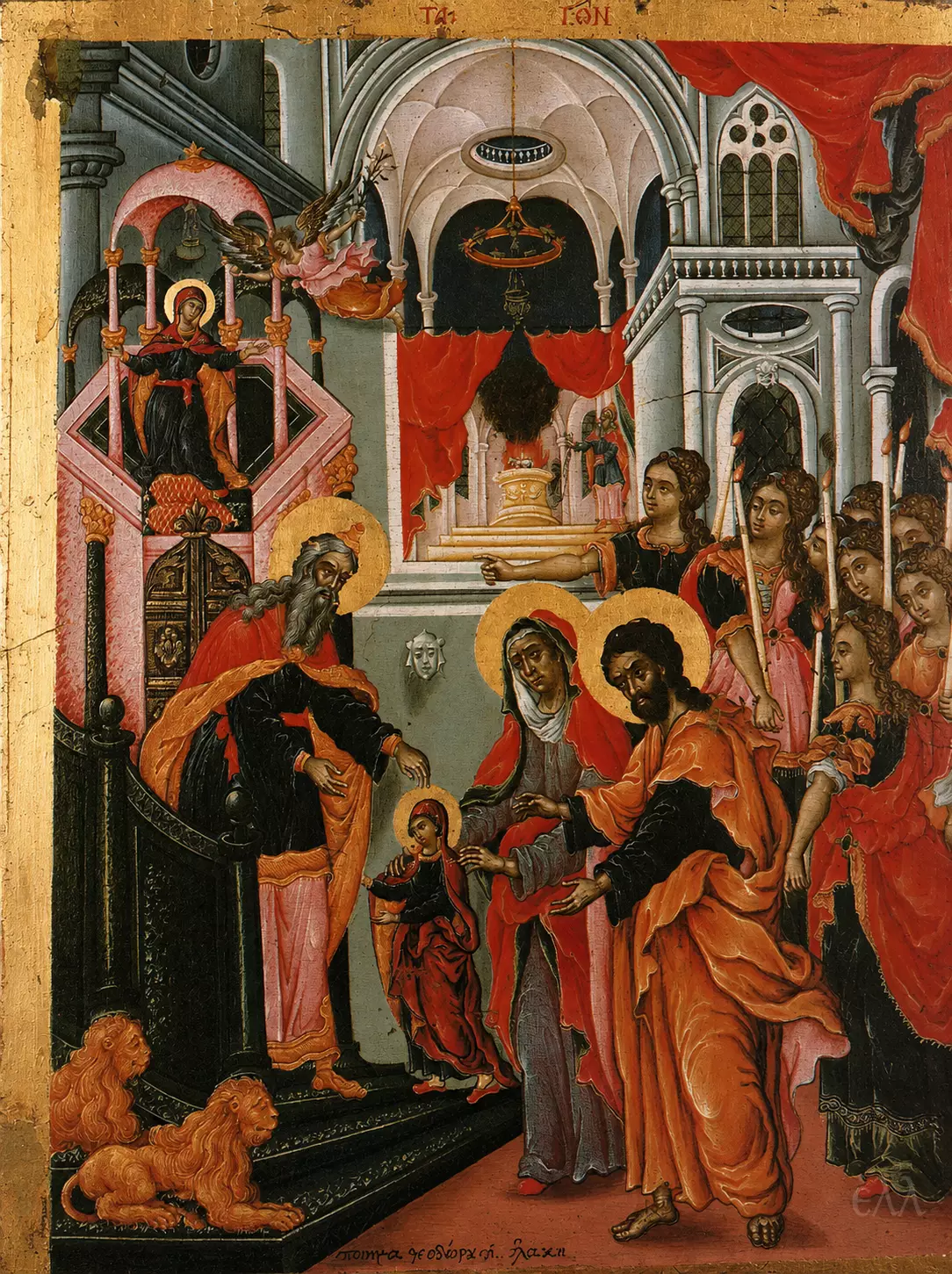
The Presentation of the Virgin Mary by Theodoros Poulakis belongs to the later seventeenth century, when Greek painters working between Crete, Venice and the Ionian Islands were reshaping inherited Byzantine pictorial forms through sustained contact with Italian art. The small panel, dated broadly between 1650 and 1692 and executed in tempera and gold leaf, measures about 35.5 by 27.9 centimetres. It is preserved in the Hellenic Institute of Byzantine and Post-Byzantine Studies in Venice under inventory number AMI 88. Its modest dimensions contain an elaborate interior crowded with figures, architectural recessions, suspended fittings and heavy textiles.
At the centre, the child Mary approaches the high priest Zechariah. Joachim and Anna accompany her, while young women gather nearby carrying tall candles. Higher within the architecture, a secondary episode shows Mary beneath a canopy as an angel approaches her, compressing successive moments into a single pictorial field. The sacred event unfolds inside an imagined temple whose arcades, vaults, balconies and traceried openings draw on a visual world familiar from Venetian and wider Italian painting. Red curtains cross several architectural zones; gold haloes punctuate the lower scene; dark garments, orange-red mantles and pale masonry produce a dense chromatic rhythm. Byzantine narrative convention remains active, while the pictorial space acquires weight, recession and theatrical complexity.
Presentation of the Virgin Mary: Byzantine Tradition and Venetian Space
The subject derives from the early apocryphal tradition concerning the childhood of Mary, especially the Protoevangelium of James, which became fundamental to Byzantine iconography of her Presentation in the Temple. The narrative tells of Joachim and Anna dedicating their young daughter to the Temple, where she is received by the priest and later nourished by an angel. In Byzantine art, these episodes could be presented with remarkable economy: gesture, attendant figures, the priest, the child and an architectural sign were enough to establish the sacred setting.
Poulakis expands this structure. The temple becomes a complex interior, deep enough to contain several actions and sufficiently ornamented to compete with the figures for attention. Behind the principal group rise broad arches supported by columns and piers, opening toward further chambers. A suspended circular fitting occupies the central vault, while another hanging object descends into the darker recess beyond. Higher up, a tall traceried window interrupts the wall above a balustrade. Intense red curtains, gathered in broad folds, hang from several openings and transform the temple into a ceremonial stage.
Perspective remains deliberately flexible. Recession emerges through overlapping planes, narrowing openings, converging lines and changes of scale, yet portions of the architecture remain compressed. The older icon tradition could organise sacred narrative through juxtaposition and hierarchy; Poulakis adds a stronger sense of physical setting while retaining that freedom. The eye moves from the dark raised platform in the foreground to the central chamber and farther into curtained, vaulted recesses whose proportions shift subtly from zone to zone.
This spatial elaboration corresponds closely to Poulakis’s broader artistic language. He spent substantial periods in Venice and later worked in Corfu, maintaining a workshop there; accounts of his career emphasise vivid colour, complex multi-figure scenes and the importance of Flemish engravings in the formation of his hybrid pictorial vocabulary. Northern European prints circulating through Venice supplied Greek painters with a large repertory of architectural settings, figure arrangements and narrative devices. In this panel, Western habits of description are absorbed into an icon still governed by Byzantine sacred hierarchy and Marian narrative.
Architecture, Curtains and Ceremony
Much of the panel’s energy comes from its architecture. The central arcade rises directly above the principal encounter, drawing the eye upward from the child Mary toward arches and suspended forms. Architectural masses on either side establish an asymmetrical balance: the elevated seat and canopy occupy one zone, a more vertical façade with window, balustrade and arched doorway the other. Pale stone, dark openings and red cloth bind the two areas together.
The curtains are especially effective. Their colour links spaces that might otherwise fragment into separate compartments. One broad textile crosses the upper background; another closes part of a central opening; farther to the side, additional folds descend from above. The repeated red echoes the garments of Mary, Anna, Joachim and several attendants, carrying the eye from sacred figure to architecture and back again.
The Presentation becomes a public ceremony witnessed by a gathering whose attention is carefully staged. Several young women lean forward or turn toward the centre. One extends an arm, directing attention toward the sacred encounter. Others hold tall candles, narrow verticals that answer the columns and piers behind them. The crowded setting gives the episode an almost processional character.
The Central Encounter: Mary, Zechariah, Joachim and Anna
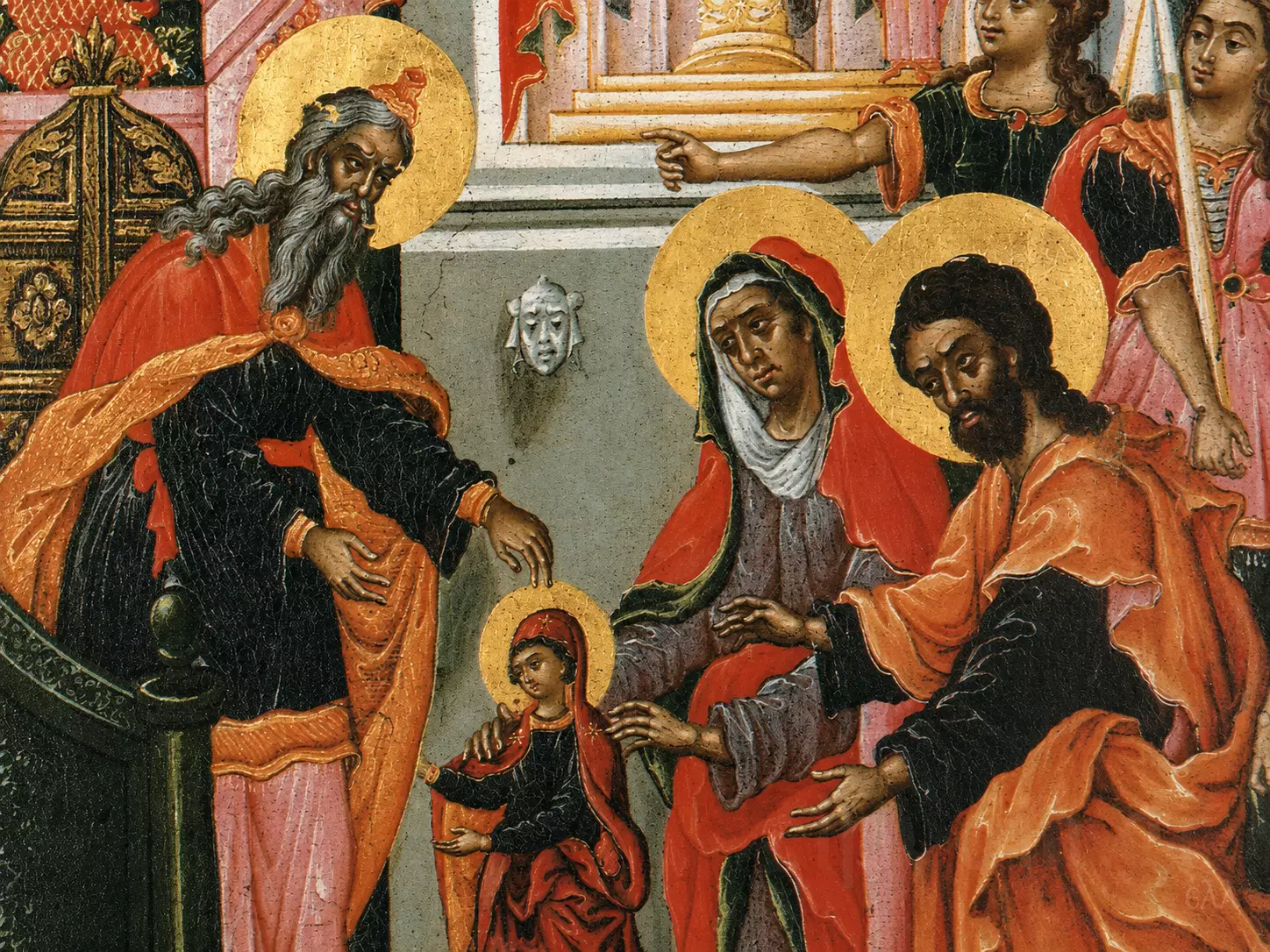
In the enlarged central group, the icon’s mixture of traditions becomes especially clear. Zechariah sits on an elevated dark platform, his body enclosed by a black garment and warm red-orange mantle. His long grey beard, pronounced facial lines and broad golden halo give him visual authority. One hand extends toward Mary while the other remains closer to his body, the gesture measured and receptive. The high seat behind him is richly ornamented, its dark surfaces articulated by gold linear decoration.
Mary, very small in relation to the adults, stands directly before the raised platform. Her scale isolates her immediately. A red mantle encloses the compact body, while the dark inner garment creates a strong vertical accent. The gold halo, large in proportion to her head, makes the child visible within a crowded field of hands, drapery and architectural forms. Her posture is calm; the adults around her supply most of the movement.
Anna bends toward the child from behind, her red mantle and pale head covering framing a dark, carefully modelled face. Joachim, beside her, extends his hands in an open gesture. Their bodies overlap and their haloes nearly touch, producing a compact familial group around Mary. Hands enter the central space from several directions: the priest reaches forward, Anna lowers one hand, Joachim extends both, and the child remains at the centre of this network of gestures.
Behind them, the attendants form a sequence of youthful faces, patterned garments and tall candles. Some appear in three-quarter view; others are partially concealed. Poulakis uses overlapping with confidence, allowing heads and shoulders to accumulate while maintaining the structure of the group. Deep black anchors Zechariah and several garments, reds and oranges warm the central action, pale grey-green architecture separates the figures from the background, and gold remains concentrated in haloes, ornamental details and the surviving border.
A Secondary Episode Within the Temple
Above the seated priest, Mary appears again beneath a small domed canopy supported by slender columns. An angel approaches her in flight, bringing food according to the traditional narrative of her life in the Temple. The second appearance is embedded within the architecture of the same painted world, allowing two moments of time to coexist.
That device belongs deeply to Byzantine narrative practice, where chronological succession could inhabit one continuous pictorial field. Poulakis gives it a strongly spatial setting. The secondary Mary is elevated, enclosed by a light architectural structure and separated from the principal scene by differences of scale and height. The angel enters diagonally, adding movement against the stable verticals of the columns. Below, two sculpted lions at the base of the dark platform introduce another note of material richness, their warm ochre bodies set at the threshold of the encounter.
Theodoros Poulakis and the Post-Byzantine Image
Poulakis worked during a period of profound displacement in the Greek-speaking eastern Mediterranean. Born in Chania around 1620 and dying in Corfu in 1692, he lived for extended periods in Venice and Corfu, where he developed a prolific workshop practice. His career belongs to a generation shaped by the movement of Cretan artists toward Venetian territories and by increasingly dense exchange between Orthodox icon painting and Western printed imagery.
Within that environment, the Presentation of the Virgin Mary preserves the authority of the icon while allowing architecture, gesture and narrative abundance to expand around it. The Palaiologan inheritance remains perceptible in the interest in articulate movement, expressive interaction and enriched sacred narrative, transformed through seventeenth-century Italianate spatial conventions. Bodies occupy interiors; curtains possess weight; balconies, arches and openings imply inhabited structures. The sacred protagonists remain organised through haloes and hierarchical emphasis.
On a panel scarcely larger than a sheet of writing paper, Poulakis builds a temple that seems to unfold in several directions at once. The smallest figure carries the narrative focus. Mary stands between the dark throne, the clustered bodies of her parents and the priest, the candle-bearing attendants, and the high architectural spaces in which her future life in the Temple is already visible.