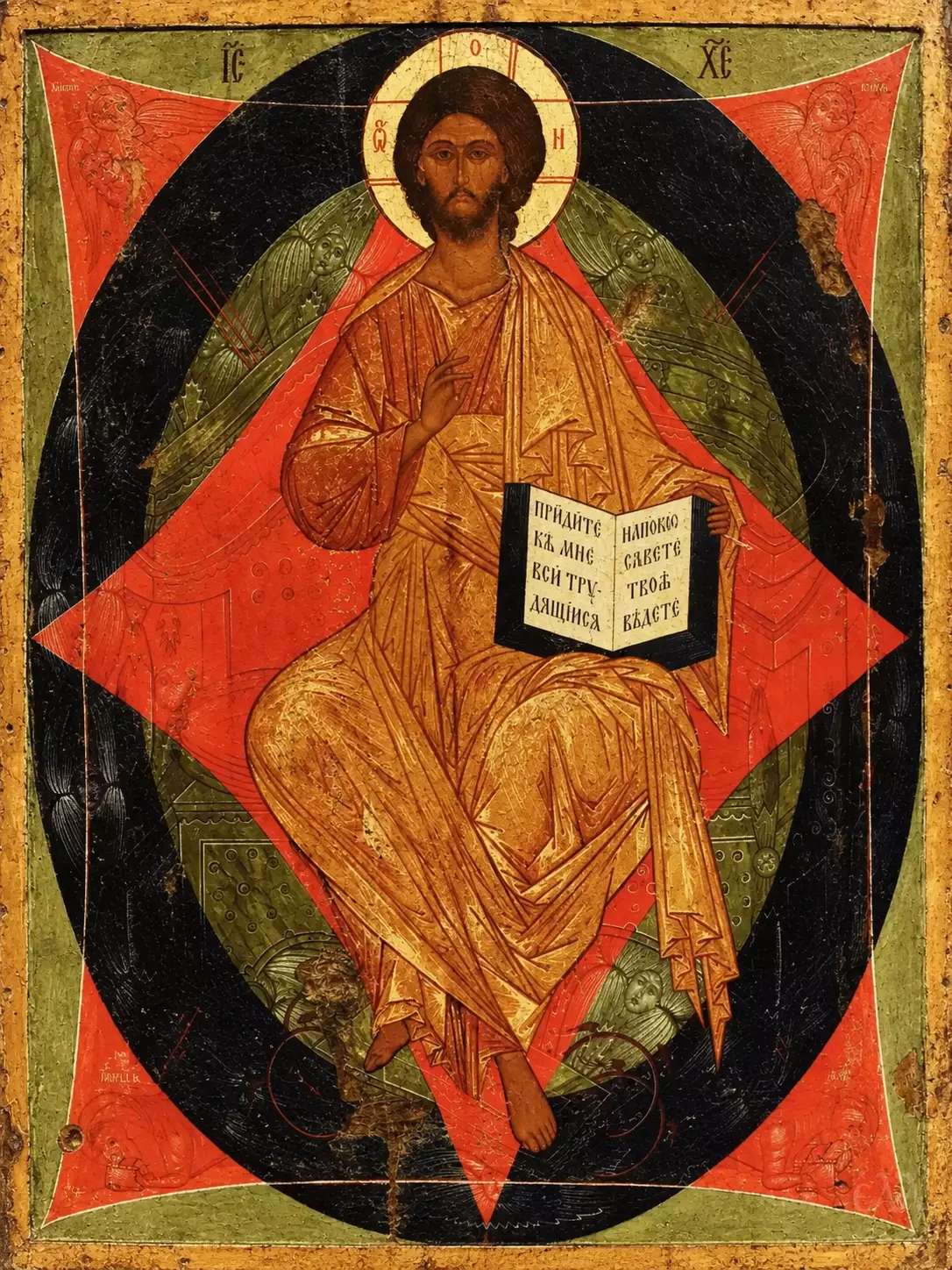
A wooden icon panel measuring seventy-one by fifty-four centimeters, crafted around 1580 by an anonymous Russian iconographer, is preserved today at the Museum of Russian Icons in Clinton, Massachusetts. It depicts Christ Pantocrator enthroned within a composition where color functions as a language fully as meaningful as form. The iconographic type did not originate in Russia; it traces back to sixth-century Byzantine tradition—specifically the earliest known depictions of the Almighty Lord preserved at Saint Catherine’s Monastery in Sinai—and traveled through centuries of copying and adaptation to sixteenth-century Russia, where it found one of its most symbol-dense variations. The painter remains anonymous, as was typical for ecclesiastical painting of the era, yet his hand preserves with rare precision the demands of the egg tempera technique: a painstaking process of applying successive transparent layers over wood covered with gold leaf. Christ’s left hand holds an open Gospel book inscribed in Church Slavonic script, His right hand is raised in blessing, and surrounding the figure unfolds a geometric schema—a rhombus, an oval, a square—elements composing a theological argument rather than mere decoration.
Form, Geometry, and Iconographic Tradition
All the tension of the composition converges on the face. The hair falls symmetrically over the shoulders, the beard is short and well-kept, and the gaze—heavy and nearly motionless—does not so much seek the viewer as await them. Above the head opens a cruciform halo with the letters Ο, Ω, and Ν inscribed within its three visible arms, referencing the name revealed to Moses, “He Who Is” (I AM), while in the two upper corners of the panel appear the contracted monograms ΙΣ and ΧΣ. No detail here is a casual choice; everything obeys an ancient code.
Open upon His knees Christ holds the Gospel, written in red and black Church Slavonic lettering—a choice recalling the missionary legacy of Saints Cyril and Methodius and the translation of sacred texts into the vernacular. His right hand, raised in blessing with fingers formed in the recognized liturgical gesture, creates together with the book a diagonal leading the eye upward, from word to action. The sternness of the expression does not negate the blessing. It tempers it, rendering it weightier in significance, as if to say authority and compassion do not exclude one another but coexist in the same person.
Inscribed within a near-black oval frame—traditionally signifying the unapproachable, incomprehensible nature of the Divine—is a vivid red rhombus. This deep crimson was not chosen at random; in the icon’s visual language it carries a dual weight, expressing supreme power alongside the sacrificial love that led to the Incarnation. The rhombus and the square behind it, faintly visible at the corners beneath the olive-toned surface, form an eight-pointed star shape that in Orthodox theology refers to the Eighth Day—the day following the week of creation that inaugurates a new order of reality. Christ Himself, seated upon a throne barely outlined behind His garments, wears an ochre and golden tunic, its folds rendered through fine gold lines over the color—a technique imparting an inner glow to the fabric without losing the volume of the body. Bare feet rest upon a footstool below, almost hidden beneath the drapery.
Symbolic Architecture and Historical Context
At the four corners of the composition, where the square intersects the oval, winged figures are rendered in delicate, almost etched lines against the dark backdrop. They recall the tradition placing the four Evangelists at the extremities to symbolically bear the Gospel to the four corners of the earth. Time has left its mark primarily on the upper right section, where pigment has flaked away over a broad area to reveal the wood underneath, while smaller losses appear along the borders. This wear does not diminish the work; it authenticates it, testifying to more than four hundred years of use, transport, and preservation before reaching its present home.
This composition does not stand isolated in the history of Russian iconography. It belongs to a period when major schools—Novgorod with its bold reds and striking shapes, Moscow with its serene faces and Rublevian influence—were simultaneously shaping distinct versions of the same theological content. The Clinton museum today houses dozens of such examples from the fourteenth through the nineteenth century, allowing one to trace how an image of Christ Pantocrator shifted in style while keeping its dogmatic core intact. What the art historian studies in this panel is not merely a religious composition, but evidence of how an anonymous master’s workshop operated: which conventions were respected, and where the hand was permitted subtle variations. Precisely at that junction—between the strict repetition of an ancient model and the personal brushstroke of a craftsman who never signed his name—lies the enduring value of this icon.