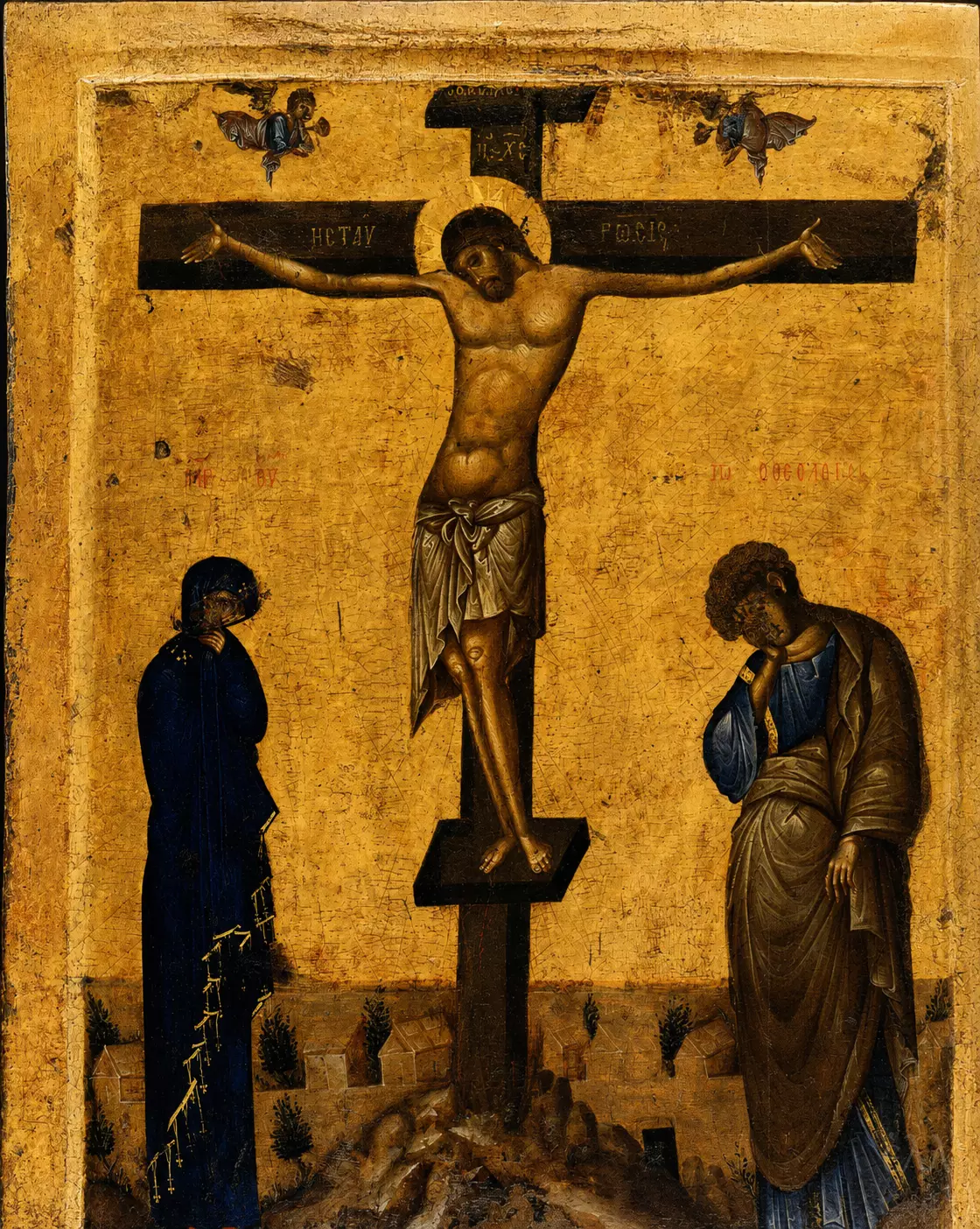
Against a field of gold leaf, worn by centuries of fine craquelure and scattered losses, the crucified body of Christ hangs from a cross whose horizontal arm very nearly spans the width of the panel. Painted on both faces of a single wooden support measuring 1.03 by 0.85 metres, this bilateral Byzantine icon of the Crucifixion belongs to the collections of the Byzantine Museum of Athens and has been dated to the fourteenth century, the period of pronounced artistic vitality generally associated with Palaiologan painting. No name attaches to the painter, which holds true for most Byzantine production of any period; the assurance of the drawing, however, and the sophistication of certain iconographic choices point to a hand trained on models circulating well beyond a single regional workshop. Icons painted on both faces of a panel were generally reserved for processional or festival use within the liturgical calendar, carried in and out of the sanctuary rather than fixed permanently to the templon, though nothing is recorded here of the image originally painted on the reverse.
The Composition of the Byzantine Crucifixion Icon
Christ is nailed to the horizontal beam with both arms fully extended, the torso curving gently under its own weight, a feature that suggests genuine observation of anatomical strain and not simply the repetition of a workshop formula. The head has already fallen toward the right shoulder. The knees bend slightly, the feet are nailed separately rather than crossed and pinned together, and both rest upon a narrow suppedaneum fixed low on the shaft. The loincloth, gathered into sharp, angular folds, ends in a pointed hem falling to the left, introducing into the lower register a note of movement that offsets the stillness the subject otherwise demands. Two small angels occupy the upper corners, flying toward the arms of the cross with a hand brought to the face, a gesture of lament transposed from the earthly mourners below into the celestial register above.
The titulus follows Byzantine rather than Latin practice. An abbreviated Christogram appears on the vertical beam above the head, while a second inscription, broken into two halves set on either side of the upright, spells across the horizontal arm the word for the Crucifixion itself. Smaller identifying inscriptions in red accompany the flanking figures, naming the Mother of God and John the Theologian in the manner standard to Byzantine painting. Behind the cross rises a walled city rendered at miniature scale: crenellated ramparts, a rectangular gate, and a scatter of small buildings under double-pitched roofs stand among low, sparse trees, an economical shorthand for Jerusalem that Palaiologan painters employed with remarkable consistency across otherwise unrelated commissions. At the foot of the cross, the shaft is set into a rocky mound and held upright by stakes and stones wedged around its base, a practical detail seldom rendered with such explicitness in icons of comparable scale.
Style and the Question of Date
The rendering of the body itself situates the panel comfortably within the classicizing current running through much of fourteenth-century painting. The chest and abdomen are built up through soft transitions of light and shadow rather than through the harder linear divisions favoured in earlier centuries, and the slight torque of the torso against the rigid horizontal of the arms lends the figure a corporeality that Comnenian painting had approached more cautiously. Such volumetric modelling, together with the humanized pathos of the two mourning figures, belongs to the broader current sometimes labelled, not without controversy among historians of Byzantine art, the Palaiologan Renaissance — a term describing a tendency toward antique fullness of form rather than any conscious revival of classical antiquity as such.
The Virgin, John the Theologian, and Traces of Western Contact
Wrapped so tightly in a deep blue maphorion that only the lower part of her face and a single hand remain visible, the Virgin stands at Christ’s right hand; the hand is raised to her mouth, thumb touching the lips, in a gesture of grief that leaves the body itself upright and largely motionless. Fine gold striations, sparingly applied, descend the folds of her mantle. John, at Christ’s left hand, gives his sorrow open expression: the torso inclines forward, the head rests against the right hand, and the left hand falls loosely at his side, appearing to gather the edge of his own mantle. The contrast between the Virgin’s composure and John’s more human, almost unguarded posture is not a casual choice of composition. It reflects two conventions for representing lament that coexisted comfortably in Byzantine painting of this century, set here side by side without either being allowed to overwhelm the scene.
This particular pairing of gestures — the Virgin’s hand at her lips within a closed maphorion, John’s head resting against his own hand — recurs in other monuments of the same century, including a liturgical scroll and an illuminated psalter, evidence that the Athens panel draws on a circulating repertory rather than a purely local invention. A comparable composition is known from a thirteenth-century icon at Sinai, attributed to a workshop associated with Crusader Acre, and from an epistyle beam of the same monastery linked to a Venetian workshop active in the third quarter of that century. None of this weakens the Byzantine character of the panel; it illustrates instead how fluidly painters worked across the borders separating Byzantine, Crusader, and Venetian ateliers in the eastern Mediterranean, where the same repertory of mourning gestures could pass from an icon at Sinai to a panel destined, a century later, for a church within the Byzantine sphere.