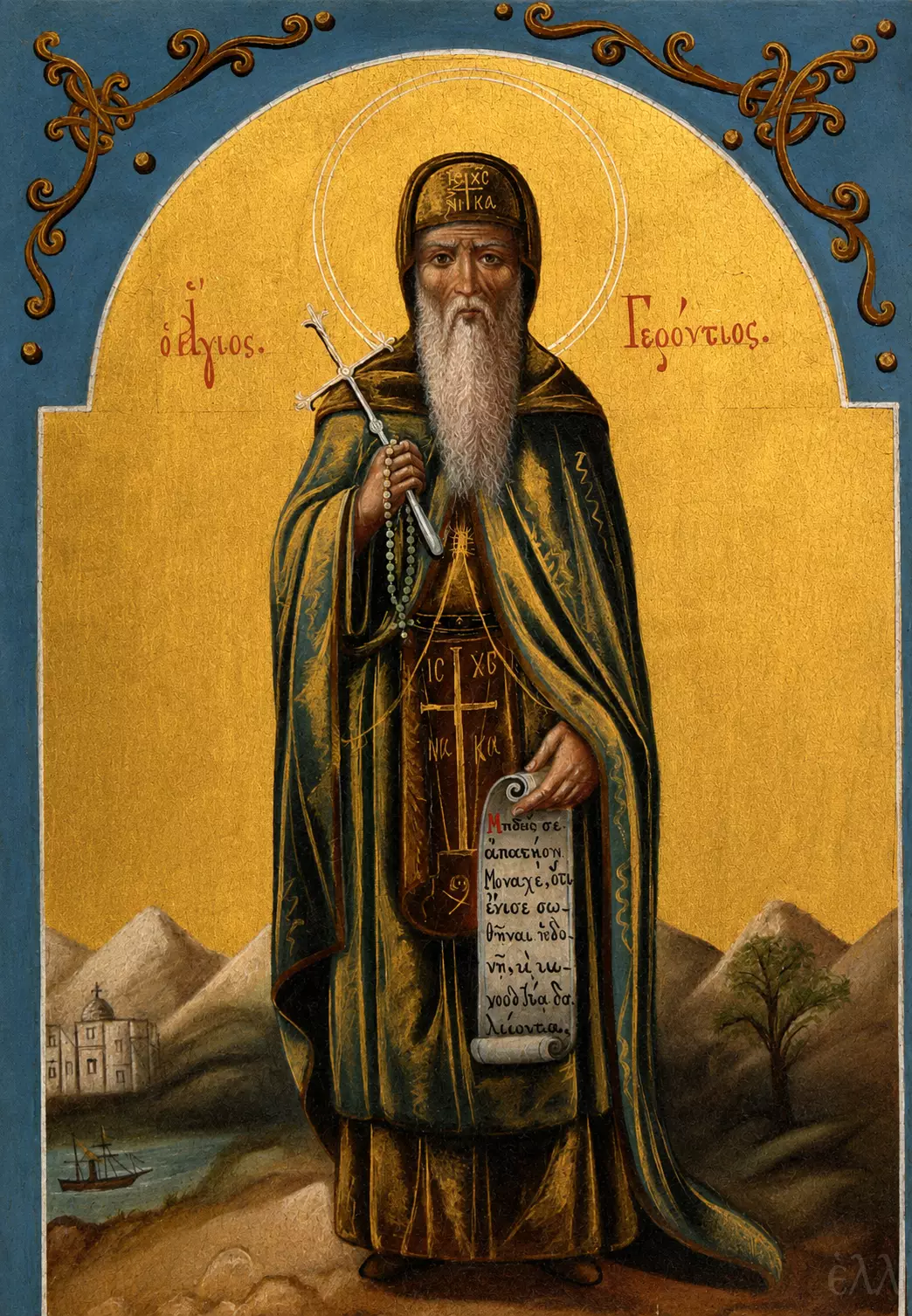
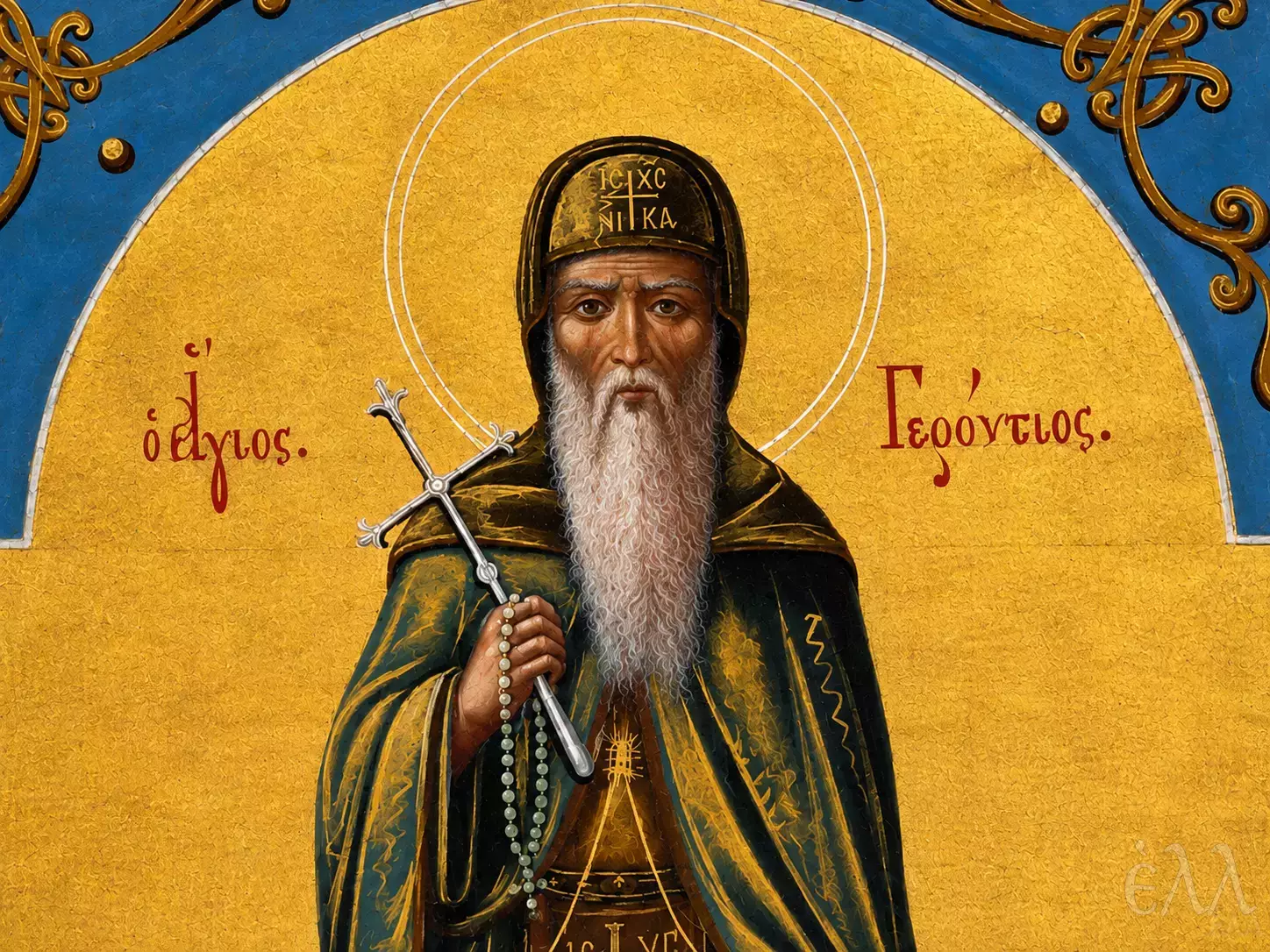
The Saint Gerontios of Saint Anne icon, a twentieth-century portable icon preserved in the Holy Cell of Saint Demetrios at the Skete of Saint Anne on Mount Athos, presents the fourteenth-century Athonite monk as an austere, full-length figure against an expansive gold ground. His identity is made explicit by the red Greek inscription, ὁ ἅγιος Γερόντιος, divided on either side of the halo. The saint stands frontally, his long grey-white beard descending almost to his waist, while the direct gaze and deeply articulated features give the physiognomy a restrained severity. Over his monastic habit falls a dark green mantle enlivened by ochre-gold borders and narrow linear highlights. The cap bears the familiar IC XC NIKA abbreviation.
His iconographic attributes are unusually abundant without disturbing the strict vertical structure. In his right hand—the hand appearing on the viewer’s left—Gerontios holds a slender cross, while a prayer rope falls between his fingers in a long loop. His left hand supports an open inscribed scroll. Outlined by two pale concentric lines, the nimbus is set into the uninterrupted gold field, producing a strongly centralised visual focus. Below, the abstract background gives way abruptly to landscape: steep mountains, a solitary tree, a small ecclesiastical building by the shore and a boat upon the water. These elements connect the sacred figure with an Athonite environment while remaining pictorial rather than topographically documentary.
Saint Gerontios of Saint Anne Icon and the Origins of the Skete
Gerontios is remembered in Athonite tradition as the last hegumen of the Monastery of the Bouleuteria, an early establishment situated near the coast in the area now occupied by the Cell of Saint Eleutherios. Repeated pirate attacks led the community away from the exposed shoreline towards the higher, rocky slopes of Athos. This movement of monks is associated with the formation of the first nucleus from which the later Skete of Saint Anne developed; Gerontios consequently came to be regarded as its first settler or founder. Sources place him in the fourteenth century and commemorate him on 26 July.
Mountain, coast, church, tree, boat: compressed into a narrow zone, these elements give particular force to the geographical logic of that history at the bottom of the panel. The vessel may recall the maritime setting from which the community withdrew, while the sharply rising terrain corresponds more broadly to the difficult southern Athonite landscape. Such details should not be treated as literal portraits of individual buildings; their function is to establish place and memory. A useful broader account of Athonite monasteries, sketes and portable icons is provided in Kadas’s study, while the steep approach to the Skete of Saint Anne already appears in Tozer’s description.
According to the monastic tradition, Gerontios later withdrew still farther upwards with a single monk and established a hermitage dedicated to Saint Panteleimon. Near this ascetic dwelling, tradition associates him with the appearance of a spring after prayer to the Theotokos; the water continues to be identified locally as a sacred spring. His life is also connected with Saint Maximos Kavsokalyvites through a tradition of spiritual friendship. The icon, while preserving these associations through the saint’s bearing and attributes, does not attempt a narrative cycle of the episodes. Cross, prayer rope, scroll, monastic dress, severe mountain landscape: the details are gathered into a devotional and commemorative image, preserving in twentieth-century Athonite painting the memory of a figure associated with the earliest historical formation of one of Mount Athos’s most important sketes.
(The translation was edited by A. Williams.)