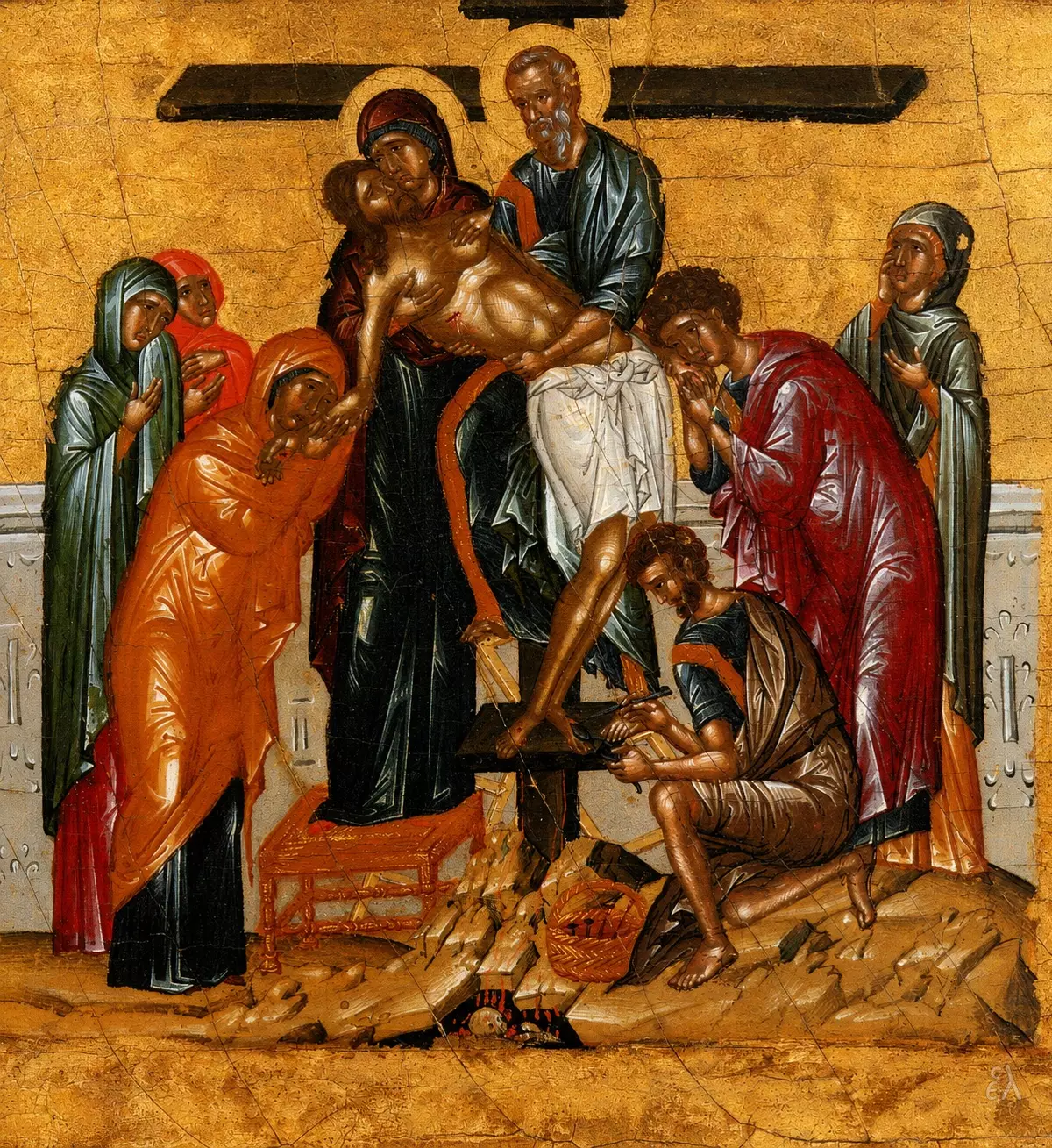
The Deposition of Christ icon scene belongs to a larger panel of the Virgin and Child enthroned in the Benaki Museum in Athens, a work dated to the second half of the fifteenth century and attributed to the Cretan painter Andreas Ritzos or his workshop. The measurements of 87 × 65 cm refer to this complete icon, not to the smaller Passion scene reproduced here. On the raised frame of the parent panel, carved from the same wooden support, four narrative episodes occupy the upper zone: the Annunciation, Crucifixion, Deposition from the Cross, and Descent into Hell. The remaining sides contain busts of saints. The Benaki Museum identifies the work with inventory number 3051.
Removed from that larger ensemble, the Deposition possesses an unexpected visual independence. Nine figures gather around the dead Christ, yet the surface never dissolves into confusion. The body gives the scene its structure: almost horizontal across the upper centre before dropping sharply through the legs, it crosses the more stable verticals of the mourners and establishes a sequence of gestures from head to hands, then downward to the feet. Above, the dark beams of the Cross cut across the gold ground. Below, the earth opens into a small black fissure containing Adam’s skull. Between those two poles, Cross and grave, the painter compresses the narrative into a remarkably narrow pictorial space.
The terminology of Post-Byzantine icon painting is especially appropriate for a work produced in the decades following the conventional end of the Byzantine Empire while preserving, and actively developing, Byzantine pictorial and iconographic traditions.
The Deposition of Christ Icon and Its Composition
At the centre, the Virgin receives the upper body of Christ and presses her face close to his. Her dark red maphorion forms a deep chromatic mass behind his head and shoulders, while the arc of her halo separates the two profiles just enough to maintain their individual contours. The gesture carries physical consequence, since her arms are what actually help bear the weight of the body. Behind her rises the grey-haired Joseph of Arimathea, whose hands hold Christ around the torso and waist. His blue-green garment, broken by narrow pale highlights, sets up a colder field against the warmer flesh tones.
Christ’s body bends without rigidity. The head has fallen backwards, the neck exposed; the chest projects forward before the line of the torso contracts at the waist. One arm descends freely toward the woman who raises his hand to her lips, while the other is received in a corresponding act of farewell by the youthful figure conventionally identified as St John the Theologian. At the feet, Nicodemus kneels with pincers, concentrating upon the removal of a nail. This identification of Joseph, Nicodemus, Mary Magdalene and John corresponds to the established scheme documented in later painters’ working drawings related to the Benaki image.
Three additional female mourners close the composition at its outer edges. Their motions are restrained but not identical: hands rise toward the face, rest against the breast, or open slightly in grief. No single movement is allowed to dominate. Even the brilliant orange garment of the woman bending over Christ’s hand, generally identified as Mary Magdalene, is contained by a strong contour and by the darker figures immediately behind her.
The result is densely centralized. Heads incline inward, arms cross one another, bodies overlap, yet a narrow interval of gold remains around several silhouettes, allowing the individual forms to remain legible. Much of the emotional force comes from this physical proximity. The scene does not require an elaborate landscape or extensive architecture to construct its drama: a low pale wall, the dark timbers of the Cross, gold, rock. Almost everything else is human figure.
The Body of Christ as the Visual Axis
Across this gathering of upright or bending mourners, Christ introduces another order of movement. His body runs diagonally through the centre, and because the arms and legs hang at different angles, the line is repeatedly interrupted. The effect is neither geometric nor mechanically symmetrical. The painter has made the body heavy.
That weight is conveyed by several small decisions. Joseph’s arms are visibly engaged in supporting the torso; the Virgin encloses Christ from behind; the hanging arm has no independent tension; the knees and lower legs descend towards Nicodemus with a slackness very different from the sharply articulated drapery around them. Even the white loincloth contributes to the distinction. Its angular, almost graphic folds gather around the hips and then break into a series of fine linear passages, while the exposed flesh is modelled through warmer transitions and concentrated light.
On the torso, fine pale strokes define the ribs, abdomen, shoulders and limbs without turning them into fully naturalistic anatomy. A narrow red mark identifies the wound in the side. The face has received similar treatment: the closed eyes, beard and strands of hair are clearly delineated, though subordinated to the downward inclination of the head. Byzantine linearity remains fundamental, but line has been made responsive to bodily volume.
Colour, Gold Ground and the Architecture of Grief
Against the gold ground, which occupies most of the background, the figures never dissolve into decorative silhouettes. The garments instead become large chromatic units: maroon and almost black around the Virgin, blue-green around Joseph, saturated red around John, orange beside the lowered arm, cooler green-grey at the edges. Smaller highlights run across the folds in sharply directed strokes, sometimes following the cloth, sometimes exaggerating its angular change of direction.
Particularly striking is the garment of St John. The deep red field is crossed by pale, almost silvery lines that divide the material into restless surfaces. His body bends towards Christ’s hand, and the pattern of the drapery follows that inclination. Joseph’s folds, by comparison, descend more vertically. The painter varies the articulation of cloth according to posture, an economical means of differentiating movement without abandoning the highly controlled linear vocabulary of Cretan icon painting.
The gold ground also possesses a material history. Cracks, abrasions and small losses remain visible across the surface, particularly in the upper field. Conservation research on the complete icon documented earlier overpainting and extensive damage to its wooden support from wood-boring insects; during restoration, later overpaint was removed, losses in the support were filled where necessary, and the structure was consolidated. Examination also revealed an incised preparatory drawing beneath parts of the original paint.
None of these changes prevents the scene from being read. The network of age-related cracking has, instead, become another layer through which the fifteenth-century image survives, especially apparent in the uninterrupted gold around the Cross.
The Deposition of Christ Icon in Detail: Faces, Hands and Drapery
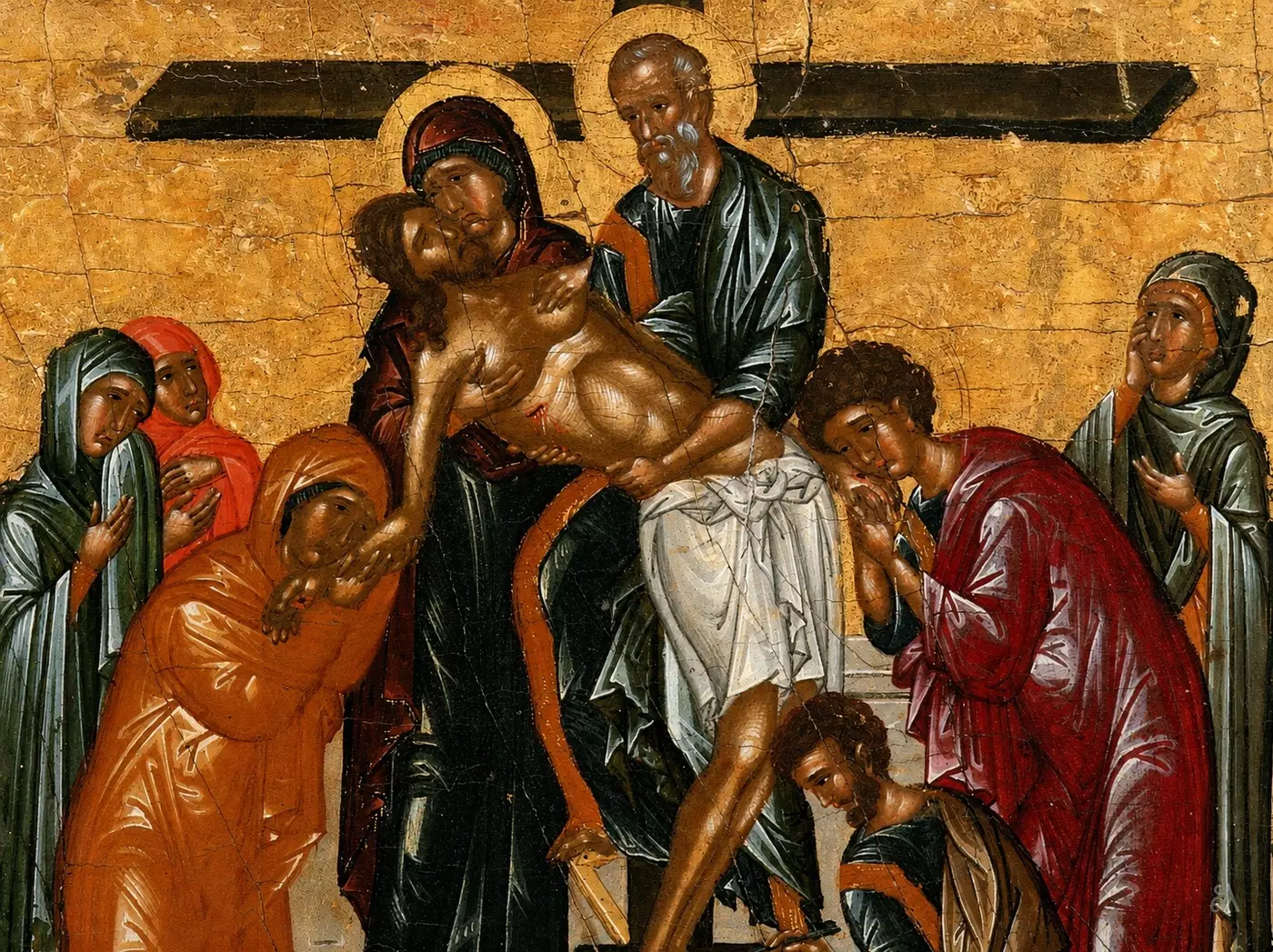
Seen at closer range, the composition depends to an unusual extent on touch. The Virgin’s hands meet Christ’s upper body; Joseph’s hands carry the weight further down; Mary Magdalene encloses one hand; John receives the other. The gestures do not form a repeated pattern. Fingers spread, curve, overlap or disappear beneath another form, and this unevenness avoids the rigid ceremonial rhythm found in more hieratic representations.
The faces are equally differentiated. Joseph looks down with a direct, concentrated expression, his broad forehead and grey beard defined by fine highlights. The Virgin lowers her eyes towards Christ at very close range. John turns inward so completely that his face becomes part of the diagonal descending from Christ’s torso. Among the women, grief is conveyed through variations in the inclination of the head and positioning of the hands, particularly the solitary figure near the outer edge whose hand rises towards her cheek.
The closer view also clarifies how carefully the flesh modelling has been organized. Dark brown under-tones remain visible around the eyes, neck, ribcage and joints; warmer middle tones occupy the larger planes; narrow highlights pick out brows, noses, shoulders and limbs. This layered treatment does not dissolve the contour. A firm dark outline continues to hold the body against adjoining garments and against the gold, even at points where the tonal modelling has become comparatively subtle.
The white loincloth offers the sharpest counterpoint. Pale, nearly colourless at first glance, it is constructed from grey shadows, thin ochre lines and broken angular folds. It marks the centre of the arrangement almost as strongly as the flesh itself.
From Palaiologan Models to Fifteenth-Century Crete
The historical importance of the image lies partly in its continuity. Research into later working drawings of the Deposition has traced the underlying iconographic scheme to Palaiologan models, including an early fourteenth-century icon from the Prodromos Monastery at Serres and a related representation in a mid-fourteenth-century diptych at St Catherine’s Monastery on Sinai. A seventeenth- or eighteenth-century pricked cartoon preserved at the Benaki Museum repeats many features also found in the fifteenth-century icon: the Virgin and Joseph supporting Christ, Mary Magdalene and John at the hands, and Nicodemus working at the feet.
Yet transmission did not mean simple repetition. The Benaki version contains Adam’s skull at the base of the Cross, set within a dark opening in the rocky ground, whereas the later cartoon specifically omits it. The terrain and architectural setting also differ. Such variations are revealing because they show how an established compositional model could remain recognizable while details were altered across generations of painters and working drawings.
Its Cretan setting adds another dimension. The parent icon was produced in Venetian-ruled Crete, and the attribution to Andreas Ritzos or his workshop places it within one of the most consequential environments of fifteenth-century Eastern Christian painting. Vassilaki identifies the work among icons painted on Venetian Crete and notes the combination of the enthroned Virgin and Child with angels at the centre and narrative scenes on the surrounding raised border.
The Deposition is only one component of that larger object, but within a comparatively small field it gathers several characteristics that would give Cretan painting its durability: precise contour, controlled colour, inherited Byzantine iconography, carefully differentiated gestures and a capacity for strong emotion without allowing expression to break the formal structure. Christ’s body remains at the centre, suspended among hands that support, kiss and release it; below, almost hidden in the earth, the small skull fixes the scene to Golgotha and to an iconographic tradition much older than the panel itself.
(The translation was edited by P. Alexiou.)