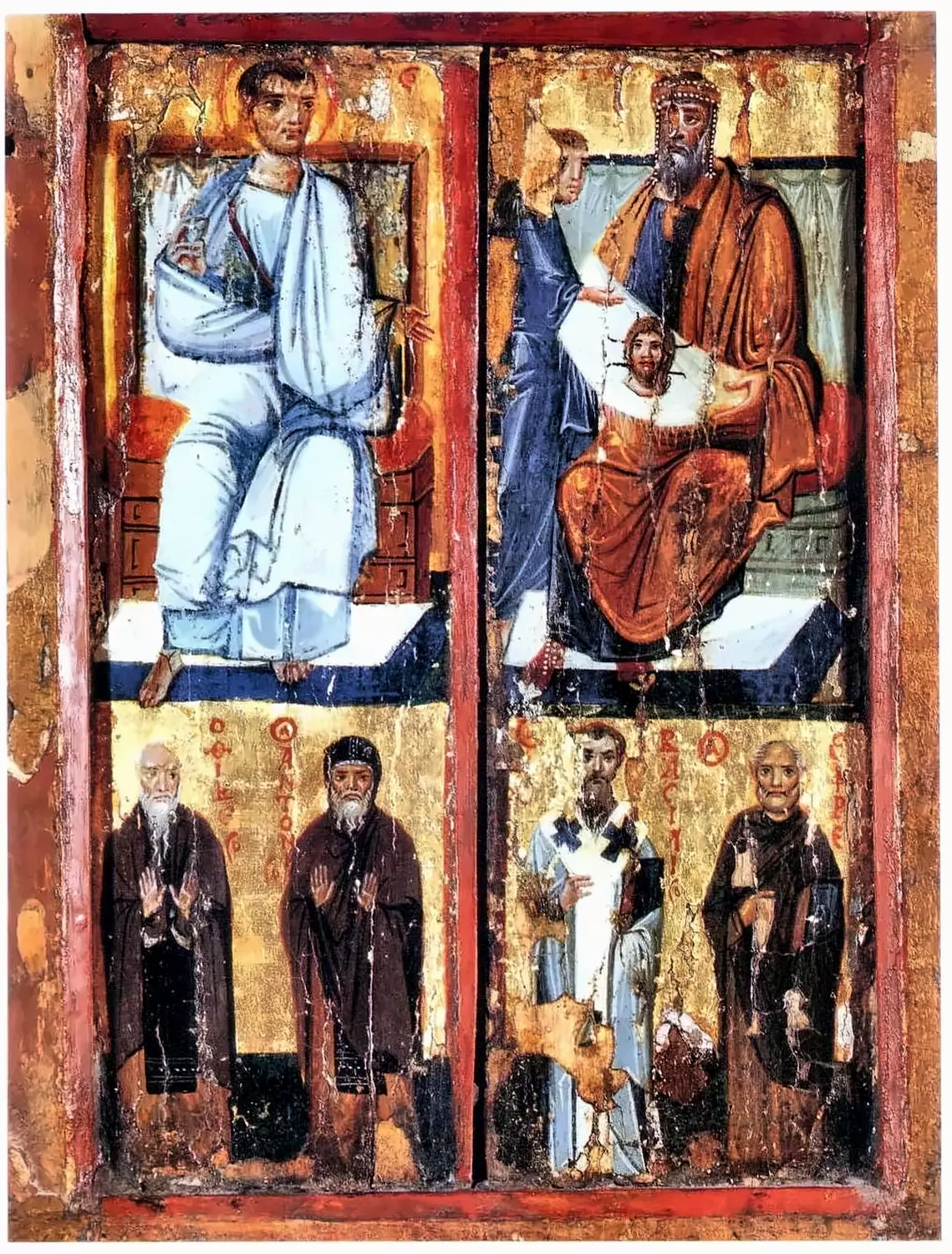
The Holy Mandylion Byzantine icon preserved at Saint Catherine’s Monastery on Mount Sinai survives in an unusual form: two narrow wings of a mid-tenth-century triptych whose central panel has been lost. Painted in tempera on wood, the ensemble measures approximately 34.5 × 25.2 cm with its frame; each of the two original vertical panels is about 28 × 9.5 cm. The wings were subsequently brought together within the present wooden framing, leaving a strong vertical division down the middle.
Across four pictorial fields the painter combined the story of the Image of Edessa with a compact assembly of saints. In the upper register Saint Thaddeus sits on a throne at left, facing King Abgar of Edessa on the opposite wing. Abgar receives a white cloth bearing the face of Christ, while a youthful attendant, generally identified as Ananias, stands beside him. Below appear Paul of Thebes and Anthony on one wing, Basil and Ephrem the Syrian on the other. Their identification and arrangement are confirmed by inscriptions and by the scholarly record of the panels.
The Holy Mandylion Byzantine Icon and the Abgar Narrative
The upper scenes belong to the Byzantine tradition surrounding the Mandylion, or Image of Edessa: a cloth believed to preserve an acheiropoietic likeness of Christ, an image understood as having come into existence without the ordinary intervention of a painter. The story connected the sacred cloth with King Abgar of Edessa and, in its developed medieval form, with the transmission of Christ’s likeness to the king through his messengers and disciples. By the tenth century, as the tradition acquired an increasingly prominent place in Byzantine devotional culture, the Mandylion had assumed exceptional importance.
That importance increased sharply when the celebrated relic was transferred from Edessa to Constantinople in 944 and installed within the ceremonial and religious world of the imperial capital. The Sinai panels were painted around the middle of the same century, close enough to the event for their subject to carry a distinctly contemporary resonance. Their iconography joins an ancient sacred narrative to the political and artistic circumstances of tenth-century Constantinople.
The moment chosen for Abgar is one of reception. Seated frontally but turning slightly toward the attendant, the king spreads the white cloth across his lap. Christ’s bearded head appears in its centre, isolated against the fabric and presented directly to the beholder. The attendant’s hands remain close to the cloth, preserving the sense that it has only just been delivered. Abgar’s reddish-brown mantle descends in broad folds over his knees; a jewelled crown and carefully articulated beard establish his royal character. Behind him, a pale hanging fills the recess of the throne.
Thaddeus, opposite, creates a quieter image. His pale garments occupy much of the narrow panel, their cool whites and blue-grey shadows standing sharply against the warmer throne and gold field. His body turns subtly toward the missing centre, one hand extending outward. With the original central panel in place, this directional movement would have carried the eye inward, toward a pictorial element now absent from the composition.
The Lost Centre of the Triptych
The present arrangement can easily obscure the original structure. Kurt Weitzmann argued that the remaining pieces were the two wings of a triptych and proposed that the missing central panel contained a substantially larger representation of the Image of Edessa in its upper section, with further standing saints below. Later scholarship has continued to discuss the work according to this reconstruction.
Such an arrangement would have produced an unusually elaborate sequence. Abgar holds a miniature Mandylion on one wing; in the lost centre, probably, that same sacred image appeared on a much larger scale, transforming the small narrative object into the visual focus of the triptych. The extant Christ face is compact and frontal, surrounded by the broad white field of the cloth. Its relative smallness now seems striking. Originally, it may have functioned as an anticipation of the central image.
Physical fragmentation affects the way the composition is read. Red framing members now enclose the two remaining leaves as a continuous rectangular object, yet the poses retain the logic of a three-part structure. Thaddeus turns inward. Abgar and the attendant cluster around the cloth. Below them, the saints stand with the stability of figures conceived to flank something no longer present.
Classicizing Form and Tenth-Century Constantinople
Within the upper register, the painter’s interest in bodily volume is particularly apparent. Thaddeus occupies his throne with a convincing sense of weight; knees project beneath the pale drapery, feet rest upon the foreground strip, folds pass around the body rather than merely crossing its surface. Abgar is heavier and more compact, his broad mantle forming curved, overlapping masses across the seated figure.
The faces, too, retain a degree of individual characterization. Thaddeus is youthful, smooth-faced and alert. Abgar has an elongated grey beard, concentrated gaze and strongly marked features. The attendant appears in profile, an economical device that intensifies the exchange between messenger and king. Against the gold ground, the distinctions between the three faces give the narrative a restrained physical immediacy.
Such features belong to the classicizing current of tenth-century Byzantine painting, often discussed in relation to Constantinopolitan court culture and the broader artistic revival associated with the Macedonian period. The concept of a “Macedonian Renaissance,” particularly when it implies a straightforward rebirth of antiquity, remains a debated art-historical category; more securely observed is the renewed use of classical models, volumetric forms and naturalistic devices in elite tenth-century production.
Weitzmann went further, proposing that the physiognomy of Abgar deliberately recalled Emperor Constantine VII Porphyrogenitus. In this interpretation, the historical king who received the Mandylion at Edessa became a visual counterpart of the Byzantine emperor associated with its reception in Constantinople—imperial history folded into sacred narrative. The proposed resemblance remains an interpretation rather than a documented identification.
Paul, Anthony, Basil and Ephrem
A different visual rhythm governs the lower register. Against uninterrupted gold grounds stand the saints, almost entirely frontal, their bodies forming narrow vertical accents beneath the more expansive seated figures above. Paul of Thebes and Anthony wear dark monastic garments and raise their hands before their bodies. White beards, austere clothing, restrained gestures: the treatment gives both figures a deliberate simplicity, while the painted inscriptions between and beside them supply their identities.
On the opposite wing, Basil is distinguished immediately by his pale episcopal vestments and the large dark codex held against his side. Ephrem, beside him, wears much darker clothing. Black-brown habits, pale vestments, gold field form a compact sequence of monastic and ecclesiastical types within the lower zone.
Their presence has been understood as especially appropriate to a monastic setting. Paul and Anthony embody early ascetic traditions; Basil and Ephrem connect monastic spirituality with major strands of Greek and Syriac Christian culture. Scholarship has consequently regarded the selection of these saints as compatible with an object intended for a monastery, possibly Saint Catherine’s itself.
Age has altered the painted surface considerably. Abrasion crosses faces, garments and gilding; areas of the gold ground are broken, numerous losses reveal the underlying preparation. Yet important passages remain clearly legible—the pale modelling of Thaddeus, Abgar’s crown and beard, the dark habits of the ascetics, the white episcopal vestments of Basil. Most conspicuous is the small face carried on the cloth, a surviving echo of the image that probably once occupied the missing centre of the triptych.
(The translation was edited by K. Pappas.)