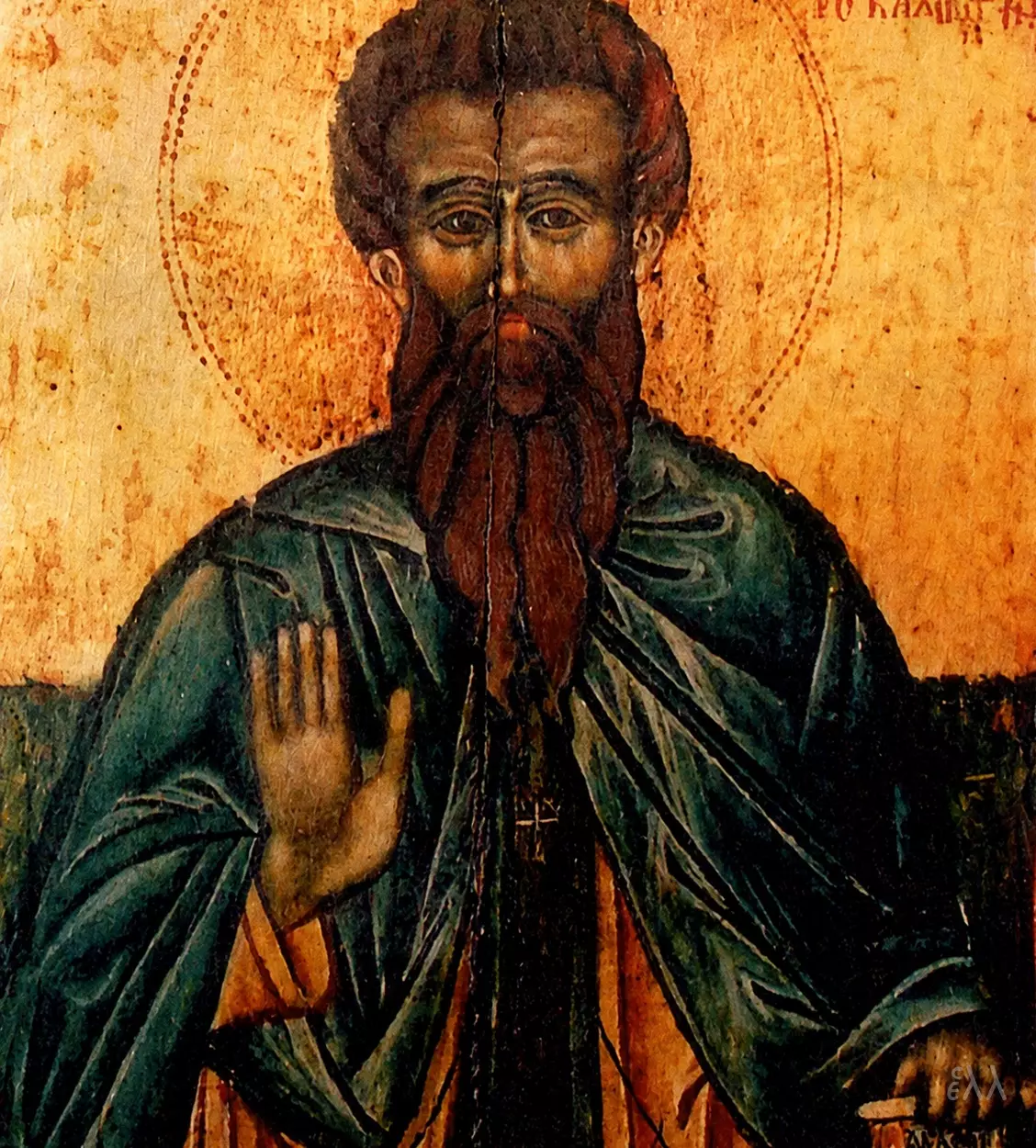
Saint Maximos Kavsokalyvites, painted by an unidentified artist in the seventeenth century, presents the fourteenth-century Athonite ascetic in a concentrated half-length image. Preserved in the kyriakon of the Holy Skete of Kavsokalyvia on Mount Athos, the portable icon belongs to the Post-Byzantine continuation of an artistic tradition in which established iconographic forms remained active within monastic communities long after the end of the Byzantine Empire.
Against the warm golden field, Maximos faces directly outward. His raised right hand forms a gesture of blessing, while his left supports a scroll carrying red lettering. A small cross hangs at the centre of his chest.
Particularly forceful is the physiognomy of the saint: an elongated face, closely defined eyes, dark reddish-brown hair and a long bifurcated beard falling in narrow strands over the garment. Around the head, the halo is articulated through two lines of minute punched or dotted marks, creating a delicate circular boundary against the background.
Across the painted surface, age has left visible traces. Abrasions disturb the gold field, and a pronounced vertical fissure passes through the centre of the panel and across the face of the saint. These material interruptions now form part of how the work is seen, without obscuring its principal forms.
Saint Maximos Kavsokalyvites Icon and Athonite Ascetic Imagery
Deep green dominates the broad mantle covering Maximos’s shoulders and torso. Across it, long angular folds are picked out with lighter strokes, breaking the dark mass into sharply defined planes. Beneath the mantle appears an ochre garment whose warmer colour gives the lower part of the figure a restrained chromatic counterpoint. Dark contours around the eyes, nose and cheeks, narrow highlights, and repeated strokes through hair and beard give the modelling of the face an equally linear character. Within a comparatively limited palette, the painter builds a severe, intensely frontal presence.
The iconography connects this visual austerity with the historical identity of the ascetic. Born at Lampsakos in Asia Minor, he left his family while still young and eventually reached Mount Athos after periods of monastic and ascetic life elsewhere. Sources associate him closely with the hesychast culture of the Holy Mountain and with Saint Gregory of Sinai. As for the epithet Kavsokalyvites, commonly explained as “hut-burner,” it recalls the tradition that he repeatedly burned the simple huts in which he had lived before moving elsewhere.
In the painted figure, biography has been compressed into the established language of a monastic saint: blessing hand, inscribed scroll, dark mantle, frontal gaze. The scroll introduces the dimension of teaching, while the identifying inscription in red occupies the upper field without competing with the face. Particularly around the eyes and beard, the handling is graphic and emphatic, giving the saint an austere physiognomy characteristic of an image intended for sustained recognition and veneration within an Athonite setting. Within Orthodox monastic culture, such Post-Byzantine imagery also carries forward, largely unbroken, the visual conventions inherited from Byzantine painting.
(The translation was edited by P. Alexiou)